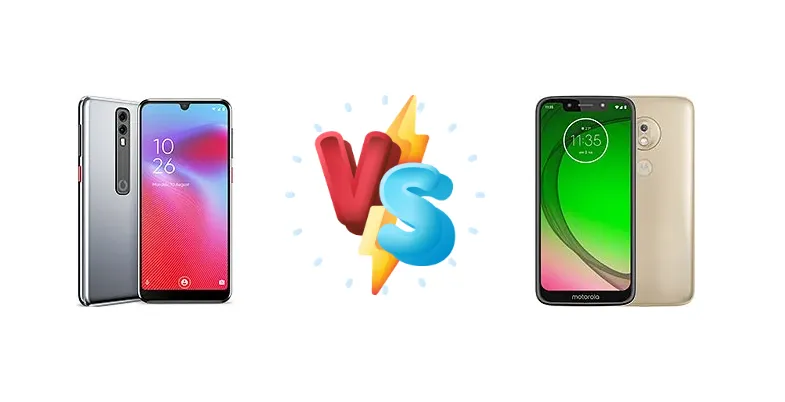
The Vodafone Smart V10 and Motorola Moto G7 Play represent two compelling options in the ultra-budget smartphone space. While both aim to deliver essential smartphone functionality at a low price point, they diverge significantly in their internal hardware, particularly in their Qualcomm Snapdragon chipsets. This comparison will dissect those differences, helping you determine which device best suits your needs.
🏆 Quick Verdict
For most users, the Motorola Moto G7 Play is the superior choice. Its Snapdragon 632 chipset, featuring an octa-core CPU, provides a noticeably smoother and more responsive experience than the Vodafone Smart V10’s quad-core Snapdragon 429. While battery life is comparable, the G7 Play’s processing power offers a better long-term user experience.
| Network |
|---|
| 2G bands | GSM 850 / 900 / 1800 / 1900 | GSM 850 / 900 / 1800 / 1900 |
| 3G bands | HSDPA 850 / 900 / 1900 / 2100 | HSDPA 850 / 900 / 1700(AWS) / 1900 / 2100 |
| 4G bands | 1, 3, 5, 7, 8, 28 | 1, 2, 3, 4, 5, 7, 8, 20, 28, 38, 40, 41 - Europe |
| Speed | HSPA 42.2/5.76 Mbps, LTE Cat4 150/50 Mbps | HSPA 42.2/5.76 Mbps, LTE (2CA) Cat7 300/50 Mbps |
| Technology | GSM / HSPA / LTE | GSM / HSPA / LTE |
| | - | 1, 2, 3, 4, 5, 7, 8, 12, 13, 14, 17, 20, 25, 26, 29, 30, 38, 39, 40, 41, 41, 66, 71 - USA |
| Launch |
|---|
| Announced | 2019, May. Released 2019, June | 2019, February. Released 2019, March |
| Status | Discontinued | Discontinued |
| Body |
|---|
| Build | - | Glass front (Gorilla Glass 3), plastic back, plastic frame |
| Dimensions | 151.3 x 69.9 x 8.2 mm (5.96 x 2.75 x 0.32 in) | 147.3 x 71.5 x 8 mm (5.80 x 2.81 x 0.31 in) |
| SIM | Nano-SIM | · Nano-SIM· Nano-SIM + Nano-SIM |
| Weight | 145 g (5.11 oz) | 149 g (5.26 oz) |
| | - | Splash resistant (market dependent) |
| Display |
|---|
| Protection | Asahi Dragontrail Glass | Corning Gorilla Glass 3 (market dependent) |
| Resolution | 720 x 1560 pixels, 19.5:9 ratio (~291 ppi density) | 720 x 1512 pixels, 19:9 ratio (~294 ppi density) |
| Size | 5.9 inches, 85.5 cm2 (~80.8% screen-to-body ratio) | 5.7 inches, 81.4 cm2 (~77.3% screen-to-body ratio) |
| Type | IPS LCD | IPS LCD |
| Platform |
|---|
| CPU | Quad-core 2.0 GHz Cortex-A53 | Octa-core (4x1.8 GHz Kryo 250 Gold & 4x1.8 GHz Kryo 250 Silver) |
| Chipset | Qualcomm SDM429 Snapdragon 429 (12 nm) | Qualcomm SDM632 Snapdragon 632 (14 nm) |
| GPU | Adreno 504 | Adreno 506 |
| OS | Android 9.0 (Pie) | Android 9.0 (Pie), upgradable to Android 10 |
| Memory |
|---|
| Card slot | microSDXC (dedicated slot) | microSDXC (dedicated slot) |
| Internal | 32GB 3GB RAM | 32GB 2GB RAM, 32GB 3GB RAM |
| | eMMC 5.1 | eMMC 5.1 |
| Main Camera |
|---|
| Dual | 13 MP, AF
5 MP | - |
| Features | LED flash, HDR, panorama | LED flash, panorama, HDR |
| Single | - | 13 MP, f/2.0, 1/3.1", 1.12µm, PDAF |
| Video | 1080p@30fps | 4K@30fps, 1080p@30fps |
| Selfie camera |
|---|
| Features | - | LED flash |
| Single | 8 MP | 8 MP, f/2.2, 1/4.0", 1.12µm |
| Video | - | 1080p@30fps |
| Sound |
|---|
| 3.5mm jack | Yes | Yes |
| 35mm jack | Yes | Yes |
| Loudspeaker | Yes | Yes |
| Comms |
|---|
| Bluetooth | 4.2, A2DP, LE | 4.2, A2DP, LE |
| NFC | No | No |
| Positioning | GPS | GPS, GLONASS |
| Radio | FM radio | FM radio |
| USB | microUSB 2.0 | USB Type-C 2.0, OTG |
| WLAN | Wi-Fi 802.11 b/g/n | Wi-Fi 802.11 b/g/n |
| Features |
|---|
| Sensors | Accelerometer, proximity | Fingerprint (rear-mounted), accelerometer, gyro, proximity, compass |
| Battery |
|---|
| Charging | - | 10W wired |
| Type | Li-Ion 3400 mAh, non-removable | Li-Ion 3000 mAh, non-removable |
| Misc |
|---|
| Colors | Chrome Pewter | Deep indigo, Fine Gold, Starry Black |
| Models | - | XT1952-4, XT1952-5 |
| Price | About 180 EUR | About 160 EUR |
| SAR | - | 0.74 W/kg (head) 1.40 W/kg (body) |
| SAR EU | - | 0.84 W/kg (head) 0.85 W/kg (body) |
| Tests |
|---|
| Audio quality | - |
Noise -90.0dB / Crosstalk -92.9dB |
| Battery life | - | Endurance rating 103h |
| Camera | - |
Photo / Video |
| Display | - |
Contrast ratio: 1468:1 (nominal), 3.180 (sunlight) |
| Loudspeaker | - |
Voice 66dB / Noise 74dB / Ring 81dB |
| Performance | - |
AnTuTu: 97230 (v7)
GeekBench: 4154 (v4.4)
GFXBench: 7.7fps (ES 3.1 onscreen) |
Vodafone Smart V10
- Potentially lower price point.
- Comparable battery life to the Moto G7 Play.
- Slightly higher CPU clock speed (though offset by core count).
- Significantly weaker processor (Snapdragon 429).
- Less responsive user experience.
- Limited multitasking capabilities.
Motorola Moto G7 Play
- More powerful processor (Snapdragon 632).
- Smoother and more responsive user experience.
- Better multitasking capabilities.
- More efficient processor architecture.
- Potentially slightly higher price.
- 10W charging is relatively slow.
- Camera specs are unknown.
Display Comparison
Both the Vodafone Smart V10 and Motorola Moto G7 Play share identical display characteristics, boasting a contrast ratio of 1468:1 (nominal) and 3180:1 (sunlight). This suggests similar viewing experiences in both indoor and outdoor conditions. However, the lack of information regarding panel type (IPS, TFT) or resolution limits a deeper analysis. The shared contrast ratio indicates a similar level of black depth and color vibrancy, but neither device is likely to compete with higher-end displays.
Camera Comparison
Both devices are listed with 'Photo / Video' capabilities, but lack specific details regarding sensor size, aperture, or features like Optical Image Stabilization (OIS). Given their price point, it’s reasonable to assume both utilize basic camera modules. Without further information, it’s difficult to assess camera performance beyond stating that neither is likely to excel in low-light conditions or offer advanced photographic features. The absence of details suggests the cameras are primarily intended for casual snapshots.
Performance
The core difference between these two devices lies in their chipsets. The Motorola Moto G7 Play utilizes the Qualcomm Snapdragon 632 (14nm), an octa-core processor with a combination of Kryo 250 Gold and Silver cores clocked at 1.8 GHz. This architecture allows for efficient task handling and better multi-tasking capabilities. Conversely, the Vodafone Smart V10 is equipped with the Snapdragon 429 (12nm), a quad-core processor clocked at 2.0 GHz. While the V10’s cores have a higher clock speed, the G7 Play’s eight cores provide superior parallel processing. The 14nm process of the SD632, while older, is optimized for efficiency, potentially mitigating any thermal concerns. This translates to a more fluid user experience on the G7 Play, especially when running multiple apps or playing less demanding games.
Battery Life
Both the Vodafone Smart V10 and Motorola Moto G7 Play achieve an impressive endurance rating of 103 hours, indicating comparable battery life under similar usage conditions. Both support 10W wired charging. This suggests that while neither device offers particularly fast charging, they are both capable of lasting a full day on a single charge with moderate use. The similar endurance ratings, despite the G7 Play’s more powerful processor, suggest Qualcomm’s optimization efforts with the SD632 contribute to efficient power consumption.
Buying Guide
Buy the Vodafone Smart V10 if your primary need is a basic, functional smartphone for essential tasks like calls, texts, and light social media, and you prioritize minimizing upfront cost. Buy the Motorola Moto G7 Play if you value a smoother, more responsive user experience, even for moderately demanding apps, and are willing to spend slightly more for improved performance and future-proofing.
Frequently Asked Questions
❓ Will the Motorola Moto G7 Play handle popular games like PUBG Mobile?
While the Snapdragon 632 isn't a gaming powerhouse, it can handle PUBG Mobile at lower graphics settings. Expect playable frame rates with reduced visual fidelity. The Vodafone Smart V10’s Snapdragon 429 will struggle significantly with this title, likely requiring the lowest possible settings and still experiencing lag.
❓ How much faster is the Motorola Moto G7 Play in everyday tasks like browsing and social media?
The difference will be noticeable. The Snapdragon 632’s octa-core architecture allows for quicker app loading times, smoother scrolling, and more responsive multitasking compared to the Vodafone Smart V10’s quad-core processor. This translates to a less frustrating experience when switching between apps or browsing the web.
❓ Is the 10W charging speed on the Moto G7 Play a significant drawback?
10W charging is relatively slow by today's standards, taking around 3-4 hours for a full charge. However, given the comparable battery life of both devices, this isn't a critical issue. It's more important to charge overnight or during downtime.
❓ Does either phone support software updates beyond the initial Android version?
Given the budget nature of both devices, long-term software support is unlikely. Motorola generally provides at least one major Android update for the G7 series, while Vodafone’s update track record is less consistent. Don't expect frequent security patches or feature updates.