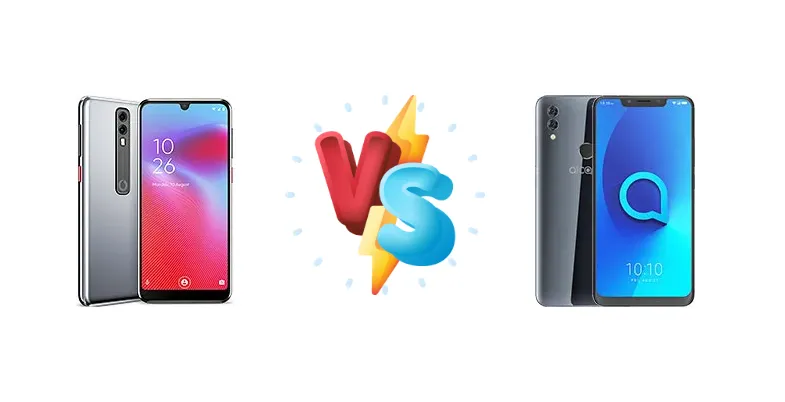
The Vodafone Smart V10 and alcatel 5v represent the lower end of the smartphone spectrum, targeting users prioritizing affordability. However, beneath the similar price points lie key differences in their core processing power. This comparison dissects those differences, focusing on the Qualcomm Snapdragon 429 in the V10 versus the MediaTek Helio P22 in the 5v, to determine which device offers the best value.
🏆 Quick Verdict
For the average user prioritizing multitasking and potentially smoother app switching, the alcatel 5v is the better choice. Its octa-core Helio P22 chipset, while built on the same 12nm process as the V10’s Snapdragon 429, provides a theoretical performance advantage over the quad-core configuration of the Vodafone device.
| Network |
|---|
| 2G bands | GSM 850 / 900 / 1800 / 1900 | GSM 850 / 900 / 1800 / 1900 |
| 3G bands | HSDPA 850 / 900 / 1900 / 2100 | HSDPA 900 / 2100 |
| 4G bands | 1, 3, 5, 7, 8, 28 | 1, 3, 7, 8, 20, 28 |
| Speed | HSPA 42.2/5.76 Mbps, LTE Cat4 150/50 Mbps | HSPA 42.2/5.76 Mbps, LTE Cat4 150/50 Mbps |
| Technology | GSM / HSPA / LTE | GSM / HSPA / LTE |
| Launch |
|---|
| Announced | 2019, May. Released 2019, June | 2018, July. Released 2018, August |
| Status | Discontinued | Discontinued |
| Body |
|---|
| Dimensions | 151.3 x 69.9 x 8.2 mm (5.96 x 2.75 x 0.32 in) | 153.7 x 74.5 x 8.5 mm (6.05 x 2.93 x 0.33 in) |
| SIM | Nano-SIM | Single SIM (Micro-SIM) or Dual SIM (Micro-SIM, dual stand-by) |
| Weight | 145 g (5.11 oz) | 158 g (5.57 oz) |
| Display |
|---|
| Protection | Asahi Dragontrail Glass | Asahi Dragontrail Glass |
| Resolution | 720 x 1560 pixels, 19.5:9 ratio (~291 ppi density) | 720 x 1500 pixels (~268 ppi density) |
| Size | 5.9 inches, 85.5 cm2 (~80.8% screen-to-body ratio) | 6.2 inches, 96.7 cm2 (~84.5% screen-to-body ratio) |
| Type | IPS LCD | IPS LCD |
| Platform |
|---|
| CPU | Quad-core 2.0 GHz Cortex-A53 | Octa-core 2.0 GHz Cortex-A53 |
| Chipset | Qualcomm SDM429 Snapdragon 429 (12 nm) | Mediatek MT6762 Helio P22 (12 nm) |
| GPU | Adreno 504 | PowerVR GE8320 |
| OS | Android 9.0 (Pie) | Android 8.1 (Oreo) |
| Memory |
|---|
| Card slot | microSDXC (dedicated slot) | microSDXC |
| Internal | 32GB 3GB RAM | 32GB 3GB RAM |
| | eMMC 5.1 | eMMC 5.1 |
| Main Camera |
|---|
| Dual | 13 MP, AF
5 MP | 12 MP, f/2.2, 1/2.8", 1.25 μm, PDAF
Auxiliary lens |
| Features | LED flash, HDR, panorama | Dual-LED dual-tone flash, HDR, panorama |
| Video | 1080p@30fps | 1080p@30fps (gyro-EIS) |
| Selfie camera |
|---|
| Features | - | LED flash |
| Single | 8 MP | 8 MP, f/2.8, 1/4.0", 1.12µm |
| Video | - | 720p@30fps |
| Sound |
|---|
| 3.5mm jack | Yes | Yes |
| 35mm jack | Yes | Yes |
| Loudspeaker | Yes | Yes |
| Comms |
|---|
| Bluetooth | 4.2, A2DP, LE | 4.0, A2DP, LE |
| NFC | No | Yes |
| Positioning | GPS | GPS |
| Radio | FM radio | FM radio |
| USB | microUSB 2.0 | microUSB 2.0 |
| WLAN | Wi-Fi 802.11 b/g/n | Wi-Fi 802.11 b/g/n, Wi-Fi Direct |
| Features |
|---|
| Sensors | Accelerometer, proximity | Fingerprint (rear-mounted), accelerometer, gyro, proximity, compass |
| Battery |
|---|
| Type | Li-Ion 3400 mAh, non-removable | Li-Ion 4000 mAh, non-removable |
| Misc |
|---|
| Colors | Chrome Pewter | Black, Blue |
| Models | - | 5060D, 5060A, 5060J |
| Price | About 180 EUR | About 180 EUR |
Vodafone Smart V10
- Potentially simpler software experience (Vodafone branding)
- Reliable performance for basic tasks
- Efficient 12nm Snapdragon 429 chipset
- Quad-core CPU limits multitasking capabilities
- Likely lower performance in demanding apps
- Limited camera features
alcatel 5v
- Octa-core Helio P22 offers better multitasking
- Potentially smoother app switching
- More responsive user interface
- MediaTek chipsets sometimes have less consistent software support
- Potential for bloatware
- Similar camera limitations to the V10
Display Comparison
Neither Vodafone nor Alcatel provide detailed display specifications beyond resolution. Given their market positioning, both likely utilize IPS LCD panels. The absence of information regarding peak brightness, color gamut coverage, or refresh rates suggests a focus on cost reduction. Bezels are expected to be substantial on both devices, typical for this price bracket. Color accuracy is unlikely to be a strong point on either model.
Camera Comparison
Without detailed sensor information, a direct camera comparison is difficult. Both devices likely feature a primary camera and potentially a depth sensor. However, the image signal processor (ISP) within the Helio P22 may offer slightly more advanced image processing capabilities. The absence of optical image stabilization (OIS) on either device suggests reliance on software-based stabilization, which is likely to be limited in effectiveness. The usefulness of any secondary 2MP macro camera (if present) is questionable, as image quality will be significantly lower than the main sensor.
Performance
The core difference lies in the chipset architecture. The alcatel 5v’s MediaTek Helio P22 features an octa-core CPU (8x Cortex-A53 at 2.0 GHz) compared to the Vodafone Smart V10’s Qualcomm Snapdragon 429, which has a quad-core CPU (4x Cortex-A53 at 2.0 GHz). While both are Cortex-A53 cores clocked at the same speed, the increased core count of the Helio P22 provides a significant advantage in multi-threaded tasks. This translates to faster app loading times when switching between multiple applications and a smoother experience with demanding apps. Both chipsets are fabricated on a 12nm process, suggesting similar power efficiency, but the P22’s ability to distribute workload across more cores could lead to better sustained performance under load.
Battery Life
Battery capacity is not specified in the provided data. However, given the similar chipsets and target market, both devices likely house batteries in the 3000-4000 mAh range. Charging wattage is also unknown, but is likely to be limited to 10W or 15W on both devices, resulting in relatively slow charging times. The Helio P22’s potentially more efficient core distribution could translate to slightly longer battery life under heavy use, but real-world battery performance will heavily depend on usage patterns and software optimization.
Buying Guide
Buy the Vodafone Smart V10 if you need a reliably basic smartphone for essential tasks like calls, texts, and light social media use, and value a potentially simpler software experience. Buy the alcatel 5v if you prefer a device capable of handling more demanding multitasking, enjoy occasional gaming, or anticipate running more apps concurrently. The 5v’s octa-core processor offers a noticeable edge in these scenarios.
Frequently Asked Questions
❓ Will the alcatel 5v struggle with popular games like PUBG Mobile?
While the Helio P22 can run PUBG Mobile, expect to play at lower graphics settings and potentially experience frame rate drops during intense action. It's not a gaming-focused chipset, but it's capable of casual gaming. The Vodafone Smart V10 will likely perform even worse in demanding games.
❓ Does either phone support fast charging, and how long will it take to fully charge the battery?
Neither device is expected to support fast charging. Based on the market segment, charging speeds will likely be limited to 10W or 15W, meaning a full charge from 0% will likely take between 2.5 and 4 hours. Exact charging times depend on the battery capacity, which is currently unknown.
❓ Which phone is likely to receive more software updates?
Software update support is unpredictable in this price range. Vodafone may offer slightly more consistent updates for the Smart V10, but this is not guaranteed. Alcatel's update track record is less reliable. Expect limited updates beyond security patches.