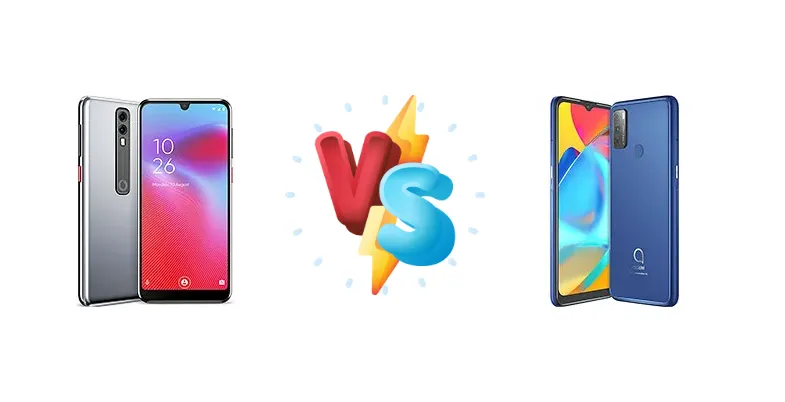
The Vodafone Smart V10 and Alcatel 3L (2021) represent the lower end of the smartphone market, targeting users prioritizing affordability. However, beneath the similar price points lie key differences in processing power and overall user experience. This comparison dissects those differences, focusing on the core hardware that dictates performance and usability.
🏆 Quick Verdict
For the average user prioritizing basic smartphone functions like calling, texting, and light social media, the Alcatel 3L (2021) offers a slight edge due to its octa-core processor. While the Vodafone Smart V10 is still capable, the Helio P22’s multi-core advantage translates to smoother multitasking and a more responsive feel.
| Network |
|---|
| 2G bands | GSM 850 / 900 / 1800 / 1900 | GSM 850 / 900 / 1800 / 1900 |
| 3G bands | HSDPA 850 / 900 / 1900 / 2100 | HSDPA 850 / 900 / 1900 / 2100 |
| 4G bands | 1, 3, 5, 7, 8, 28 | 1, 3, 7, 8, 20, 28 |
| Speed | HSPA 42.2/5.76 Mbps, LTE Cat4 150/50 Mbps | HSPA 42.2/5.76 Mbps, LTE Cat4 150/50 Mbps |
| Technology | GSM / HSPA / LTE | GSM / HSPA / LTE |
| Launch |
|---|
| Announced | 2019, May. Released 2019, June | 2021, January 12 |
| Status | Discontinued | Available. Released 2021, April 26 |
| Body |
|---|
| Build | - | Glass front, plastic back, plastic frame |
| Dimensions | 151.3 x 69.9 x 8.2 mm (5.96 x 2.75 x 0.32 in) | 165.6 x 75.6 x 8.7 mm (6.52 x 2.98 x 0.34 in) |
| SIM | Nano-SIM | · Nano-SIM· Nano-SIM + Nano-SIM |
| Weight | 145 g (5.11 oz) | 194 g (6.84 oz) |
| Display |
|---|
| Protection | Asahi Dragontrail Glass | - |
| Resolution | 720 x 1560 pixels, 19.5:9 ratio (~291 ppi density) | 720 x 1600 pixels, 20:9 ratio (~269 ppi density) |
| Size | 5.9 inches, 85.5 cm2 (~80.8% screen-to-body ratio) | 6.52 inches, 102.6 cm2 (~82.0% screen-to-body ratio) |
| Type | IPS LCD | IPS LCD |
| Platform |
|---|
| CPU | Quad-core 2.0 GHz Cortex-A53 | Octa-core (4x1.8 GHz Cortex-A53 & 4x1.5 GHz Cortex-A53) |
| Chipset | Qualcomm SDM429 Snapdragon 429 (12 nm) | Mediatek MT6762D Helio P22 (12 nm) |
| GPU | Adreno 504 | PowerVR GE8320 |
| OS | Android 9.0 (Pie) | Android 11 |
| Memory |
|---|
| Card slot | microSDXC (dedicated slot) | microSDXC (only single sim model) |
| Internal | 32GB 3GB RAM | 64GB 4GB RAM |
| | eMMC 5.1 | eMMC 5.1 |
| Main Camera |
|---|
| Dual | 13 MP, AF
5 MP | - |
| Features | LED flash, HDR, panorama | LED flash, HDR, panorama |
| Triple | - | 48 MP, f/1.8, 26mm (wide), 1/2.0", 0.8µm, PDAF
2 MP (macro)
Auxiliary lens |
| Video | 1080p@30fps | 1080p@30fps |
| Selfie camera |
|---|
| Features | - | HDR |
| Single | 8 MP | 8 MP, f/2.0, 26mm (wide), 1/4.0", 1.12µm |
| Video | - | 1080p@30fps |
| Sound |
|---|
| 3.5mm jack | Yes | Yes |
| 35mm jack | Yes | Yes |
| Loudspeaker | Yes | Yes |
| Comms |
|---|
| Bluetooth | 4.2, A2DP, LE | 5.0, A2DP, LE |
| NFC | No | Yes |
| Positioning | GPS | GPS, GLONASS, GALILEO, BDS |
| Radio | FM radio | FM radio |
| USB | microUSB 2.0 | microUSB 2.0, OTG |
| WLAN | Wi-Fi 802.11 b/g/n | Wi-Fi 802.11 b/g/n, Wi-Fi Direct |
| Features |
|---|
| Sensors | Accelerometer, proximity | Fingerprint (rear-mounted), accelerometer, proximity, compass |
| Battery |
|---|
| Charging | - | 10W wired |
| Type | Li-Ion 3400 mAh, non-removable | Li-Po 4000 mAh |
| Misc |
|---|
| Colors | Chrome Pewter | Jewelry Blue, Jewelry Black |
| Models | - | 6056D |
| Price | About 180 EUR | About 330 EUR |
Vodafone Smart V10
- Potentially better battery efficiency due to the quad-core processor.
- Reliable Qualcomm chipset with established software support.
- Carrier-branded, potentially offering bundled services.
- Quad-core processor may struggle with multitasking.
- Likely slower performance in demanding apps.
- Charging speed is unknown and potentially slower.
alcatel 3L (2021)
- Octa-core processor offers smoother multitasking.
- More responsive user experience for everyday tasks.
- Includes 10W wired charging.
- Potentially slightly lower battery life due to increased processing load.
- MediaTek chipset may have less consistent software updates.
- Generic branding with less carrier support.
Display Comparison
Neither device boasts a standout display. Both utilize 12nm chipsets, suggesting a focus on cost reduction over premium display features. Specific display specs (resolution, panel type, brightness) are not provided, but given the price bracket, we can assume both employ LCD panels with modest brightness levels. Bezels are likely to be noticeable on both devices, and color accuracy will be standard for this segment.
Camera Comparison
Without detailed camera specifications, a direct comparison is difficult. However, it’s safe to assume both devices feature basic camera setups geared towards casual photography. Given the market segment, image processing will likely prioritize speed over detail. The absence of information regarding sensor size or optical image stabilization (OIS) suggests both rely on software-based image enhancement. Any 2MP macro or depth sensors included on either device are likely to offer minimal benefit to the overall camera experience.
Performance
The core difference lies in the chipset: the Vodafone Smart V10 uses the Qualcomm Snapdragon 429, a quad-core processor clocked at 2.0 GHz, while the Alcatel 3L (2021) features the MediaTek Helio P22, an octa-core chip with a split configuration of 4x1.8 GHz and 4x1.5 GHz Cortex-A53 cores. This octa-core setup provides a significant advantage in multitasking and handling multiple apps simultaneously. While both utilize the Cortex-A53 architecture, the Helio P22’s additional cores allow it to distribute the workload more efficiently. The Snapdragon 429 will likely perform adequately for single-threaded tasks, but will struggle more with demanding applications. Neither chipset is geared towards intensive gaming.
Battery Life
Battery capacity isn't specified for either device. However, the Alcatel 3L (2021) includes 10W wired charging, while the Vodafone Smart V10’s charging speed is unknown. 10W charging is relatively slow by modern standards, meaning both phones will require a significant amount of time to fully charge. The more efficient Snapdragon 429 *could* translate to slightly better battery life under light usage, but the Helio P22’s ability to quickly complete tasks might result in less overall screen-on time.
Buying Guide
Buy the Vodafone Smart V10 if you need a reliably basic smartphone with a known carrier ecosystem and are comfortable with potentially slower performance in demanding apps. Buy the Alcatel 3L (2021) if you prefer a more responsive experience for everyday tasks and appreciate the benefits of an octa-core processor, even if it comes at the cost of potentially slightly lower battery efficiency due to the increased processing load.
Frequently Asked Questions
❓ Will the Alcatel 3L (2021) struggle with popular apps like Facebook or WhatsApp?
The Alcatel 3L (2021)'s octa-core Helio P22 processor should handle apps like Facebook and WhatsApp without significant issues. While not a powerhouse, the additional cores provide enough headroom for smooth operation of these commonly used applications. However, expect some slowdown when multiple apps are open simultaneously.
❓ Is the Vodafone Smart V10 a good choice for someone who primarily uses their phone for calls and texts?
Yes, the Vodafone Smart V10 is a perfectly adequate choice for users who primarily use their phone for calls and texts. The Snapdragon 429 is sufficient for these basic functions, and the phone benefits from being a carrier-branded device, potentially offering bundled services or support.
❓ Can either of these phones handle basic mobile games like Candy Crush or Angry Birds?
Both the Vodafone Smart V10 and Alcatel 3L (2021) can handle basic mobile games like Candy Crush or Angry Birds. However, don't expect high frame rates or detailed graphics. The Helio P22 in the Alcatel 3L might offer a slightly smoother experience due to its octa-core configuration, but neither phone is designed for serious gaming.