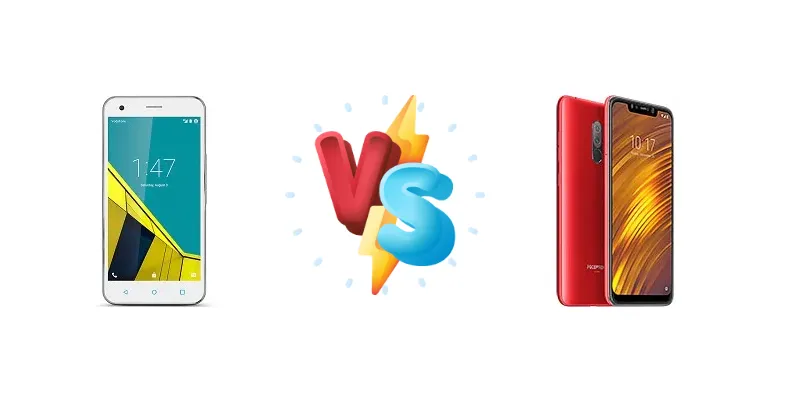
The Vodafone Smart Ultra 6 and Xiaomi Pocophone F1 both aimed to deliver impressive features without breaking the bank. But which one truly reigns supreme? This comprehensive comparison dives deep into their specs, performance, and overall value to help you make an informed decision.
🏆 Quick Verdict
The Xiaomi Pocophone F1 is the clear winner. Its Snapdragon 845 chipset offers significantly superior performance, while the excellent battery life and bright display solidify its position. The Vodafone Smart Ultra 6 is a decent budget option, but struggles to compete with the F1's power.
| Network |
|---|
| 2G bands | GSM 850 / 900 / 1800 / 1900 | GSM 850 / 900 / 1800 / 1900 |
| 3G bands | HSDPA | HSDPA 850 / 900 / 1900 / 2100 |
| 4G bands | 3, 7, 20 | 1, 3, 5, 7, 8, 20, 38, 40, 41 |
| EDGE | Yes | - |
| GPRS | Yes | - |
| Speed | HSPA, LTE | HSPA 42.2/5.76 Mbps, LTE (4CA) Cat16 1024/150 Mbps |
| Technology | GSM / HSPA / LTE | GSM / HSPA / LTE |
| Launch |
|---|
| Announced | 2015, June. Released 2015, June | 2018, August 22. Released 2018, August 27 |
| Status | Discontinued | Discontinued |
| Body |
|---|
| Build | - | Glass front (Gorilla Glass), plastic back, plastic frame |
| Dimensions | 154 x 77 x 8.4 mm (6.06 x 3.03 x 0.33 in) | 155.5 x 75.3 x 8.8 mm (6.12 x 2.96 x 0.35 in) |
| SIM | Nano-SIM | Nano-SIM + Nano-SIM |
| Weight | 159 g (5.61 oz) | 182 g (6.42 oz) |
| Display |
|---|
| Protection | - | Corning Gorilla Glass (unspecified version) |
| Resolution | 1080 x 1920 pixels, 16:9 ratio (~401 ppi density) | 1080 x 2246 pixels, 18.7:9 ratio (~403 ppi density) |
| Size | 5.5 inches, 83.4 cm2 (~70.3% screen-to-body ratio) | 6.18 inches, 96.2 cm2 (~82.2% screen-to-body ratio) |
| Type | IPS LCD | IPS LCD |
| Platform |
|---|
| CPU | Octa-core (4x1.5 GHz Cortex-A53 & 4x1.1 GHz Cortex-A53) | Octa-core (4x2.8 GHz Kryo 385 Gold & 4x1.8 GHz Kryo 385 Silver) |
| Chipset | Qualcomm MSM8939 Snapdragon 615 (28 nm) | Qualcomm SDM845 Snapdragon 845 (10 nm) |
| GPU | Adreno 405 | Adreno 630 |
| OS | Android 5.0.1 (Lollipop), upgradable to 6.0.1 (Marshmallow) | Android 8.1 (Oreo), upgradable to Android 10, MIUI 12 |
| Memory |
|---|
| Card slot | microSDXC (dedicated slot) | microSDXC (uses shared SIM slot) |
| Internal | 16GB 2GB RAM | 64GB 6GB RAM, 128GB 6GB RAM, 256GB 8GB RAM |
| | eMMC 4.5 | UFS 2.1 |
| Main Camera |
|---|
| Dual | - | 12 MP, f/1.9, 1/2.55", 1.4µm, dual pixel PDAF
Auxiliary lens |
| Features | LED flash | Dual-LED flash, HDR, panorama |
| Single | 13 MP, AF | - |
| Video | 1080p@30fps | 4K@30/60fps, 1080p@30fps (gyro-EIS), 1080p@240fps, 720p@960fps |
| Selfie camera |
|---|
| Features | - | HDR |
| Single | 5 MP | 20 MP, f/2.0, (wide), 1/3", 0.9µm |
| Video | - | 1080p@30fps |
| Sound |
|---|
| 3.5mm jack | Yes | Yes |
| 35mm jack | Yes | Yes |
| Loudspeaker | Yes | Yes, with stereo speakers |
| Comms |
|---|
| Bluetooth | 4.0, A2DP | 5.0, A2DP, LE, aptX HD |
| NFC | No | No |
| Positioning | GPS | GPS, GLONASS, BDS |
| Radio | FM radio | FM radio, recording |
| USB | microUSB 2.0 | USB Type-C 2.0, OTG |
| WLAN | Wi-Fi 802.11 b/g/n, hotspot | Wi-Fi 802.11 a/b/g/n/ac, dual-band, Wi-Fi Direct, DLNA |
| Features |
|---|
| Sensors | Accelerometer, proximity | Infrared Face ID, fingerprint (rear-mounted), accelerometer, gyro, proximity, compass |
| Battery |
|---|
| Charging | - | 18W wired, QC3 |
| Type | Li-Ion 3000 mAh, non-removable | Li-Po 4000 mAh, non-removable |
| Misc |
|---|
| Colors | Gray, Silver | Graphite Black, Steel Blue, Rosso Red, Armored Edition with Kevlar |
| Models | Smart ultra 6 | M1805E10A, POCO F1 |
| Price | About 170 EUR | About 360 EUR |
| SAR | - | 0.66 W/kg (head) 1.18 W/kg (body) |
| SAR EU | - | 0.54 W/kg (head) 1.58 W/kg (body) |
| Tests |
|---|
| Audio quality | - |
Noise -93.6dB / Crosstalk -93.8dB |
| Battery life | - |
Endurance rating 94h
|
| Camera | - |
Photo / Video |
| Display | - |
Contrast ratio: 1468:1 (nominal), 3.059 (sunlight) |
| Loudspeaker | - |
Voice 72dB / Noise 74dB / Ring 86dB
|
| Performance | - |
AnTuTu: 265314 (v7)
GeekBench: 9003 (v4.4)
GFXBench: 31fps (ES 3.1 onscreen) |
Vodafone Smart ultra 6
- Larger screen
- Traditional Android experience
- Good value for budget
- Outdated chipset
- Lower performance
- Less impressive camera
Xiaomi Pocophone F1
- Flagship-level performance
- Excellent battery life
- Bright and vibrant display
- Fast charging
- Design may not appeal to everyone
- No official waterproofing
Display Comparison
Both phones boast impressive contrast ratios (1468:1 nominal, 3.059 in sunlight), indicating excellent image quality. However, the Pocophone F1's display is generally considered brighter and more vibrant, offering a slightly better viewing experience. The Ultra 6 has a larger screen, which some may prefer for media consumption.
Camera Comparison
While both offer 'Photo / Video' capabilities, the Pocophone F1 generally delivers better image quality, especially in low light. The Snapdragon 845's image signal processor (ISP) contributes to improved processing and detail. The Ultra 6's camera is serviceable but lacks the F1's overall quality.
Performance
This is where the Pocophone F1 truly shines. The Snapdragon 845 is a significant upgrade over the Snapdragon 615. Expect noticeably faster app loading, smoother multitasking, and significantly better gaming performance on the F1. The Ultra 6's performance is adequate for everyday tasks but will struggle with demanding applications.
Battery Life
Both phones boast exceptional battery life, with an endurance rating of 94h. This suggests all-day (and potentially multi-day) usage is easily achievable on either device. Charging speeds are also comparable with the Pocophone F1's QC3 support offering slightly faster charging.
Buying Guide
The Vodafone Smart Ultra 6 is best suited for users prioritizing a larger screen and a more traditional Android experience on a tight budget. The Xiaomi Pocophone F1 is ideal for gamers, power users, and anyone seeking flagship-level performance at a mid-range price.
Frequently Asked Questions
❓ Is the Pocophone F1 worth the extra money?
Yes, the significant performance boost and improved camera make the Pocophone F1 well worth the extra investment, especially if you're a power user or gamer.
❓ What is the Vodafone Smart Ultra 6's screen size?
The Vodafone Smart Ultra 6 typically features a 6-inch display, offering a larger viewing area compared to the Pocophone F1.
❓ Does the Pocophone F1 have a headphone jack?
Yes, the Pocophone F1 retains a 3.5mm headphone jack, a feature increasingly absent in flagship phones.