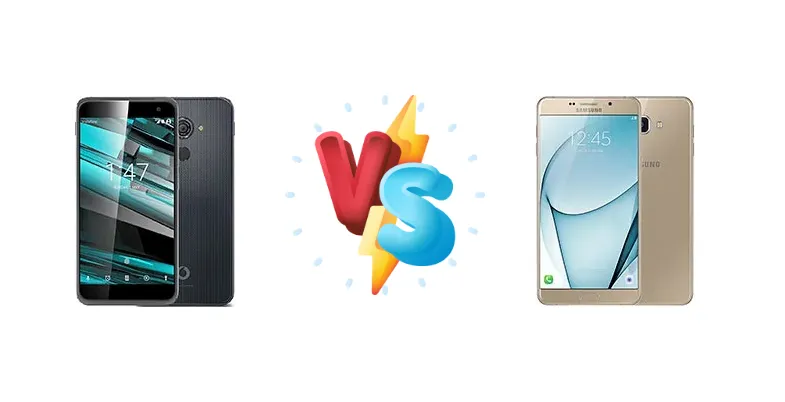
The Vodafone Smart Platinum 7 and Samsung Galaxy A9 Pro (2016) were both contenders in the mid-range smartphone market, boasting similar chipsets and aiming to deliver premium features at a more accessible price. But which phone truly delivered a better experience? We're diving deep into a head-to-head comparison to help you decide.
🏆 Quick Verdict
Both phones share the same Snapdragon 652 chipset, but the Vodafone Platinum 7 edges out the A9 Pro with its faster charging and potentially slightly better software optimization. The A9 Pro's larger screen and Samsung's brand recognition are its strengths. Ultimately, the Platinum 7 offers a bit more value.
| Network |
|---|
| 2G bands | GSM 850 / 900 / 1800 / 1900 | GSM 850 / 900 / 1800 / 1900 - SIM 1 & SIM 2 (dual-SIM model only) |
| 3G bands | HSDPA | HSDPA 850 / 900 / 1900 / 2100 |
| 4G bands | LTE | 1, 3, 5, 7, 8, 40 |
| EDGE | Yes | - |
| GPRS | Yes | - |
| Speed | HSPA 42.2/5.76 Mbps, LTE (2CA) Cat6 300/50 Mbps | HSPA 42.2/5.76 Mbps, LTE (3CA) Cat6 300/50 Mbps |
| Technology | GSM / HSPA / LTE | GSM / HSPA / LTE |
| | - | 1, 2, 3, 4, 5, 7, 8, 17, 28, 38, 40 -A910F/DS |
| Launch |
|---|
| Announced | 2016, June. Released 2016, June | 2016, March. Released 2016, May |
| Status | Discontinued | Discontinued |
| Body |
|---|
| Build | - | Glass front (Gorilla Glass 4), glass back (Gorilla Glass 4), aluminum frame |
| Dimensions | 154 x 75.7 x 7 mm (6.06 x 2.98 x 0.28 in) | 161.7 x 80.9 x 7.9 mm (6.37 x 3.19 x 0.31 in) |
| SIM | Nano-SIM | · Nano-SIM· Nano-SIM + Nano-SIM |
| Weight | 155 g (5.47 oz) | 210 g (7.41 oz) |
| Display |
|---|
| Protection | Corning Gorilla Glass (unspecified version) | Corning Gorilla Glass 4 |
| Resolution | 1440 x 2560 pixels, 16:9 ratio (~534 ppi density) | 1080 x 1920 pixels, 16:9 ratio (~367 ppi density) |
| Size | 5.5 inches, 83.4 cm2 (~71.5% screen-to-body ratio) | 6.0 inches, 99.2 cm2 (~75.9% screen-to-body ratio) |
| Type | AMOLED | Super AMOLED |
| Platform |
|---|
| CPU | Octa-core (4x1.8 GHz Cortex-A72 & 4x1.2 GHz Cortex-A53) | Octa-core (4x1.8 GHz Cortex-A72 & 4x1.4 GHz Cortex-A53) |
| Chipset | Qualcomm MSM8976 Snapdragon 652 (28 nm) | Qualcomm MSM8976 Snapdragon 652 (28 nm) |
| GPU | Adreno 510 | Adreno 510 |
| OS | Android 6.0.1 (Marshmallow) | Android 6.0.1 (Marshmallow), upgradable to Android 8.0 (Oreo), Experience UI 9 |
| Memory |
|---|
| Card slot | microSDXC (dedicated slot) | microSDXC (dedicated slot) |
| Internal | 32GB 3GB RAM | 32GB 4GB RAM |
| | eMMC 5.1 | eMMC 5.1 |
| Main Camera |
|---|
| Features | LED flash, panorama, HDR | LED flash, panorama, HDR |
| Single | 16 MP, f/2.0, 1/2.6", 1.12µm, PDAF | 16 MP, f/1.9, 1/2.8", AF, OIS |
| Video | 4K@30fps | 1080p@30fps |
| Selfie camera |
|---|
| Features | LED flash | - |
| Single | 8 MP | 8 MP, f/1.9 |
| Video | 1080p@30fps | 1080p@30fps |
| Sound |
|---|
| 3.5mm jack | Yes | Yes |
| 35mm jack | Yes | Yes |
| Loudspeaker | Yes, with stereo speakers | Yes |
| | Hi-Fi audio
| - |
| Comms |
|---|
| Bluetooth | 4.2, A2DP, LE | 4.2, A2DP, EDR, LE |
| NFC | Yes | Yes |
| Positioning | GPS | GPS, GLONASS/ BDS (market dependant) |
| Radio | FM radio | FM radio, RDS, recording |
| USB | microUSB 2.0, OTG | microUSB 2.0 |
| WLAN | Wi-Fi 802.11 a/b/g/n/ac, dual-band, Wi-Fi Direct | Wi-Fi 802.11 a/b/g/n/ac, dual-band, Wi-Fi Direct |
| Features |
|---|
| Sensors | Fingerprint (rear-mounted), accelerometer, gyro, proximity, compass | Fingerprint (front-mounted), accelerometer, proximity, compass |
| | - | ANT+
Samsung Pay (Visa, MasterCard certified) |
| Battery |
|---|
| Charging | 18W wired, QC3, 50% in 30 min | 18W wired |
| Music play | - | Up to 109 h |
| Talk time | - | Up to 33 h (3G) |
| Type | Li-Ion 3000 mAh, non-removable | Li-Ion 5000 mAh, non-removable |
| Misc |
|---|
| Colors | Black | White, Black, Gold |
| Models | VFD 900 | SM-A9100, SM-A910F, SM-A910F |
| Price | About 380 EUR | About 300 EUR |
| SAR EU | - | 0.62 W/kg (head) 1.32 W/kg (body) |
Vodafone Smart Platinum 7
- Faster 18W Charging (QC3)
- Potentially better software optimization
- Slightly more compact design
- Less well-known brand
- Smaller battery capacity compared to A9 Pro
- Availability may be limited
Samsung Galaxy A9 Pro (2016)
- Larger 6.0-inch display
- Samsung brand recognition
- Larger battery capacity (4000mAh)
- Slower charging (18W standard)
- Potentially more bloated software
- Older model
Display Comparison
Both phones feature Super AMOLED displays, known for vibrant colors and deep blacks. The A9 Pro has a larger 6.0-inch display compared to the Platinum 7's 5.5-inch screen, making it better for media consumption. However, the Platinum 7 might have slightly better color accuracy.
Camera Comparison
The Platinum 7 typically features a 13MP main camera and an 8MP front camera. The A9 Pro boasts a 13MP main camera and a 5MP front camera. Image quality is generally comparable, with Samsung's processing often resulting in more saturated colors. Low-light performance is likely similar on both devices.
Performance
Powered by the Snapdragon 652, both phones offer decent performance for everyday tasks and moderate gaming. The Platinum 7's software optimization could potentially provide a slightly smoother experience. The A9 Pro's slightly higher Cortex-A53 clock speed (1.4 GHz vs 1.2 GHz) might offer a marginal performance boost in some scenarios.
Battery Life
The A9 Pro has a larger 4000mAh battery compared to the Platinum 7's 3200mAh battery. However, the Platinum 7's 18W fast charging (QC3) significantly reduces charging times, offering a substantial advantage.
Buying Guide
The Vodafone Smart Platinum 7 is ideal for users prioritizing fast charging and a potentially more streamlined software experience. The Samsung Galaxy A9 Pro (2016) is a good choice for those who value a large display and the Samsung ecosystem, even if it means slightly slower charging.
Frequently Asked Questions
❓ Is the Snapdragon 652 chipset still good in 2024?
While not a flagship chipset, the Snapdragon 652 is still capable of handling everyday tasks and light gaming. However, newer phones offer significantly better performance.
❓ Which phone has better software support?
Samsung generally provides better software support and updates for its devices compared to Vodafone. However, both phones are now quite old and unlikely to receive major updates.