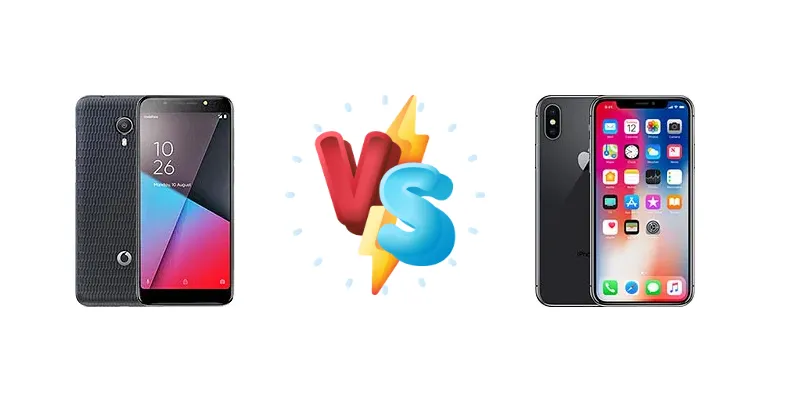
The smartphone landscape is vast, with options ranging from ultra-budget to premium flagships. Today, we're pitting a budget contender, the Vodafone Smart N9 Lite, against a former flagship titan, the Apple iPhone X. Can the N9 Lite offer surprising value, or is the iPhone X's pedigree simply too much to overcome?
🏆 Quick Verdict
The iPhone X unequivocally wins this comparison. While the Vodafone N9 Lite offers affordability, the iPhone X boasts superior performance, a vastly better camera, a premium build, and a more polished software experience. It's a significant generational leap in almost every aspect.
| Network |
|---|
| 2G bands | GSM 850 / 900 / 1800 / 1900 | GSM 850 / 900 / 1800 / 1900 |
| 3G bands | HSDPA | HSDPA 850 / 900 / 1700(AWS) / 1900 / 2100 |
| 4G bands | 1, 3, 5, 7, 8, 20, 28 | 1, 2, 3, 4, 5, 7, 8, 12, 13, 17, 18, 19, 20, 25, 26, 28, 29, 30, 34, 38, 39, 40, 41, 66 |
| EDGE | Yes | - |
| GPRS | Yes | - |
| Speed | HSPA 42.2/5.76 Mbps, LTE Cat4 150/50 Mbps | HSPA 42.2/5.76 Mbps, LTE (3CA) Cat12 600/150 Mbps, EV-DO Rev.A 3.1 Mbps |
| Technology | GSM / HSPA / LTE | GSM / HSPA / LTE |
| Launch |
|---|
| Announced | 2018, June. Released 2018, June | 2017, September 12. Released 2017, November 03 |
| Status | Discontinued | Discontinued |
| Body |
|---|
| Build | - | Glass front (Corning-made glass), glass back (Corning-made glass), stainless steel frame |
| Dimensions | 148.2 x 68.9 x 9.4 mm (5.83 x 2.71 x 0.37 in) | 143.6 x 70.9 x 7.7 mm (5.65 x 2.79 x 0.30 in) |
| SIM | Nano-SIM | Nano-SIM |
| Weight | 155 g (5.47 oz) | 174 g (6.14 oz) |
| | - | IP67 dust/water resistant (up to 1m for 30 mins)
Apple Pay (Visa, MasterCard, AMEX certified) |
| Display |
|---|
| Protection | - | Scratch-resistant glass |
| Resolution | 480 x 960 pixels, 18:9 ratio (~201 ppi density) | 1125 x 2436 pixels, 19.5:9 ratio (~458 ppi density) |
| Size | 5.34 inches, 73.6 cm2 (~72.1% screen-to-body ratio) | 5.8 inches, 84.4 cm2 (~82.9% screen-to-body ratio) |
| Type | IPS LCD | Super Retina OLED, HDR10, Dolby Vision, 625 nits (HBM) |
| | - | 3D Touch |
| Platform |
|---|
| CPU | Quad-core 1.3 GHz Cortex-A53 | Hexa-core 2.39 GHz (2x Monsoon + 4x Mistral) |
| Chipset | Mediatek MT6739WA (28 nm) | Apple A11 Bionic (10 nm) |
| GPU | Mali-T720MP2 | Apple GPU (three-core graphics) |
| OS | Android 8.1 Oreo (Go edition) | iOS 11.1.1, up to iOS 16.7.12 |
| Memory |
|---|
| Card slot | microSDHC | No |
| Internal | 16GB 1GB RAM | 64GB 3GB RAM, 256GB 3GB RAM |
| | eMMC 5.1 | NVMe |
| Main Camera |
|---|
| Dual | - | 12 MP, f/1.8, 28mm (wide), 1/3.0", 1.22µm, dual pixel PDAF, OIS
12 MP, f/2.4, 52mm (telephoto), 1/3.4", 1.0µm, PDAF, OIS, 2x optical zoom |
| Features | LED flash, HDR, panorama | Quad-LED dual-tone flash, HDR (photo/panorama), panorama, HDR |
| Single | 8 MP, AF | - |
| Video | 1080p@30fps | 4K@24/30/60fps, 1080p@30/60/120/240fps |
| Selfie camera |
|---|
| Features | LED flash | HDR |
| Single | 5 MP | 7 MP, f/2.2, 32mm (standard)
SL 3D, (depth/biometrics sensor) |
| Video | - | 1080p@30fps |
| Sound |
|---|
| 3.5mm jack | Yes | No |
| 35mm jack | Yes | No |
| Loudspeaker | Yes | Yes, with stereo speakers |
| Comms |
|---|
| Bluetooth | 4.0, A2DP | 5.0, A2DP, LE |
| NFC | Yes | Yes |
| Positioning | GPS | GPS, GLONASS, GALILEO, QZSS |
| Radio | FM radio | No |
| USB | microUSB 2.0 | Lightning, USB 2.0 |
| WLAN | Wi-Fi 802.11 b/g/n | Wi-Fi 802.11 a/b/g/n/ac, dual-band, hotspot |
| Features |
|---|
| Sensors | Accelerometer, gyro (market dependent), proximity, compass | Face ID, accelerometer, gyro, proximity, compass, barometer |
| Battery |
|---|
| Charging | - | 15W wired, PD2.0, 50% in 30 min
Wireless (Qi) |
| Talk time | - | Up to 21 h (3G) |
| Type | Li-Ion 2460 mAh battery | Li-Ion 2716 mAh, non-removable (10.35 Wh) |
| Misc |
|---|
| Colors | White Pearl, Black Ice | Space Gray, Silver |
| Models | VFD 620 | A1865, A1901, A1902, A1903, iPhone10,3, iPhone10,6 |
| Price | About 100 EUR | About 100 EUR |
| SAR | - | 1.09 W/kg (head) 1.17 W/kg (body) |
| SAR EU | 0.90 W/kg (head) 1.69 W/kg (body) | - |
| Tests |
|---|
| Audio quality | - |
Noise -93.7dB / Crosstalk -82.8dB |
| Battery life | - | Endurance rating 74h |
| Camera | - |
Photo / Video |
| Display | - |
Contrast ratio: Infinity (nominal), 5.013 (sunlight) |
| Loudspeaker | - |
Voice 68dB / Noise 74dB / Ring 76dB |
| Performance | - |
AnTuTu: 233100 (v7)
GeekBench: 10215 (v4.4)
GFXBench: 28fps (ES 3.1 onscreen) |
Vodafone Smart N9 lite
- Affordable
- Decent battery life (reported)
- Lightweight
- Weak performance
- Basic camera
- Outdated design
- Limited software updates
Apple iPhone X
- Excellent performance
- Premium design
- Outstanding camera
- Long software support
- Fast charging (wired & wireless)
- Expensive (even used)
- Older model
- No headphone jack
Display Comparison
The iPhone X's OLED display offers vibrant colors, deep blacks, and excellent contrast, a stark contrast to the N9 Lite's likely LCD panel. While both have good sunlight readability (5.013 contrast ratio noted), the iPhone X's overall visual quality is significantly superior. The iPhone X also has a smaller bezel design, contributing to a more modern look.
Camera Comparison
The iPhone X's camera system is renowned for its image quality, offering excellent detail, dynamic range, and low-light performance. The N9 Lite's camera is likely adequate for casual snapshots, but falls far short of the iPhone X's capabilities. Features like Portrait Mode and Cinematic video are exclusive to the iPhone X.
Performance
The A11 Bionic chip in the iPhone X is a powerhouse, easily outperforming the Mediatek MT6739WA in the N9 Lite. Expect smoother multitasking, faster app loading, and better gaming performance on the iPhone X. The N9 Lite will handle basic tasks adequately, but struggles with demanding applications.
Battery Life
Both devices are reported to have an endurance rating of 74h, which is impressive. However, the iPhone X's efficient A11 Bionic chip and optimized iOS likely contribute to better real-world battery life despite potentially having a slightly smaller battery capacity than the N9 Lite. The iPhone X also supports fast charging (15W wired, PD2.0) and wireless charging (Qi).
Buying Guide
Who should buy the Vodafone Smart N9 Lite? Users on a very tight budget who prioritize basic functionality and affordability. Who should buy the Apple iPhone X? Users seeking a premium smartphone experience with excellent performance, a top-tier camera, and access to the Apple ecosystem, even if it's a slightly older model.
Frequently Asked Questions
❓ Is the Vodafone Smart N9 Lite worth buying in 2024?
Only if your budget is extremely limited and you only need basic smartphone functionality. There are likely better options available in the same price range.
❓ How much does the iPhone X cost now?
The price of an iPhone X varies depending on condition and storage capacity, but you can typically find used models for around $200-$400.
❓ Will the Vodafone Smart N9 Lite receive software updates?
Likely limited or no further software updates. It's an older, budget device.
❓ What are the key differences between iOS and Android?
iOS (iPhone) is known for its simplicity, security, and tight integration with Apple's ecosystem. Android (Vodafone N9 Lite) offers more customization options and a wider range of devices.