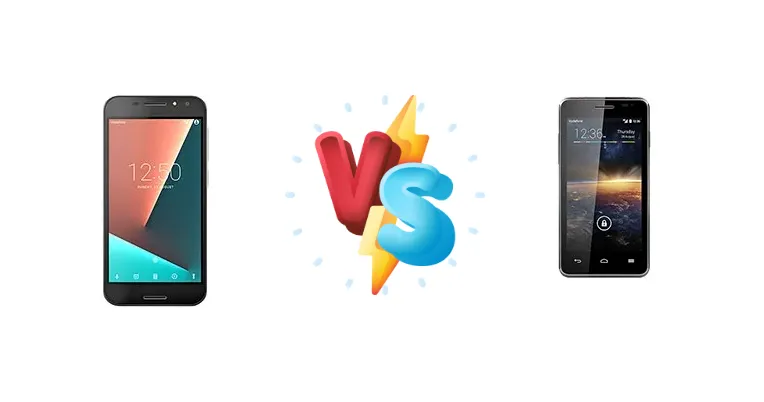
Looking for an affordable Android phone? Vodafone's Smart N8 and Smart 4 Turbo were popular budget options. But which one offers the best value? We're diving deep into their specs, performance, and features to help you decide.
🏆 Quick Verdict
The Vodafone Smart N8 edges out the Smart 4 Turbo thanks to its slightly more powerful CPU and generally better performance. While both are budget devices, the N8 offers a smoother experience for everyday tasks and light gaming. However, availability and price will be key factors.
| Network |
|---|
| 2G bands | GSM 850 / 900 / 1800 / 1900 | GSM 900 / 1800 / 1900 |
| 3G bands | HSDPA | HSDPA 900 / 2100 |
| 4G bands | LTE | 3, 7, 20 |
| EDGE | Yes | - |
| GPRS | Yes | - |
| Speed | HSPA 42.2/5.76 Mbps, LTE Cat4 150/50 Mbps | HSPA, LTE Cat4 150/50 Mbps |
| Technology | GSM / HSPA / LTE | GSM / HSPA / LTE |
| Launch |
|---|
| Announced | 2017, June. Released 2017, June | 2014, Q2. Released 2014, Q2 |
| Status | Discontinued | Discontinued |
| Body |
|---|
| Dimensions | 144.5 x 71.9 x 8.6 mm (5.69 x 2.83 x 0.34 in) | 134.5 x 67.5 x 10.4 mm (5.30 x 2.66 x 0.41 in) |
| SIM | Nano-SIM | Micro-SIM |
| Weight | 151 g (5.33 oz) | 155 g (5.47 oz) |
| Display |
|---|
| Resolution | 720 x 1280 pixels, 16:9 ratio (~294 ppi density) | 480 x 854 pixels, 16:9 ratio (~218 ppi density) |
| Size | 5.0 inches, 68.9 cm2 (~66.3% screen-to-body ratio) | 4.5 inches, 55.8 cm2 (~61.5% screen-to-body ratio) |
| Type | IPS LCD | TFT |
| Platform |
|---|
| CPU | Quad-core 1.3 GHz Cortex-A53 | Quad-core 1.2 GHz Cortex-A7 |
| Chipset | Mediatek MT6737 (28 nm) | Qualcomm MSM8926 Snapdragon 400 (28 nm) |
| GPU | Mali-T720MP2 | Adreno 305 |
| OS | Android 7.0 (Nougat) | Android 4.4.2 (KitKat) |
| Memory |
|---|
| Card slot | microSDHC | microSDHC (dedicated slot) |
| Internal | 16GB 1.5GB RAM | 4GB 1GB RAM |
| | eMMC 5.0 | eMMC 4.5 |
| Main Camera |
|---|
| Features | LED flash, HDR | LED flash |
| Single | 13 MP, AF | 5 MP |
| Video | 720p@30fps | Yes |
| Selfie camera |
|---|
| Single | 5 MP | VGA |
| Sound |
|---|
| 3.5mm jack | Yes | Yes |
| 35mm jack | Yes | Yes |
| Loudspeaker | Yes, dual speakers | Yes |
| Comms |
|---|
| Bluetooth | 4.0, A2DP | 4.0, A2DP |
| NFC | Yes | Yes |
| Positioning | GPS | GPS |
| Radio | FM radio | FM radio |
| USB | microUSB 2.0 | microUSB 2.0 |
| WLAN | Wi-Fi 802.11 b/g/n | Wi-Fi 802.11 b/g/n, hotspot |
| Features |
|---|
| Sensors | Fingerprint (rear-mounted), accelerometer, proximity | Accelerometer, proximity |
| Battery |
|---|
| Type | Li-Ion 2400 mAh, non-removable | Li-Ion 1880 mAh, removable |
| Misc |
|---|
| Colors | Graphite, Gold | Black, White |
| Models | VFD 610 | 890N |
| Price | About 100 EUR | About 100 EUR |
| SAR | - | 0.45 W/kg (head) 1.32 W/kg (body) |
Vodafone Smart N8
- Slightly more powerful CPU
- Potentially newer display technology
- Generally smoother performance
- Availability may be limited
- Camera performance is still basic
- Plastic build quality
Vodafone Smart 4 turbo
- Potentially better battery life (due to Snapdragon 400 efficiency)
- Likely more affordable
- Simple and easy to use
- Older CPU architecture
- Lower performance compared to N8
- Basic camera capabilities
Display Comparison
Both phones likely feature similar sized (around 5.5-6 inch) IPS LCD displays with HD (720p) resolution. Expect decent viewing angles and color reproduction for the price point, but don't anticipate flagship-level sharpness or brightness. The N8 *might* have a slightly newer display technology, but this is difficult to confirm without more detailed specifications.
Camera Comparison
Camera specs are often limited on these budget devices. Both likely feature an 8MP or 13MP main camera and a 5MP front-facing camera. Image quality will depend heavily on software processing and lighting conditions. Expect decent photos in good light, but struggles in low-light situations. The N8 *might* have slightly improved image processing due to a newer chipset.
Performance
The Mediatek MT6737 in the Smart N8 has a Cortex-A53 CPU clocked at 1.3 GHz, while the Smart 4 Turbo uses a Qualcomm Snapdragon 400 with a Cortex-A7 CPU at 1.2 GHz. While both are quad-core, the A53 architecture is generally more efficient and offers better performance than the older A7. Expect the N8 to handle multitasking and apps slightly better.
Battery Life
Battery capacity is likely around 2500-3000 mAh for both devices. Battery life will depend on usage patterns, but expect a full day of moderate use. The Snapdragon 400 is known for its power efficiency, so the Smart 4 Turbo *could* potentially offer slightly better battery life under similar usage.
Buying Guide
The Vodafone Smart N8 is a good choice for users prioritizing a bit more performance and a slightly more modern chipset. The Smart 4 Turbo is suitable for those on a very tight budget and primarily need a phone for basic communication and light usage.
Frequently Asked Questions
❓ Are these phones still available?
Both the Vodafone Smart N8 and Smart 4 Turbo are older models and may be difficult to find new. You might find them on used marketplaces.
❓ What operating system do these phones run?
Both phones originally shipped with Android 6.0 (Marshmallow) or 7.0 (Nougat). Software updates are unlikely at this point.