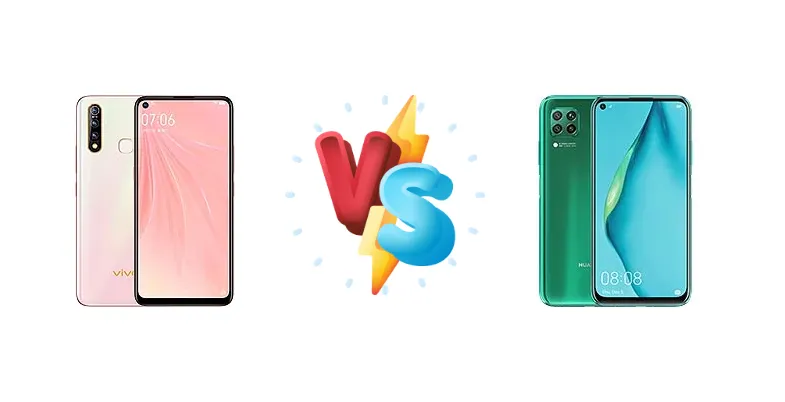
The vivo Z5x (2020) and Huawei nova 7i represent compelling options in the competitive mid-range smartphone market. While both aim to deliver a balanced experience, they take different approaches to achieving it. The Z5x relies on Qualcomm’s Snapdragon 712, while the nova 7i leverages Huawei’s in-house Kirin 810. This comparison dissects their key differences to help you determine which device best aligns with your needs.
🏆 Quick Verdict
For the average user prioritizing fast charging and a slight performance edge, the Huawei nova 7i is the better choice. Its 40W charging significantly reduces downtime, and the Kirin 810, built on a 7nm process, offers a modest but noticeable performance advantage over the Snapdragon 712’s 10nm architecture.
| Network |
|---|
| 2G bands | GSM 850 / 900 / 1800 / 1900 | GSM 850 / 900 / 1800 / 1900 |
| 3G bands | HSDPA 850 / 900 / 2100 | HSDPA 800 / 850 / 900 / 1700(AWS) / 2100 |
| 4G bands | 1, 3, 4, 5, 8, 34, 38, 39, 40, 41 | 1, 2, 3, 4, 5, 7, 8, 18, 19, 20, 28, 34, 38, 39, 40, 41 - JNY-L21A, JNY-L01A, JNY-L21B |
| Speed | HSPA, LTE | HSPA 42.2/5.76 Mbps, LTE (2CA) Cat13 400/75 Mbps |
| Technology | GSM / CDMA / HSPA / LTE | GSM / CDMA / HSPA / LTE |
| | CDMA 800 & TD-SCDMA | 1, 2, 3, 4, 5, 7, 8, 18, 19, 28, 34, 38, 39, 40, 41 - JNY-L22A, JNY-L02A, JNY-L22B |
| Launch |
|---|
| Announced | 2020, June 09. Released 2020, June 09 | 2020, January 30. Released 2020, February 14 |
| Status | Discontinued | Discontinued |
| Body |
|---|
| Build | Glass front, plastic back, plastic frame | Glass front, plastic back, plastic frame |
| Dimensions | 162.4 x 77.3 x 8.9 mm (6.39 x 3.04 x 0.35 in) | 159.2 x 76.3 x 8.7 mm (6.27 x 3.00 x 0.34 in) |
| SIM | Nano-SIM + Nano-SIM | · Nano-SIM· Nano-SIM + Nano-SIM |
| Weight | 204.1 g (7.20 oz) | 183 g (6.46 oz) |
| Display |
|---|
| Resolution | 1080 x 2340 pixels, 19.5:9 ratio (~395 ppi density) | 1080 x 2310 pixels (~398 ppi density) |
| Size | 6.53 inches, 104.7 cm2 (~83.4% screen-to-body ratio) | 6.4 inches, 101.4 cm2 (~83.5% screen-to-body ratio) |
| Type | IPS LCD | IPS LCD |
| Platform |
|---|
| CPU | Octa-core (2x2.3 GHz Kryo 360 Gold & 6x1.7 GHz Kryo 360 Silver) | Octa-core (2x2.27 GHz Cortex-A76 & 6x1.88 GHz Cortex-A55) |
| Chipset | Qualcomm SDM712 Snapdragon 712 (10 nm) | Kirin 810 (7 nm) |
| GPU | Adreno 616 | Mali-G52 MP6 |
| OS | Android 9.0 (Pie), upgradable to Android 10, Funtouch 10 | Android 10, EMUI 10, no Google Play Services |
| Memory |
|---|
| Card slot | microSDXC (dedicated slot) | Nano Memory (uses shared SIM slot) |
| Internal | 64GB 4GB RAM, 64GB 6GB RAM, 128GB 8GB RAM | 128GB 8GB RAM |
| | - | UFS 2.1 |
| Main Camera |
|---|
| Features | LED flash, HDR, panorama | LED flash, HDR, panorama |
| Quad | - | 48 MP, f/1.8, 26mm (wide), 1/2.0", 0.8µm, PDAF
8 MP, f/2.4, (ultrawide)
2 MP (macro)
Auxiliary lens |
| Triple | 16 MP, f/1.8, (wide), 1/2.8", 1.12µm, AF
8 MP, f/2.2, 16mm (ultrawide), 1/4.0", 1.12µm
Auxiliary lens | - |
| Video | 1080p@30fps | 1080p@30fps |
| Selfie camera |
|---|
| Features | - | HDR |
| Single | 16 MP, f/2.0, 26mm (wide), 1/3.06", 1.0µm | 16 MP, f/2.0, (wide), 1/3.06", 1.0µm |
| Video | 1080p@30fps | 1080p@30fps |
| Sound |
|---|
| 3.5mm jack | Yes | Yes |
| 35mm jack | Yes | Yes |
| Loudspeaker | Yes | Yes |
| Comms |
|---|
| Bluetooth | 5.0, A2DP, LE | 5.1, A2DP, LE |
| NFC | No | No |
| Positioning | GPS, GLONASS, BDS | GPS, GLONASS, GALILEO, BDS, QZSS |
| Radio | No | FM radio (market/region dependent) |
| USB | microUSB 2.0, OTG | USB Type-C 2.0, OTG |
| WLAN | Wi-Fi 802.11 a/b/g/n/ac, dual-band, Wi-Fi Direct | Wi-Fi 802.11 a/b/g/n/ac, dual-band, Wi-Fi Direct |
| Features |
|---|
| Sensors | Fingerprint (rear-mounted), accelerometer, gyro, proximity, compass | Fingerprint (side-mounted), accelerometer, proximity, compass |
| Battery |
|---|
| Charging | 18W wired | 40W wired, 70% in 30 min |
| Type | 5000 mAh | Li-Po 4200 mAh |
| Misc |
|---|
| Colors | Black, Blue, White, Dark Blue | Midnight Black, Crush Green, Sakura Pink |
| Models | - | JNY-L22B, JNY-L21A, JNY-L01A, JNY-L21B, JNY-L22A, JNY-L02A, JNY-LX2 |
| Price | About 160 EUR | About 240 EUR |
vivo Z5x (2020)
- Familiar Qualcomm Snapdragon chipset
- Potentially more stable software experience (depending on user preference)
- Generally more affordable
- Slower 18W charging
- Less powerful chipset compared to Kirin 810
- 10nm process less efficient than 7nm
Huawei nova 7i
- Significantly faster 40W charging
- More efficient Kirin 810 chipset (7nm)
- Potentially smoother multitasking
- Huawei software ecosystem (potential concerns for some users)
- May be slightly more expensive
- Potential for app compatibility issues (depending on region)
Display Comparison
Neither device boasts a standout display. While specific panel details (like peak brightness or color gamut coverage) are unavailable, the focus here is on the internal hardware. Both likely utilize IPS LCD panels common in this price bracket. The absence of high refresh rates is expected. The real differentiator will be software calibration, which is difficult to assess without direct testing. Bezels are likely comparable, typical of mid-range phones from this era.
Camera Comparison
Without detailed camera specs beyond the main sensors, a direct comparison is limited. Both phones likely feature multi-camera setups with a primary sensor, ultrawide, and depth sensor. The image processing algorithms will be a key differentiator. Huawei’s image processing is generally known for vibrant, sometimes oversaturated colors, while vivo tends towards a more natural look. The absence of Optical Image Stabilization (OIS) on either device suggests a reliance on software stabilization, which may struggle in low-light conditions. The usefulness of any 2MP macro lenses included on either phone is questionable, offering limited detail and often serving as a marketing gimmick.
Performance
The core difference lies in the chipsets. The Huawei nova 7i’s Kirin 810, fabricated on a 7nm process, inherently offers better power efficiency and transistor density compared to the vivo Z5x’s Snapdragon 712 (10nm). This translates to potentially lower temperatures under sustained load and a slight performance uplift. The Kirin 810’s CPU configuration – 2x2.27 GHz Cortex-A76 & 6x1.88 GHz Cortex-A55 – is architecturally more advanced than the Snapdragon 712’s 2x2.3 GHz Kryo 360 Gold & 6x1.7 GHz Kryo 360 Silver. While clock speeds are close, the Cortex-A76 cores provide a more significant performance boost in CPU-intensive tasks. Gaming performance will favor the nova 7i, though both phones will handle most mobile titles at medium settings.
Battery Life
The Huawei nova 7i’s 40W wired charging is a game-changer. Huawei claims 70% charge in 30 minutes, a significant advantage over the vivo Z5x’s 18W charging. While battery capacity isn’t specified, the faster charging mitigates any potential disadvantage from a slightly smaller battery. The Kirin 810’s 7nm process also contributes to better power efficiency, potentially extending battery life during typical usage. The Z5x will take considerably longer to fully charge, impacting user convenience.
Buying Guide
Buy the vivo Z5x (2020) if you prioritize a familiar Qualcomm chipset ecosystem and are comfortable with slower charging speeds. It’s a solid all-rounder for everyday tasks and light gaming. Buy the Huawei nova 7i if you value rapid charging, a potentially smoother multitasking experience due to the Kirin 810’s architecture, and don't mind the potential software considerations associated with Huawei devices.
Frequently Asked Questions
❓ Does the Kirin 810 in the Huawei nova 7i get noticeably warmer than the Snapdragon 712 during extended gaming sessions?
While the Kirin 810 is more efficient overall, its higher performance ceiling means it *can* generate more heat under sustained load. However, the 7nm process helps mitigate this, and Huawei’s thermal management is generally effective. Expect some warming, but likely not to the point of significant throttling, especially compared to the Snapdragon 712 which will throttle sooner to manage heat.
❓ Is Huawei's 40W charging compatible with all USB-PD chargers, or do I need to use the included charger for optimal speed?
While the nova 7i supports fast charging, it utilizes Huawei's proprietary SuperCharge protocol. To achieve the full 40W charging speed, you *must* use the included charger and cable. Standard USB-PD chargers will likely charge the device at a slower rate.
❓ Will I experience any issues with app availability or Google Mobile Services on the Huawei nova 7i?
The Huawei nova 7i launched with full Google Mobile Services (GMS). However, depending on your region and the software version, there's a possibility of future updates removing GMS. It's crucial to verify the current software status before purchasing if GMS is a necessity for you.