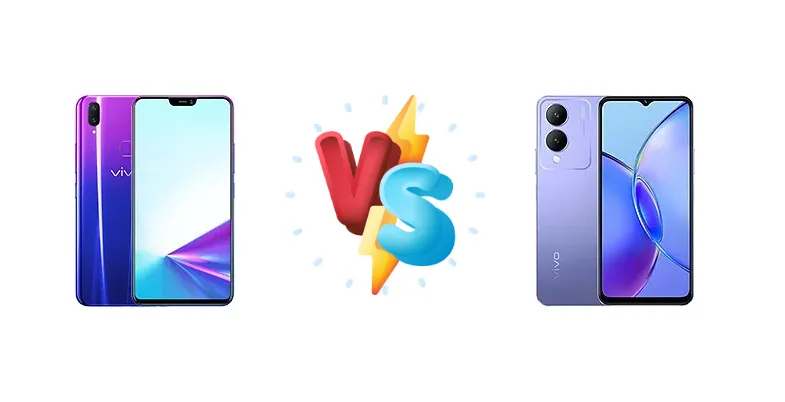
The vivo Z3x and Y17s represent vivo’s approach to the budget smartphone market, but they diverge in their core components. The Z3x, utilizing the older Qualcomm Snapdragon 660, aims for a balance of established performance, while the Y17s leverages the newer MediaTek Helio G85, focusing on efficiency and potentially improved gaming. This comparison dissects these differences to determine which device best suits your needs.
🏆 Quick Verdict
For the average user prioritizing sustained performance and a proven track record, the vivo Z3x emerges as the better choice. While the Y17s boasts a more efficient 12nm process, the Snapdragon 660’s Kryo cores and overall architecture provide a more robust experience, particularly in multitasking and demanding applications.
| Network |
|---|
| 2G bands | GSM 850 / 900 / 1800 / 1900 | GSM 850 / 900 / 1800 / 1900 |
| 3G bands | HSDPA 850 / 900 / 2100 | HSDPA 850 / 900 / 2100 |
| 4G bands | 1, 3, 5, 8, 34, 38, 39, 40, 41 | 1, 3, 5, 7, 8, 20, 28, 38, 40, 41 |
| Speed | HSPA 42.2/5.76 Mbps, LTE (2CA) Cat6 300/50 Mbps | HSPA, LTE |
| Technology | GSM / CDMA / HSPA / LTE | GSM / HSPA / LTE |
| | CDMA 800 & TD-SCDMA | - |
| Launch |
|---|
| Announced | 2019, April. Released 2019, May | 2023, September 18 |
| Status | Discontinued | Available. Released 2023, October 02 |
| Body |
|---|
| Build | Glass front, plastic back, plastic frame | Glass front, plastic frame, plastic back |
| Dimensions | 154.8 x 75 x 7.9 mm (6.09 x 2.95 x 0.31 in) | 163.7 x 75.4 x 8.1 mm (6.44 x 2.97 x 0.32 in) |
| SIM | Nano-SIM + Nano-SIM | Nano-SIM + Nano-SIM |
| Weight | 150 g (5.29 oz) | 186 g (6.56 oz) |
| Display |
|---|
| Resolution | 1080 x 2280 pixels, 19:9 ratio (~403 ppi density) | 720 x 1612 pixels, 20:9 ratio (~269 ppi density) |
| Size | 6.26 inches, 97.8 cm2 (~84.2% screen-to-body ratio) | 6.56 inches, 103.4 cm2 (~83.8% screen-to-body ratio) |
| Type | IPS LCD | IPS LCD, 700 nits (peak) |
| Platform |
|---|
| CPU | Octa-core (4x2.2 GHz Kryo 260 Gold & 4x1.8 GHz Kryo 260 Silver) | Octa-core (2x2.0 GHz Cortex-A75 & 6x1.8 GHz Cortex-A55) |
| Chipset | Qualcomm SDM660 Snapdragon 660 (14 nm) | Mediatek MT6769 Helio G85 (12 nm) |
| GPU | Adreno 512 | Mali-G52 MC2 |
| OS | Android 9.0 (Pie), Funtouch 9 | Android 13, Funtouch 13 |
| Memory |
|---|
| Card slot | microSDXC (dedicated slot) | microSDXC (dedicated slot) |
| Internal | 64GB 4GB RAM, 64GB 6GB RAM | 64GB 4GB RAM, 128GB 4GB RAM, 128GB 6GB RAM |
| | eMMC 5.1 | - |
| Main Camera |
|---|
| Dual | 13 MP, f/2.2, PDAF
Auxiliary lens | 50 MP, f/1.8, (wide), PDAF
Auxiliary lens |
| Features | LED flash, panorama | LED flash, panorama |
| Video | 1080p@30fps | 1080p@30fps |
| Selfie camera |
|---|
| Single | 16 MP, f/2.0, 26mm (wide), 1/3.06", 1.0µm | 8 MP, f/2.0, (wide) |
| Video | - | 1080p@30fps |
| Sound |
|---|
| 3.5mm jack | Yes | - |
| 35mm jack | Yes | Yes |
| Loudspeaker | Yes | Yes |
| Comms |
|---|
| Bluetooth | 5.0, A2DP, LE | 5.0, A2DP, LE |
| NFC | No | No |
| Positioning | GPS, GLONASS, BDS | GPS, GLONASS, GALILEO, BDS, QZSS |
| Radio | FM radio | FM radio |
| USB | microUSB 2.0, OTG | USB Type-C 2.0, OTG |
| WLAN | Wi-Fi 802.11 a/b/g/n, Wi-Fi Direct | Wi-Fi 802.11 a/b/g/n/ac, dual-band |
| Features |
|---|
| Sensors | Fingerprint (rear-mounted), accelerometer, proximity, compass | Fingerprint (side-mounted), accelerometer, proximity, compass |
| Battery |
|---|
| Charging | - | 15W wired
Reverse wired |
| Type | Li-Ion 3260 mAh, non-removable | 5000 mAh |
| Misc |
|---|
| Colors | Black, Red, Aurora | Glitter Purple, Forest Green |
| Models | V1730GA | - |
| Price | About 160 EUR | - |
vivo Z3x
- Stronger CPU performance with Snapdragon 660
- Proven Adreno 512 GPU for gaming
- Potentially more stable software experience
- Older 14nm process may lead to higher temperatures
- No reverse wired charging
- Unknown battery capacity
vivo Y17s
- More efficient 12nm Helio G85 chipset
- 15W wired charging with reverse wired charging
- Potentially longer battery life
- Slightly weaker CPU performance compared to Snapdragon 660
- Mali-G52 GPU may struggle with demanding games
- Potentially more aggressive image processing
Display Comparison
Neither device’s display specifications are provided, so a direct comparison is limited. However, given their market positioning, both likely feature LCD panels. The Y17s’ inclusion of 15W charging suggests a focus on daily usability, potentially indicating a slightly more modern display implementation. Without knowing resolution, brightness, or color gamut coverage, it’s difficult to definitively state a winner, but the Y17s’ newer design language may translate to slightly thinner bezels.
Camera Comparison
Without detailed camera specifications, a thorough comparison is impossible. Both phones likely feature a multi-camera setup, but the quality will depend heavily on sensor size, aperture, and image processing. It’s reasonable to assume both will include a primary camera, a depth sensor, and potentially a macro lens. Given the market segment, image processing will likely prioritize social media-friendly results over absolute accuracy. The absence of OIS on either device suggests reliance on software stabilization.
Performance
The core difference lies in the chipsets. The vivo Z3x’s Snapdragon 660 (14nm) features an octa-core CPU with a Kryo 260 architecture, split into 4x2.2 GHz Gold and 4x1.8 GHz Silver cores. This architecture prioritizes performance with the Gold cores handling demanding tasks. Conversely, the vivo Y17s utilizes the MediaTek Helio G85 (12nm) with a 2x2.0 GHz Cortex-A75 and 6x1.8 GHz Cortex-A55 configuration. While the G85 benefits from a smaller 12nm process for improved efficiency, the Snapdragon 660’s Kryo cores generally offer superior single-core and multi-core performance. This translates to snappier app launches and smoother multitasking on the Z3x. The G85’s strength lies in its integrated Mali-G52 MC2 GPU, which is optimized for gaming, but the Snapdragon 660’s Adreno 512 GPU remains competitive.
Battery Life
The vivo Y17s’ 15W wired charging and reverse wired charging capability provide a clear advantage in terms of convenience and versatility. While the Z3x’s battery capacity is unknown, the Y17s’ 12nm chipset should contribute to better battery life under similar usage scenarios. The reverse wired charging feature allows the Y17s to act as a power bank for other devices, a feature not available on the Z3x. The 15W charging, while not exceptionally fast, is sufficient for overnight charging and topping up throughout the day.
Buying Guide
Buy the vivo Z3x if you need a phone capable of handling moderate multitasking and consistent performance across a wider range of applications. It’s ideal for users who value a stable experience over the latest chipset. Buy the vivo Y17s if you prioritize battery efficiency and occasional gaming, and are looking for a phone with reverse wired charging – a feature absent on the Z3x. It’s a good fit for users who primarily use social media, messaging, and light web browsing.
Frequently Asked Questions
❓ Will the Helio G85 in the vivo Y17s struggle with graphically intensive games like PUBG Mobile?
While the Helio G85 is a gaming-focused chipset, demanding titles like PUBG Mobile may require reduced graphics settings for a smooth experience. The Snapdragon 660 in the Z3x, despite being older, offers comparable GPU performance and may provide a more consistent frame rate in some scenarios.
❓ Does the Snapdragon 660 in the vivo Z3x get noticeably hot during extended use?
The Snapdragon 660, built on a 14nm process, can generate more heat than the 12nm Helio G85. However, vivo likely implemented thermal management solutions to mitigate overheating. Expect some warmth during prolonged gaming or video recording, but significant throttling is unlikely under normal usage.
❓ Is the reverse wired charging feature on the vivo Y17s useful in everyday scenarios?
Yes, the reverse wired charging feature is surprisingly practical. It allows you to top up accessories like wireless earbuds or even a friend’s phone in a pinch, offering a convenient solution when a power outlet isn’t available.