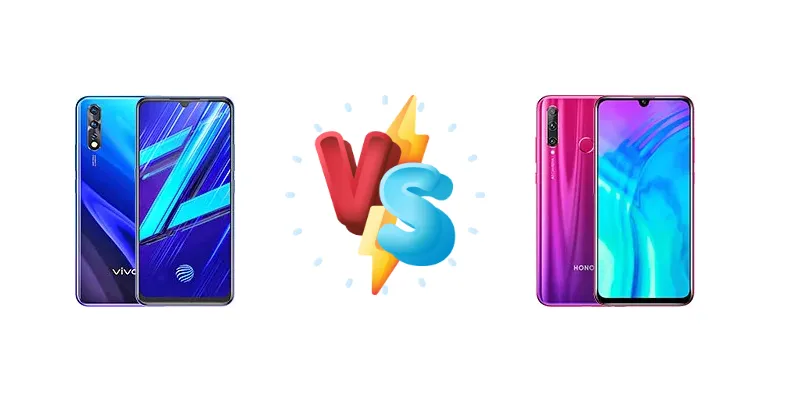
The vivo Z1x and Honor 20i represent a fascinating intersection in the mid-range smartphone market. Both devices aimed to deliver a compelling experience without breaking the bank, but they took different approaches to achieving that goal, primarily through their chipset choices. This comparison dissects the key differences between the Qualcomm Snapdragon 712-powered Z1x and the Kirin 710-equipped 20i, focusing on real-world impact for the user.
🏆 Quick Verdict
For the average user prioritizing performance and faster charging, the vivo Z1x emerges as the stronger contender. The Snapdragon 712’s more efficient 10nm process and superior CPU architecture translate to a smoother experience, especially in demanding tasks. While the Honor 20i offers a respectable experience, its slower charging and less powerful chipset hold it back.
| Network |
|---|
| 2G bands | GSM 850 / 900 / 1800 / 1900 | GSM 900 / 1800 / 1900 |
| 3G bands | HSDPA 850 / 900 / 2100 | HSDPA 850 / 900 / 2100 |
| 4G bands | 1, 3, 5, 8, 38, 40, 41 | 1, 3, 5, 8, 34, 38, 39, 40, 41 |
| Speed | HSPA, LTE | HSPA 42.2/5.76 Mbps, LTE Cat4 150/50 Mbps |
| Technology | GSM / HSPA / LTE | GSM / CDMA / HSPA / LTE |
| | - | CDMA 800 & TD-SCDMA |
| Launch |
|---|
| Announced | 2019, September. Released 2019, September | 2019, April. Released 2019, April |
| Status | Discontinued | Discontinued |
| Body |
|---|
| Build | Glass front, plastic back, plastic frame | - |
| Dimensions | 159.5 x 75.2 x 8.1 mm (6.28 x 2.96 x 0.32 in) | 154.8 x 73.6 x 8 mm (6.09 x 2.90 x 0.31 in) |
| SIM | Nano-SIM + Nano-SIM | Nano-SIM + Nano-SIM |
| Weight | 189.6 g (6.70 oz) | 164 g (5.78 oz) |
| Display |
|---|
| Resolution | 1080 x 2340 pixels, 19.5:9 ratio (~404 ppi density) | 1080 x 2340 pixels, 19.5:9 ratio (~415 ppi density) |
| Size | 6.38 inches, 99.9 cm2 (~83.3% screen-to-body ratio) | 6.21 inches, 94.7 cm2 (~83.1% screen-to-body ratio) |
| Type | Super AMOLED | IPS LCD |
| | Always-on display | - |
| Platform |
|---|
| CPU | Octa-core (2x2.3 GHz Kryo 360 Gold & 6x1.7 GHz Kryo 360 Silver) | Octa-core (4x2.2 GHz Cortex-A73 & 4x1.7 GHz Cortex-A53) |
| Chipset | Qualcomm SDM712 Snapdragon 712 (10 nm) | Kirin 710 (12 nm) |
| GPU | Adreno 616 | Mali-G51 MP4 |
| OS | Android 9.0 (Pie), upgradable to Android 10, Funtouch 10 | Android 9.0 (Pie), EMUI 9.1 |
| Memory |
|---|
| Card slot | No | microSDXC (uses shared SIM slot) |
| Internal | 64GB 6GB RAM, 128GB 4GB RAM, 128GB 6GB RAM, 128GB 8GB RAM | 64GB 6GB RAM, 128GB 4GB RAM, 128GB 6GB RAM, 256GB 6GB RAM |
| | UFS 2.1 | - |
| Main Camera |
|---|
| Features | LED flash, HDR, panorama | LED flash, HDR, panorama |
| Triple | 48 MP, f/1.8, (wide), 1/2.0", 0.8µm, PDAF
8 MP, f/2.2, 13mm (ultrawide)
Auxiliary lens | 24 MP, f/1.8, PDAF
8 MP, f/2.4, 13mm (ultrawide)
Auxiliary lens |
| Video | 4K@30fps, 1080p@30fps | 1080p@30/60fps |
| Selfie camera |
|---|
| Features | HDR | HDR |
| Single | 32 MP, f/2.0, 26mm (wide), 1/2.8", 0.8µm | 32 MP, f/2.0, 26mm (wide), 1/2.8", 0.8µm |
| Video | 1080p@30fps | 1080p@30fps |
| Sound |
|---|
| 3.5mm jack | Yes | Yes |
| 35mm jack | Yes | Yes |
| Loudspeaker | Yes | Yes |
| Comms |
|---|
| Bluetooth | 5.0, A2DP, LE, aptX | 4.2, A2DP, LE, aptX HD |
| NFC | No | No |
| Positioning | GPS, GLONASS | GPS, GLONASS, BDS |
| Radio | FM radio | FM radio |
| USB | USB Type-C 2.0, OTG | microUSB 2.0, OTG |
| WLAN | Wi-Fi 802.11 a/b/g/n/ac, dual-band, Wi-Fi Direct | Wi-Fi 802.11 a/b/g/n/ac, dual-band, Wi-Fi Direct |
| Features |
|---|
| Sensors | Fingerprint (under display, optical), accelerometer, proximity, compass | Fingerprint (rear-mounted), accelerometer, proximity, compass |
| Battery |
|---|
| Charging | 22.5W wired
5W reverse wired | 10W wired |
| Type | 4500 mAh, non-removable | Li-Po 3400 mAh, non-removable |
| Misc |
|---|
| Colors | Fusion Blue, Phantom Purple | Gradient Blue, Gradient red, Magic Night Black |
| Models | 1917, PD1921F_EX | HRY-TL00T, HRY-AL00TA, HRY-AL00Ta, HRY-AL00T |
| Price | About 220 EUR | About 210 EUR |
| SAR | 1.03 W/kg (head) 0.55 W/kg (body) | - |
vivo Z1x
- Faster Snapdragon 712 processor
- Significantly faster 22.5W charging
- 5W Reverse Wired Charging
- Brand recognition may be lower than Honor
- Detailed camera specs are unknown
Honor 20i
- Potentially more familiar software experience (Honor)
- May be available at a lower price point
- Established brand reputation
- Slower Kirin 710 processor
- Slow 10W charging
- Less efficient 12nm process
Display Comparison
Neither device boasts a standout display. Both likely feature LCD panels, common in this price bracket. However, detailed specs like resolution and refresh rate are missing. The focus here is on internal performance, not display fidelity. The absence of information prevents a detailed comparison of color accuracy or brightness.
Camera Comparison
Without detailed camera sensor information, a direct comparison is limited. Both phones likely feature multi-camera setups, but the quality will depend heavily on sensor size, aperture, and image processing algorithms. It’s reasonable to assume both include standard wide, ultrawide, and depth sensors, but the Z1x’s more powerful chipset could potentially enable more sophisticated image processing, leading to better low-light performance and dynamic range. The presence of a 2MP macro lens on either device is unlikely to significantly impact image quality.
Performance
The core difference lies in the chipsets. The vivo Z1x’s Snapdragon 712, built on a 10nm process, offers a clear advantage over the Honor 20i’s Kirin 710 (12nm). The Snapdragon 712’s Kryo 360 Gold cores, clocked at 2.3 GHz, provide a performance boost over the Kirin 710’s Cortex-A73 cores at 2.2 GHz. This translates to snappier app launches and smoother multitasking. The 10nm process also contributes to better thermal efficiency, reducing the likelihood of throttling during sustained workloads. While both are octa-core CPUs, the architectural differences favor the Snapdragon 712, particularly for gaming and demanding applications.
Battery Life
The vivo Z1x’s 22.5W wired charging is a significant advantage over the Honor 20i’s 10W charging. This means the Z1x can replenish its battery much faster, reducing downtime. While battery capacity isn’t specified, the faster charging speed effectively mitigates any potential disadvantage from a slightly smaller battery. The Z1x also includes 5W reverse wired charging, a feature absent on the Honor 20i, allowing it to top up other devices.
Buying Guide
Buy the vivo Z1x if you need a phone that can handle multitasking, moderate gaming, and benefits from significantly faster 22.5W charging. It’s ideal for users who frequently consume media and appreciate a responsive user interface. Buy the Honor 20i if you prioritize a slightly more established brand reputation and are willing to trade performance and charging speed for potential software familiarity, or if you find it at a substantially lower price point.
Frequently Asked Questions
❓ Will the Kirin 710 in the Honor 20i struggle with graphically intensive games like PUBG or Call of Duty?
The Kirin 710 is capable of running these games, but you’ll likely need to lower the graphics settings to achieve a smooth frame rate. The Snapdragon 712 in the vivo Z1x offers a more comfortable gaming experience with higher settings and less frame rate fluctuation due to its superior GPU and thermal efficiency.
❓ How long does it realistically take to fully charge the vivo Z1x from 0% to 100% with the 22.5W charger?
With the included 22.5W charger, the vivo Z1x should fully charge from 0% to 100% in approximately 1 hour and 15 minutes to 1 hour and 30 minutes, depending on background app activity. This is significantly faster than the Honor 20i, which will take over 3 hours with its 10W charger.
❓ Does the Snapdragon 712 in the vivo Z1x offer noticeable improvements in app loading times compared to the Kirin 710?
Yes, the Snapdragon 712’s more powerful CPU and optimized architecture result in noticeably faster app loading times. You’ll experience quicker transitions between apps and a more responsive overall user experience, especially when launching frequently used applications.