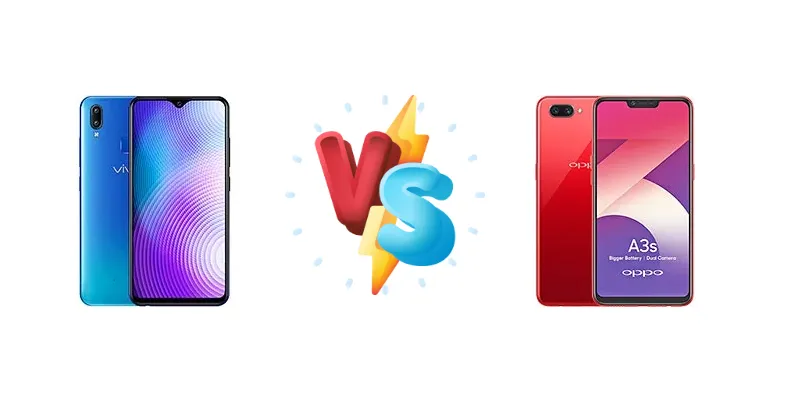
The vivo Y91i and Oppo A3s represent a common segment of the smartphone market: affordable devices aimed at first-time smartphone buyers or those seeking a reliable secondary device. Both rely on Qualcomm's Snapdragon 4-series chipsets, but subtle differences in their implementation and features can significantly impact the user experience. This comparison dives deep into those differences, focusing on performance, battery life, and charging capabilities.
🏆 Quick Verdict
For the average user prioritizing slightly better performance and a more efficient processor, the vivo Y91i emerges as the better choice. Its Snapdragon 439, built on a smaller 12nm process, offers a modest performance edge and potentially better thermal management compared to the Oppo A3s' Snapdragon 450. However, the Oppo A3s' 20W charging is a significant advantage.
| Network |
|---|
| 2G bands | GSM 850 / 900 / 1800 / 1900 | GSM 850 / 900 / 1800 / 1900 |
| 3G bands | HSDPA 850 / 900 / 2100 | HSDPA 850 / 900 / 2100 |
| 4G bands | 1, 3, 5, 8, 28, 38, 40, 41 | 1, 3, 5, 8, 38, 40, 41 |
| Speed | HSPA, LTE | HSPA 42.2/5.76 Mbps, LTE (2CA) Cat6 300/50 Mbps |
| Technology | GSM / HSPA / LTE | GSM / HSPA / LTE |
| Launch |
|---|
| Announced | 2018, November. Released 2018, November | 2018, July 13. Released 2018, July |
| Status | Discontinued | Discontinued |
| Body |
|---|
| Build | - | Glass front (Gorilla Glass 3), plastic back, plastic frame |
| Dimensions | 155.1 x 75.1 x 8.3 mm (6.11 x 2.96 x 0.33 in) | 156.2 x 75.6 x 8.2 mm (6.15 x 2.98 x 0.32 in) |
| SIM | Nano-SIM + Nano-SIM | Nano-SIM + Nano-SIM |
| Weight | 163.5 g (5.78 oz) | 168 g (5.93 oz) |
| Display |
|---|
| Protection | - | Corning Gorilla Glass 3 |
| Resolution | 720 x 1520 pixels, 19:9 ratio (~271 ppi density) | 720 x 1520 pixels, 19:9 ratio (~271 ppi density) |
| Size | 6.2 inches, 95.9 cm2 (~82.4% screen-to-body ratio) | 6.2 inches, 95.9 cm2 (~81.2% screen-to-body ratio) |
| Type | IPS LCD | IPS LCD |
| Platform |
|---|
| CPU | Octa-core (4x1.95 GHz Cortex-A53 & 4x1.45 GHz Cortex A53) | Octa-core 1.8 GHz Cortex-A53 |
| Chipset | Qualcomm SDM439 Snapdragon 439 (12 nm) | Qualcomm SDM450 Snapdragon 450 (14 nm) |
| GPU | Adreno 505 | Adreno 506 |
| OS | Android 8.1 (Oreo), Funtouch 4.5 | Android 8.1 (Oreo), ColorOS 5.1 |
| Memory |
|---|
| Card slot | microSDXC | microSDXC (dedicated slot) |
| Internal | 16GB 2GB RAM | 16GB 2GB RAM, 32GB 3GB RAM, 64GB 4GB RAM |
| | eMMC 5.1 | eMMC 5.1 |
| Main Camera |
|---|
| Dual | 13 MP, f/2.2, PDAF
Auxiliary lens | 13 MP, f/2.2, AF
Auxiliary lens |
| Features | LED flash, panorama | LED flash, HDR, panorama |
| Video | 1080p@30fps | 1080p@30fps |
| Selfie camera |
|---|
| Single | 8 MP, f/2.0 | 8 MP, f/2.2 |
| Video | - | 1080p@30fps |
| Sound |
|---|
| 3.5mm jack | Yes | Yes |
| 35mm jack | Yes | Yes |
| Loudspeaker | Yes | Yes |
| Comms |
|---|
| Bluetooth | 4.2, A2DP, LE | 4.2, A2DP, LE |
| NFC | No | No |
| Positioning | GPS, GLONASS, BDS | GPS |
| Radio | FM radio | FM radio |
| USB | microUSB 2.0, OTG | microUSB 2.0, OTG |
| WLAN | Wi-Fi 802.11 b/g/n, Wi-Fi Direct | Wi-Fi 802.11 b/g/n, Wi-Fi Direct |
| Features |
|---|
| Sensors | Fingerprint (rear-mounted), accelerometer, proximity, compass | Accelerometer, gyro, proximity, compass |
| Battery |
|---|
| Charging | - | 20W wired |
| Type | 4030 mAh, non-removable | Li-Ion 4230 mAh, non-removable |
| Misc |
|---|
| Colors | Starry Black, Ocean Blue, Red | Red, Dark Purple |
| Models | - | CPH1803, CPH1853, CPH1805 |
| Price | About 130 EUR | About 11000 INR |
vivo Y91i
- More efficient Snapdragon 439 processor
- Potentially better thermal management
- Slightly better performance in sustained tasks
- Likely slower charging speeds
- Unspecified battery capacity
Oppo A3s
- 20W fast charging
- Uniform CPU clock speed
- Potentially lower price point
- Less efficient Snapdragon 450 processor
- Larger 14nm process node
Display Comparison
Neither vivo nor Oppo provide detailed display specifications for these models. Given their price point, both likely utilize IPS LCD panels with 720p+ resolutions. The absence of detailed specs makes a direct comparison impossible, but it's reasonable to assume both displays prioritize affordability over color accuracy or peak brightness. Bezels are likely to be substantial on both devices, reflecting their budget nature.
Camera Comparison
Detailed camera specifications are scarce for both devices. It's safe to assume both feature a primary camera and potentially a depth sensor. Without sensor size or aperture information, a meaningful comparison is difficult. The inclusion of a 2MP depth sensor on either device is unlikely to significantly improve portrait mode quality. Image processing will likely be heavily reliant on software algorithms to enhance photos, and results will vary depending on lighting conditions. Users shouldn't expect flagship-level camera performance from either phone.
Performance
The core difference lies in the chipsets. The vivo Y91i features the Qualcomm Snapdragon 439 (12nm), an octa-core processor with a split core configuration – four cores clocked at 1.95 GHz and four at 1.45 GHz. The Oppo A3s utilizes the Snapdragon 450 (14nm), an octa-core processor running at a uniform 1.8 GHz. The 12nm process of the SD439 offers a theoretical advantage in power efficiency compared to the 14nm SD450. While the clock speeds suggest the SD450 might have a slight edge in raw processing power, the architectural improvements and smaller node size of the SD439 likely translate to a smoother experience during sustained tasks. Both phones will handle basic multitasking and app usage adequately, but demanding games will require significant graphical settings reductions.
Battery Life
Battery capacity is not specified for either device. However, given their target market, both likely house batteries in the 3000-4000 mAh range. The Oppo A3s boasts 20W wired charging, a significant advantage over the likely slower charging speeds of the vivo Y91i. This means the A3s can replenish its battery much faster, a crucial benefit for users who frequently need to top up their charge. The more efficient Snapdragon 439 in the Y91i *could* translate to slightly longer battery life during typical usage, but the 20W charging of the A3s offers a compelling trade-off.
Buying Guide
Buy the vivo Y91i if you need a phone for everyday tasks like social media, messaging, and light web browsing, and value a slightly more efficient processor for potentially longer battery life. Buy the Oppo A3s if fast charging is a top priority, and you frequently find yourself needing to quickly top up your battery, even if it means a slightly less efficient chipset.
Frequently Asked Questions
❓ Will the Snapdragon 439 in the vivo Y91i handle popular games like PUBG Mobile?
PUBG Mobile is playable on the vivo Y91i, but you'll need to significantly lower the graphics settings to achieve a smooth frame rate. The Snapdragon 439 isn't a gaming powerhouse, so expect compromises in visual fidelity. The Oppo A3s will offer a similar gaming experience.
❓ How long does it take to fully charge the Oppo A3s with its 20W charging?
While a precise 0-100% charging time isn't officially specified, the 20W charging on the Oppo A3s should fully charge the battery in approximately 1.5 to 2 hours, depending on battery capacity. This is considerably faster than the likely charging time of the vivo Y91i.
❓ Is the difference between the 12nm and 14nm process nodes noticeable in everyday use?
The difference isn't dramatically noticeable in short bursts of usage. However, over extended periods, the 12nm Snapdragon 439 in the vivo Y91i should exhibit better power efficiency, potentially leading to slightly longer battery life during prolonged tasks like video streaming or navigation.