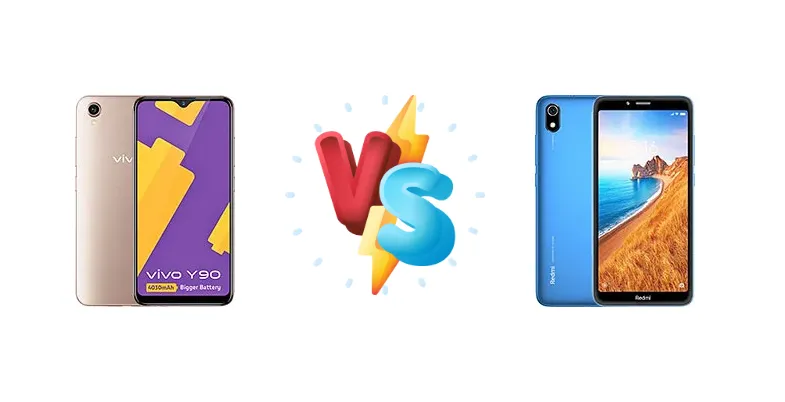
The sub-$150 smartphone market is fiercely competitive. Both the Xiaomi Redmi 7A and the vivo Y90 aim to deliver essential smartphone functionality at an incredibly affordable price. However, they take different approaches to achieving this, primarily through their choice of chipset. This comparison dissects the key differences between the Qualcomm Snapdragon 439 and the MediaTek Helio A22 to determine which device offers the best experience for the money.
🏆 Quick Verdict
For the average user prioritizing multitasking and a smoother overall experience, the Xiaomi Redmi 7A is the better choice. Its octa-core Snapdragon 439 provides a significant performance advantage over the quad-core Helio A22 in the vivo Y90, making it more capable of handling everyday tasks and light gaming. While the Y90 is functional, the Redmi 7A offers a more responsive user experience.
| Network |
|---|
| 2G bands | GSM 850 / 900 / 1800 / 1900 | GSM 850 / 900 / 1800 / 1900 |
| 3G bands | HSDPA 850 / 900 / 2100 | HSDPA 850 / 900 / 1900 / 2100 |
| 4G bands | 1, 3, 5, 8, 38, 40, 41 | 1, 2, 3, 4, 5, 7, 8, 20, 38, 40 - Global |
| Speed | HSPA 42.2/5.76 Mbps, LTE Cat4 150/50 Mbps | HSPA, LTE |
| Technology | GSM / HSPA / LTE | GSM / HSPA / LTE |
| | - | 1, 3, 5, 8, 34, 38, 39, 40, 41 - China |
| Launch |
|---|
| Announced | 2019, July. Released 2019, July | 2019, May 24. Released 2019, July 04 |
| Status | Discontinued | Discontinued |
| Body |
|---|
| Build | Glass front, plastic back, plastic frame | Glass front, plastic back, plastic frame |
| Dimensions | 155.1 x 75.1 x 8.3 mm (6.11 x 2.96 x 0.33 in) | 146.3 x 70.4 x 9.6 mm (5.76 x 2.77 x 0.38 in) |
| SIM | Nano-SIM + Nano-SIM | Nano-SIM + Nano-SIM |
| Weight | 163.5 g (5.78 oz) | 165 g (5.82 oz) |
| | - | Splash resistant |
| Display |
|---|
| Resolution | 720 x 1520 pixels, 19:9 ratio (~270 ppi density) | 720 x 1440 pixels, 18:9 ratio (~295 ppi density) |
| Size | 6.22 inches, 96.6 cm2 (~82.9% screen-to-body ratio) | 5.45 inches, 76.7 cm2 (~74.4% screen-to-body ratio) |
| Type | IPS LCD | IPS LCD |
| Platform |
|---|
| CPU | Quad-core 2.0 GHz Cortex-A53 | Octa-core (4x1.95 GHz Cortex-A53 & 4x1.45 GHz Cortex A53) |
| Chipset | Mediatek MT6761 Helio A22 (12 nm) | Qualcomm SDM439 Snapdragon 439 (12 nm) |
| GPU | PowerVR GE8320 | Adreno 505 |
| OS | Android 8.1 (Oreo), Funtouch 4.5 | Android 9.0 (Pie), upgradable to Android 10, MIUI 12 |
| Memory |
|---|
| Card slot | microSDXC (dedicated slot) | microSDXC (dedicated slot) |
| Internal | 16GB 2GB RAM, 32GB 2GB RAM | 16GB 2GB RAM, 32GB 2GB RAM, 32GB 3GB RAM |
| | eMMC 5.1 | eMMC 5.1 |
| Main Camera |
|---|
| Features | LED flash, panorama | LED flash, HDR |
| Single | 8 MP, f/2.0, AF | 13 MP, f/2.2, 1/3.1", 1.12µm, PDAF - China
or
12 MP, f/2.2, 1/2.9", 1.25µm, PDAF - Global, India |
| Video | 1080p@30fps | 1080p@30fps |
| Selfie camera |
|---|
| Features | - | HDR |
| Single | 5 MP, f/1.8 | 5 MP, f/2.2, 1/5.0", 1.12µm |
| Video | 720p | 1080p@30fps |
| Sound |
|---|
| 3.5mm jack | Yes | Yes |
| 35mm jack | Yes | Yes |
| Loudspeaker | Yes | Yes |
| Comms |
|---|
| Bluetooth | 5.0, A2DP, LE | 4.2, A2DP, LE |
| NFC | No | No |
| Positioning | GPS, GLONASS, GALILEO | GPS, GLONASS, BDS |
| Radio | FM radio | FM Radio, built-in antenna |
| USB | microUSB 2.0, OTG | microUSB 2.0, OTG |
| WLAN | Wi-Fi 802.11 b/g/n, Wi-Fi Direct | Wi-Fi 802.11 b/g/n, Wi-Fi Direct |
| Features |
|---|
| Sensors | Accelerometer, proximity, compass | Accelerometer, proximity, compass |
| Battery |
|---|
| Charging | - | 10W wired |
| Type | 4030 mAh, non-removable | Li-Po 4000 mAh, non-removable |
| Misc |
|---|
| Colors | Black, Gold | Matte Black, Morning blue, Matte Blue, Matte Gold, Gem Red, Gem Blue |
| Models | 1908, 1823 | MZB7995IN, M1903C3EG, M1903C3EH, M1903C3EI |
| Price | About 90 EUR | About 130 EUR |
| SAR | 1.28 W/kg (head) 0.61 W/kg (body) | 1.00 W/kg (head) 1.12 W/kg (body) |
| SAR EU | - | 0.56 W/kg (head) 1.17 W/kg (body) |
vivo Y90
- Octa-core Snapdragon 439 offers superior performance.
- Better multitasking capabilities.
- Potentially slightly better image processing.
- Display specs are basic.
- Camera performance is likely limited.
Xiaomi Redmi 7A
- Extremely affordable.
- Simple and easy to use.
- Suitable for basic smartphone tasks.
- Quad-core Helio A22 struggles with multitasking.
- Slower overall performance.
- Limited gaming capabilities.
Display Comparison
Neither device boasts a particularly impressive display. Both likely utilize LCD panels, common in this price bracket. However, detailed display specs like resolution and brightness are unavailable. The focus here is on performance, not visual fidelity. Bezels are expected to be substantial on both, maximizing screen real estate within their budget constraints. Color accuracy is likely to be standard for the segment, prioritizing power efficiency over color calibration.
Camera Comparison
Camera performance is expected to be basic on both devices. Detailed sensor information is unavailable, but both likely feature a primary camera and potentially a secondary depth sensor. Image processing will be limited, and low-light performance will be subpar. The Redmi 7A’s Snapdragon 439 may offer slightly better image signal processing capabilities, potentially resulting in marginally improved image quality, but the difference will likely be minimal. Focusing on the primary sensor resolution would be more impactful than analyzing the presence of low-resolution auxiliary lenses.
Performance
The core difference lies in the chipset. The Xiaomi Redmi 7A’s Qualcomm Snapdragon 439 is an octa-core processor, featuring four Cortex-A53 cores clocked at 1.95 GHz and another four at 1.45 GHz. This configuration allows for more efficient multitasking and better performance in demanding applications compared to the vivo Y90’s MediaTek Helio A22. The Y90 utilizes a quad-core Cortex-A53 processor clocked at 2.0 GHz. While the per-core clock speed is slightly higher, the lack of additional cores significantly limits its ability to handle multiple processes concurrently. The Snapdragon 439’s architecture is better suited for sustained workloads, resulting in a smoother user experience. Thermal management is unlikely to be a major concern on either device given the relatively low power draw of these chipsets.
Battery Life
Battery capacity details are missing for both devices. However, given their target market, both likely feature batteries in the 3000-4000 mAh range. The Redmi 7A includes 10W wired charging, which is standard for this price point. The Y90’s charging capabilities are unknown, but are likely similar. Real-world battery life will depend heavily on usage patterns, but the Snapdragon 439’s more efficient architecture could translate to slightly longer battery life on the Redmi 7A, even with a similar capacity battery.
Buying Guide
Buy the vivo Y90 if you need a basic smartphone for calls, texts, and very light app usage, and prioritize simplicity above all else. It's a suitable option for first-time smartphone users or those on an extremely tight budget. Buy the Xiaomi Redmi 7A if you prefer a phone that can handle more demanding tasks like social media browsing, occasional gaming, and running multiple apps simultaneously. The Redmi 7A offers a noticeable performance boost for a minimal price increase.
Frequently Asked Questions
❓ Will the Redmi 7A handle popular social media apps like Facebook and Instagram smoothly?
Yes, the Snapdragon 439 in the Redmi 7A is capable of running social media apps like Facebook and Instagram without significant lag. The octa-core processor and adequate RAM (spec not provided, but likely 2-3GB) will provide a reasonably smooth experience, even with multiple apps open.
❓ Is the vivo Y90 suitable for playing mobile games like PUBG Mobile or Call of Duty?
The vivo Y90’s Helio A22 chipset is not well-suited for demanding games like PUBG Mobile or Call of Duty. While you might be able to run them at the lowest settings, expect significant frame rate drops and a generally poor gaming experience. The Redmi 7A offers a slightly better gaming experience, but still isn't ideal for these titles.
❓ How much storage does each phone offer, and can it be expanded?
Storage details are missing, but both phones likely come with 16GB or 32GB of internal storage. Crucially, both devices almost certainly support microSD card expansion, allowing you to add more storage for photos, videos, and apps. This is essential given the limited internal storage options.
❓ Which phone is more likely to receive software updates?
Xiaomi generally provides more frequent software updates and security patches for its devices compared to vivo, particularly in the budget segment. While neither phone is guaranteed long-term support, the Redmi 7A is more likely to receive updates that improve performance and security.