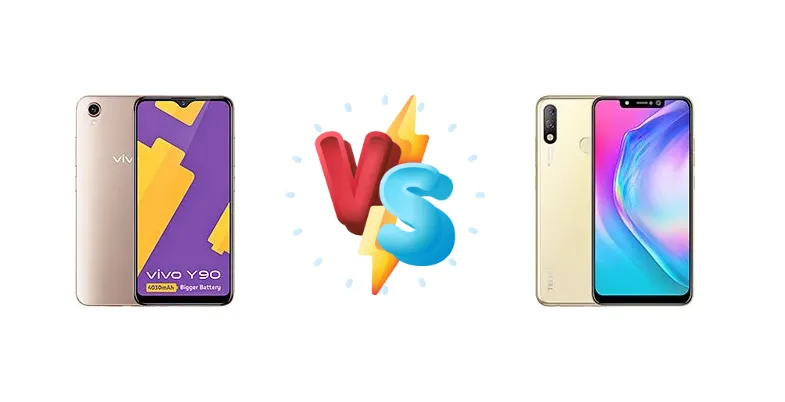
The vivo Y90 and Tecno Spark 3 Pro represent the ultra-budget end of the smartphone spectrum, both relying on MediaTek’s Helio A22 chipset. This comparison isn’t about flagship features; it’s about maximizing value for users needing basic smartphone functionality. We’ll dissect their similarities and differences to determine which offers the best experience for the price.
🏆 Quick Verdict
For the average user prioritizing a slightly more established brand and potentially better software support, the vivo Y90 edges out the Tecno Spark 3 Pro. Both phones offer identical core performance due to the shared Helio A22 chipset, but vivo’s brand recognition and potential for more consistent updates give it a slight advantage.
| Network |
|---|
| 2G bands | GSM 850 / 900 / 1800 / 1900 | GSM 850 / 900 / 1800 / 1900 |
| 3G bands | HSDPA 850 / 900 / 2100 | HSDPA 850 / 900 / 2100 |
| 4G bands | 1, 3, 5, 8, 38, 40, 41 | 1, 3, 5, 8, 38, 40, 41 |
| Speed | HSPA 42.2/5.76 Mbps, LTE Cat4 150/50 Mbps | HSPA 42.2/5.76 Mbps, LTE Cat4 150/50 Mbps |
| Technology | GSM / HSPA / LTE | GSM / HSPA / LTE |
| | - | 3, 7, 20 |
| Launch |
|---|
| Announced | 2019, July. Released 2019, July | 2019, April. Released 2019, April |
| Status | Discontinued | Discontinued |
| Body |
|---|
| Build | Glass front, plastic back, plastic frame | - |
| Dimensions | 155.1 x 75.1 x 8.3 mm (6.11 x 2.96 x 0.33 in) | 154.3 x 75.5 x 7.9 mm (6.07 x 2.97 x 0.31 in) |
| SIM | Nano-SIM + Nano-SIM | Nano-SIM + Nano-SIM |
| Weight | 163.5 g (5.78 oz) | - |
| Display |
|---|
| Resolution | 720 x 1520 pixels, 19:9 ratio (~270 ppi density) | 720 x 1500 pixels (~268 ppi density) |
| Size | 6.22 inches, 96.6 cm2 (~82.9% screen-to-body ratio) | 6.2 inches, 96.7 cm2 (~83.0% screen-to-body ratio) |
| Type | IPS LCD | IPS LCD |
| Platform |
|---|
| CPU | Quad-core 2.0 GHz Cortex-A53 | Quad-core 2.0 GHz Cortex-A53 |
| Chipset | Mediatek MT6761 Helio A22 (12 nm) | Mediatek MT6761 Helio A22 (12 nm) |
| GPU | PowerVR GE8320 | PowerVR GE8320 |
| OS | Android 8.1 (Oreo), Funtouch 4.5 | Android 9.0 (Pie) |
| Memory |
|---|
| Card slot | microSDXC (dedicated slot) | microSD |
| Internal | 16GB 2GB RAM, 32GB 2GB RAM | 32GB 2GB RAM |
| | eMMC 5.1 | eMMC 5.1 |
| Main Camera |
|---|
| Dual | - | 13 MP, AF
2 MP |
| Features | LED flash, panorama | Dual-LED flash |
| Single | 8 MP, f/2.0, AF | - |
| Video | 1080p@30fps | 1080p@30fps |
| Selfie camera |
|---|
| Features | - | LED flash |
| Single | 5 MP, f/1.8 | 8 MP |
| Video | 720p | 1080p@30fps |
| Sound |
|---|
| 3.5mm jack | Yes | Yes |
| 35mm jack | Yes | Yes |
| Loudspeaker | Yes | Yes |
| Comms |
|---|
| Bluetooth | 5.0, A2DP, LE | 5.0, A2DP, LE |
| NFC | No | No |
| Positioning | GPS, GLONASS, GALILEO | GPS |
| Radio | FM radio | FM radio |
| USB | microUSB 2.0, OTG | microUSB 2.0, OTG |
| WLAN | Wi-Fi 802.11 b/g/n, Wi-Fi Direct | Wi-Fi 802.11 b/g/n |
| Features |
|---|
| Sensors | Accelerometer, proximity, compass | Fingerprint (rear-mounted), accelerometer, proximity |
| Battery |
|---|
| Type | 4030 mAh, non-removable | Li-Ion 3500 mAh, non-removable |
| Misc |
|---|
| Colors | Black, Gold | Midnight Black, Champagne Gold, Nebula Black |
| Models | 1908, 1823 | - |
| Price | About 90 EUR | - |
| SAR | 1.28 W/kg (head) 0.61 W/kg (body) | - |
vivo Y90
- Established brand reputation (vivo)
- Potential for more consistent software updates
- Likely better resale value
- May be slightly more expensive than the Tecno Spark 3 Pro
- Performance is limited by the Helio A22 chipset
Tecno Spark 3 Pro
- Potentially lower price point
- May offer slightly larger battery capacity (unconfirmed)
- Aggressive marketing and promotions
- Less established brand reputation (Tecno)
- Potentially less frequent software updates
- Lower resale value
Display Comparison
Both the vivo Y90 and Tecno Spark 3 Pro utilize displays that prioritize cost-effectiveness over cutting-edge technology. Given the shared target market, it’s highly probable both feature similar LCD panels with resolutions around 720x1440 pixels. Without specific brightness data, it’s reasonable to assume both displays will struggle in direct sunlight. Color accuracy is likely to be standard for this price range, meaning they won’t be ideal for color-critical work. The display experience will largely be defined by the software optimizations, which may differ between the two brands.
Camera Comparison
Camera performance on both devices will be limited by the Helio A22’s image signal processor (ISP). While both may feature multiple rear cameras, the primary sensor is the most critical. Without specific sensor details, it’s likely both utilize a basic 8MP or 13MP sensor. Any additional cameras (often 2MP depth or macro sensors) are primarily for marketing and offer limited practical benefit. Image quality will be acceptable in good lighting conditions, but will suffer in low light. Expect limited dynamic range and detail. The software processing will play a significant role in the final image quality, and this is where differences may emerge between the two brands.
Performance
The core of both devices is the MediaTek MT6761 Helio A22, a quad-core processor clocked at 2.0 GHz using Cortex-A53 cores. This chipset is designed for basic tasks like calling, texting, and light social media browsing. The identical CPU and chipset mean performance will be virtually indistinguishable in everyday use. Both phones will likely be paired with 2GB or 3GB of RAM, which is sufficient for running Android Go Edition smoothly, but will struggle with multitasking or demanding applications. Thermal management shouldn’t be a concern given the low power draw of the Helio A22.
Battery Life
Battery life will be a key strength of both devices, thanks to the power efficiency of the Helio A22. While specific battery capacities are unknown, both are likely to feature batteries in the 3000mAh to 4000mAh range. Given the low power consumption of the chipset and the basic displays, users can expect all-day battery life with moderate usage. Charging speeds will likely be slow, utilizing standard 5W or 10W chargers. Expect a full charge to take several hours.
Buying Guide
Buy the vivo Y90 if you need a reliable, basic smartphone from a well-known brand and value potential long-term software support, even if minimal. Buy the Tecno Spark 3 Pro if you prioritize maximizing value and are comfortable with a less established brand, potentially finding it at a lower price point. Both are suitable for first-time smartphone users or those needing a secondary device for calls and basic tasks.
Frequently Asked Questions
❓ Will the Helio A22 struggle with popular apps like WhatsApp and Facebook?
While the Helio A22 isn't a powerhouse, it's capable of running apps like WhatsApp and Facebook smoothly. However, running multiple apps simultaneously or using more demanding features within these apps may result in slowdowns. Android Go Edition, likely pre-installed on both devices, is optimized for low-RAM phones and will help mitigate these issues.
❓ Can I play games like PUBG Mobile on either of these phones?
PUBG Mobile is unlikely to be a playable experience on either the vivo Y90 or Tecno Spark 3 Pro. The Helio A22 lacks the graphical processing power to run the game at acceptable frame rates, even on the lowest settings. You may be able to play simpler 2D games, but don't expect a good gaming experience.
❓ What version of Android do these phones run?
Both devices are highly likely to ship with Android Go Edition, a lightweight version of Android designed for phones with limited RAM and storage. This ensures a smoother experience on the Helio A22 chipset. Expect a relatively basic Android experience with pre-installed Google apps optimized for low-end hardware.