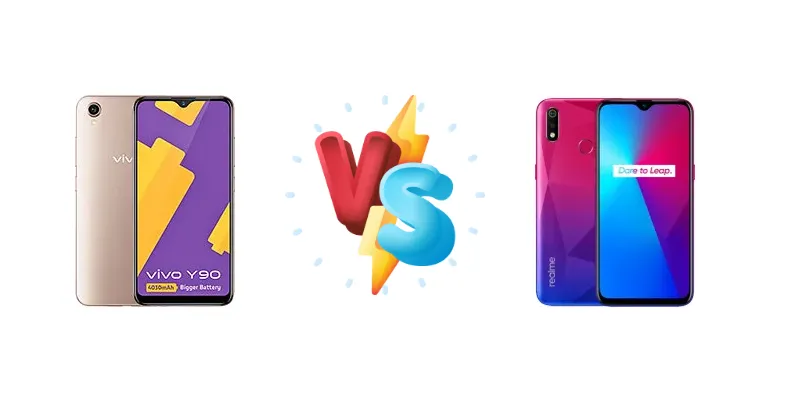
The sub-$150 smartphone market is fiercely competitive. Both the vivo Y90 and Realme 3i aim to deliver essential smartphone functionality at an accessible price point. However, a significant difference in their core processing power dictates which phone is better suited for different user needs. This comparison will dissect the key specifications to determine which device offers the best value.
🏆 Quick Verdict
For most users, the Realme 3i is the superior choice. Its Helio P60 chipset, featuring a more powerful octa-core CPU, provides a noticeably smoother experience for multitasking and gaming compared to the vivo Y90’s Helio A22. While both offer similar battery capacity, the Realme 3i’s 10W charging is a slight advantage.
| Network |
|---|
| 2G bands | GSM 850 / 900 / 1800 / 1900 | GSM 850 / 900 / 1800 / 1900 |
| 3G bands | HSDPA 850 / 900 / 2100 | HSDPA 850 / 900 / 2100 |
| 4G bands | 1, 3, 5, 8, 38, 40, 41 | 1, 3, 5, 8, 38, 40, 41 |
| Speed | HSPA 42.2/5.76 Mbps, LTE Cat4 150/50 Mbps | HSPA 42.2/5.76 Mbps, LTE (2CA) Cat12 600/50 Mbps |
| Technology | GSM / HSPA / LTE | GSM / HSPA / LTE |
| Launch |
|---|
| Announced | 2019, July. Released 2019, July | 2019, July. Released 2019, July |
| Status | Discontinued | Discontinued |
| Body |
|---|
| Build | Glass front, plastic back, plastic frame | Glass front (Gorilla Glass 3), plastic back, plastic frame |
| Dimensions | 155.1 x 75.1 x 8.3 mm (6.11 x 2.96 x 0.33 in) | 156.1 x 75.6 x 8.3 mm (6.15 x 2.98 x 0.33 in) |
| SIM | Nano-SIM + Nano-SIM | Nano-SIM + Nano-SIM |
| Weight | 163.5 g (5.78 oz) | 175 g (6.17 oz) |
| Display |
|---|
| Protection | - | Corning Gorilla Glass 3 |
| Resolution | 720 x 1520 pixels, 19:9 ratio (~270 ppi density) | 720 x 1520 pixels, 19:9 ratio (~271 ppi density) |
| Size | 6.22 inches, 96.6 cm2 (~82.9% screen-to-body ratio) | 6.2 inches, 95.9 cm2 (~81.3% screen-to-body ratio) |
| Type | IPS LCD | IPS LCD |
| Platform |
|---|
| CPU | Quad-core 2.0 GHz Cortex-A53 | Octa-core (4x2.0 GHz Cortex-A73 & 4x2.0 GHz Cortex-A53) |
| Chipset | Mediatek MT6761 Helio A22 (12 nm) | Mediatek MT6771 Helio P60 (12 nm) |
| GPU | PowerVR GE8320 | Mali-G72 MP3 |
| OS | Android 8.1 (Oreo), Funtouch 4.5 | Android 9.0 (Pie), upgradable to Android 10, Realme UI |
| Memory |
|---|
| Card slot | microSDXC (dedicated slot) | microSDXC (dedicated slot) |
| Internal | 16GB 2GB RAM, 32GB 2GB RAM | 32GB 3GB RAM, 64GB 4GB RAM |
| | eMMC 5.1 | eMMC 5.1 |
| Main Camera |
|---|
| Dual | - | 13 MP, f/1.8, 1/3.1", 1.12µm, PDAF
Auxiliary lens |
| Features | LED flash, panorama | LED flash, HDR |
| Single | 8 MP, f/2.0, AF | - |
| Video | 1080p@30fps | 1080p@30fps |
| Selfie camera |
|---|
| Features | - | HDR |
| Single | 5 MP, f/1.8 | 13 MP, f/2.0, (wide), 1/3.1", 1.12µm |
| Video | 720p | 1080p@30fps |
| Sound |
|---|
| 3.5mm jack | Yes | Yes |
| 35mm jack | Yes | Yes |
| Loudspeaker | Yes | Yes |
| Comms |
|---|
| Bluetooth | 5.0, A2DP, LE | 4.2, A2DP, LE |
| NFC | No | No |
| Positioning | GPS, GLONASS, GALILEO | GPS, GLONASS |
| Radio | FM radio | FM radio |
| USB | microUSB 2.0, OTG | microUSB 2.0, OTG |
| WLAN | Wi-Fi 802.11 b/g/n, Wi-Fi Direct | Wi-Fi 802.11 b/g/n |
| Features |
|---|
| Sensors | Accelerometer, proximity, compass | Fingerprint (rear-mounted), accelerometer, proximity |
| Battery |
|---|
| Charging | - | 10W wired |
| Type | 4030 mAh, non-removable | 4230 mAh, non-removable |
| Misc |
|---|
| Colors | Black, Gold | Diamond Blue, Diamond Red, Diamond Black |
| Models | 1908, 1823 | RMX1827 |
| Price | About 90 EUR | About 8000 INR |
| SAR | 1.28 W/kg (head) 0.61 W/kg (body) | - |
vivo Y90
- Potentially lower price point
- Simple and easy-to-use interface
- Likely lightweight design
- Significantly weaker processor
- Poor performance for multitasking
- Limited gaming capabilities
Realme 3i
- More powerful Helio P60 chipset
- Better multitasking and gaming performance
- 10W wired charging for faster top-ups
- May be slightly more expensive
- Potentially larger and heavier design
- Software experience may include more bloatware
Display Comparison
Neither device boasts a standout display. Both likely utilize LCD panels, common in this price bracket. Specifics like resolution and brightness are not provided, but we can assume they are similar – likely 720p+ resolution. The focus here isn’t on visual fidelity, but on basic usability. Bezels are likely to be substantial on both devices, maximizing screen real estate within a budget.
Camera Comparison
Without detailed camera specifications, a direct comparison is difficult. However, it’s safe to assume both phones feature basic camera setups. The Realme 3i likely benefits from the more powerful ISP (Image Signal Processor) within the Helio P60, potentially leading to better image processing and low-light performance. The presence of a 10W charger on the Realme 3i suggests a slightly more refined overall experience, potentially extending to camera software features.
Performance
The Realme 3i’s Mediatek Helio P60 is the clear winner here. Its octa-core configuration (4x2.0 GHz Cortex-A73 & 4x2.0 GHz Cortex-A53) offers a substantial performance uplift over the vivo Y90’s quad-core 2.0 GHz Cortex-A53 Helio A22. The P60’s Cortex-A73 cores provide significantly better single-core performance, crucial for app launch speeds and responsiveness. The A22 is adequate for basic tasks, but will struggle with demanding applications. The P60 also includes a more capable GPU, making it the better choice for casual gaming.
Battery Life
Both devices likely feature similar battery capacities, typical for this segment (around 4000-5000 mAh). However, the Realme 3i’s inclusion of 10W wired charging provides a tangible advantage. While not fast charging by modern standards, it’s faster than the charging speeds typically found on devices in the Y90’s class. This translates to less downtime and quicker top-ups when needed.
Buying Guide
Buy the vivo Y90 if you prioritize absolute simplicity and minimal app usage – it’s suitable for basic communication and light tasks. Buy the Realme 3i if you want a phone capable of handling social media, moderate gaming, and multitasking without significant lag. The Realme 3i is the better option for anyone who doesn’t want to be frustrated by a slow phone.
Frequently Asked Questions
❓ Will the Realme 3i handle popular games like PUBG Mobile or Call of Duty?
The Realme 3i’s Helio P60 chipset can run PUBG Mobile and Call of Duty, but likely at lower graphics settings (Medium or Low) to maintain a playable frame rate. Expect some occasional stuttering during intense moments. The vivo Y90’s Helio A22 would struggle significantly with these titles.
❓ Is the difference in performance between the Helio P60 and Helio A22 noticeable in everyday use?
Yes, the difference is very noticeable. The Helio P60 allows for smoother app switching, faster web browsing, and a more responsive overall experience. The Helio A22 will feel sluggish when running multiple apps or demanding websites. This difference is particularly apparent when opening apps or switching between them.
❓ Does the Realme 3i support fast charging beyond the 10W standard?
No, the Realme 3i is limited to 10W wired charging. While not the fastest charging available, it's still a step up from the slower charging speeds often found in this price range. Expect a full charge to take around 2-3 hours.