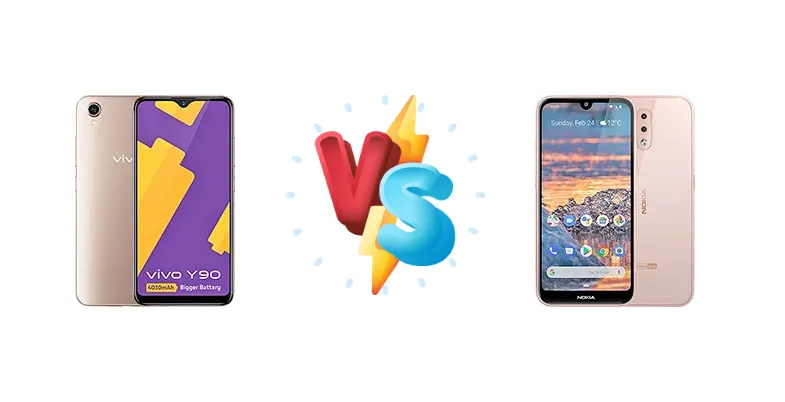
The vivo Y90 and Nokia 4.2 represent the lower end of the Android smartphone market, targeting users prioritizing affordability. However, beneath the similar price points lie significant differences in processing power, stemming from their respective chipsets. This comparison dives deep into the Mediatek Helio A22 powering the vivo Y90 and the Qualcomm Snapdragon 439 in the Nokia 4.2, revealing which phone delivers a smoother user experience.
🏆 Quick Verdict
For the average user, the Nokia 4.2 emerges as the better choice. Its Snapdragon 439, with its octa-core configuration, provides a noticeable performance advantage over the vivo Y90’s quad-core Helio A22, translating to faster app loading times and improved multitasking capabilities. While both phones are entry-level, the Nokia 4.2 offers a more responsive experience.
| Network |
|---|
| 2G bands | GSM 850 / 900 / 1800 / 1900 | GSM 850 / 900 / 1800 / 1900 |
| 3G bands | HSDPA 850 / 900 / 2100 | HSDPA 850 / 900 / 2100 - Global |
| 4G bands | 1, 3, 5, 8, 38, 40, 41 | 1, 3, 5, 7, 8, 20, 28, 38, 40, 41 - EMEA, APAC, MENA |
| Speed | HSPA 42.2/5.76 Mbps, LTE Cat4 150/50 Mbps | HSPA 42.2/5.76 Mbps, LTE Cat4 150/50 Mbps |
| Technology | GSM / HSPA / LTE | GSM / HSPA / LTE |
| | - | 1, 3, 5, 8, 40, 41 - India |
| Launch |
|---|
| Announced | 2019, July. Released 2019, July | 2019, February 24. Released 2019, May 07 |
| Status | Discontinued | Discontinued |
| Body |
|---|
| Build | Glass front, plastic back, plastic frame | Glass front, glass back, plastic frame |
| Dimensions | 155.1 x 75.1 x 8.3 mm (6.11 x 2.96 x 0.33 in) | 149 x 71.3 x 8.4 mm (5.87 x 2.81 x 0.33 in) |
| SIM | Nano-SIM + Nano-SIM | Nano-SIM + Nano-SIM |
| Weight | 163.5 g (5.78 oz) | 161 g (5.68 oz) |
| Display |
|---|
| Resolution | 720 x 1520 pixels, 19:9 ratio (~270 ppi density) | 720 x 1520 pixels, 19:9 ratio (~295 ppi density) |
| Size | 6.22 inches, 96.6 cm2 (~82.9% screen-to-body ratio) | 5.71 inches, 81.4 cm2 (~76.6% screen-to-body ratio) |
| Type | IPS LCD | IPS LCD |
| Platform |
|---|
| CPU | Quad-core 2.0 GHz Cortex-A53 | Octa-core (4x1.95 GHz Cortex-A53 & 4x1.45 GHz Cortex A53) |
| Chipset | Mediatek MT6761 Helio A22 (12 nm) | Qualcomm SDM439 Snapdragon 439 (12 nm) |
| GPU | PowerVR GE8320 | Adreno 505 |
| OS | Android 8.1 (Oreo), Funtouch 4.5 | Android 9.0 (Pie), upgradable to Android 11, Android One |
| Memory |
|---|
| Card slot | microSDXC (dedicated slot) | microSDXC (dedicated slot) |
| Internal | 16GB 2GB RAM, 32GB 2GB RAM | 16GB 2GB RAM, 32GB 3GB RAM |
| | eMMC 5.1 | eMMC 5.1 |
| Main Camera |
|---|
| Dual | - | 13 MP, f/2.2, 1/3.1", 1.12µm, PDAF
Auxiliary lens |
| Features | LED flash, panorama | LED flash |
| Single | 8 MP, f/2.0, AF | - |
| Video | 1080p@30fps | 1080p@30fps |
| Selfie camera |
|---|
| Single | 5 MP, f/1.8 | 8 MP, f/2.0, 1/4.0", 1.12µm |
| Video | 720p | 1080p@30fps |
| Sound |
|---|
| 3.5mm jack | Yes | Yes |
| 35mm jack | Yes | Yes |
| Loudspeaker | Yes | Yes |
| Comms |
|---|
| Bluetooth | 5.0, A2DP, LE | 4.2, A2DP, LE, aptX |
| NFC | No | Yes (market dependent) |
| Positioning | GPS, GLONASS, GALILEO | GPS, GLONASS, BDS |
| Radio | FM radio | FM radio |
| USB | microUSB 2.0, OTG | microUSB 2.0, OTG |
| WLAN | Wi-Fi 802.11 b/g/n, Wi-Fi Direct | Wi-Fi 802.11 b/g/n |
| Features |
|---|
| Sensors | Accelerometer, proximity, compass | Fingerprint (rear-mounted), accelerometer, proximity |
| Battery |
|---|
| Type | 4030 mAh, non-removable | Li-Ion 3000 mAh, non-removable |
| Misc |
|---|
| Colors | Black, Gold | Black, Pink Sand |
| Models | 1908, 1823 | TA-1184, TA-1133, TA-1149, TA-1150, TA-1157, TA-1152 |
| Price | About 90 EUR | About 130 EUR |
| SAR | 1.28 W/kg (head) 0.61 W/kg (body) | 0.43 W/kg (head) 1.08 W/kg (body) |
| SAR EU | - | 0.45 W/kg (head) 1.53 W/kg (body) |
vivo Y90
- Potentially longer battery life under light use
- Lower price point (likely)
- Simple and straightforward user experience
- Significantly slower performance
- Struggles with multitasking
- Less responsive user interface
Nokia 4.2
- Faster and more responsive performance
- Better multitasking capabilities
- Improved gaming experience (for casual games)
- Potentially shorter battery life under heavy use
- May be slightly more expensive
- More complex software features (potentially)
Display Comparison
Neither device boasts a standout display. Given the context data focuses on processing, we can infer both likely utilize LCD panels common in this price bracket. The real difference lies in how the processors drive them. The Snapdragon 439’s more capable GPU will likely result in smoother scrolling and animations, even if the resolution and panel technology are similar. Bezels are likely comparable, reflecting cost-cutting measures in both designs.
Camera Comparison
Without specific camera sensor details, it’s difficult to make a definitive judgment. However, the Snapdragon 439 typically supports more advanced image signal processors (ISPs) than the Helio A22. This translates to potentially better image processing, including improved noise reduction and dynamic range. While both phones likely feature basic camera setups, the Nokia 4.2’s ISP is likely to deliver slightly more refined images, especially in challenging lighting conditions. The presence of a more powerful GPU also aids in post-processing tasks.
Performance
The core difference lies in the chipset architecture. The Nokia 4.2’s Snapdragon 439 utilizes an octa-core configuration – four cores clocked at 1.95 GHz and four at 1.45 GHz – based on the Cortex-A53 architecture. This contrasts sharply with the vivo Y90’s Helio A22, which features a quad-core 2.0 GHz Cortex-A53 setup. While the Helio A22 has a slightly higher clock speed per core, the Snapdragon 439’s eight cores provide superior multitasking and overall responsiveness. The Snapdragon’s architecture is better suited for handling multiple processes simultaneously, making app switching and background tasks smoother. This is particularly noticeable when running more demanding applications.
Battery Life
Battery capacity isn’t specified, but the Helio A22’s lower power consumption *could* translate to slightly longer battery life under light usage scenarios. However, the Snapdragon 439’s efficiency improvements and potentially optimized power management in the Nokia 4.2 could offset this. Charging wattage is also unknown, but given the price point, both are likely to support relatively slow charging speeds. The real-world impact will depend on usage patterns; heavy multitasking on the Nokia 4.2 will consume more power than basic tasks on the vivo Y90.
Buying Guide
Buy the vivo Y90 if you need a basic smartphone for essential tasks like calls, texts, and light social media browsing, and prioritize a potentially longer battery life due to the less demanding processor. Buy the Nokia 4.2 if you prefer a more fluid user experience, enjoy occasional gaming, or frequently switch between applications, benefiting from the Snapdragon 439’s superior multi-core performance.
Frequently Asked Questions
❓ Will the Nokia 4.2 struggle with demanding games like PUBG Mobile?
While the Snapdragon 439 isn't a gaming powerhouse, it can handle PUBG Mobile at lower settings. Expect frame rate drops and occasional stuttering, but it's playable. The vivo Y90's Helio A22 will likely struggle significantly with PUBG, even at the lowest settings.
❓ Is the difference in performance between these two phones noticeable for everyday tasks like browsing and social media?
Yes, the difference is noticeable. The Nokia 4.2’s Snapdragon 439 will result in faster app loading times, smoother scrolling, and a more responsive overall experience when browsing the web or using social media apps. The vivo Y90 will feel sluggish in comparison.
❓ Which phone is better for someone who primarily uses their phone for calls and texts?
For basic communication, both phones are adequate. However, the Nokia 4.2 offers a more future-proof experience, as its processing power will remain sufficient for calls and texts for a longer period. The vivo Y90 might start to feel slow even for basic tasks over time.