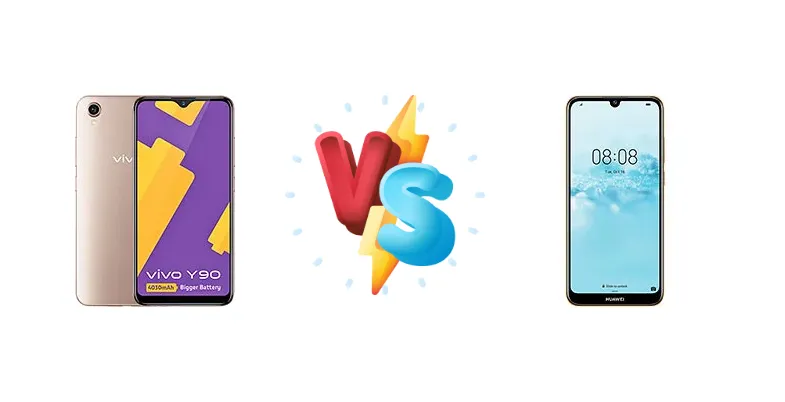
The vivo Y90 and Huawei Y6 Pro (2019) represent the extreme end of the smartphone price spectrum. Both devices aim to deliver essential smartphone functionality at the lowest possible cost. This comparison dissects their similarities and subtle differences to determine which offers the best value for users prioritizing affordability.
🏆 Quick Verdict
For the average user seeking a basic, functional smartphone, the Huawei Y6 Pro (2019) edges out the vivo Y90. While both share the same Mediatek Helio A22 chipset, the Y6 Pro’s slightly more established software support and potentially wider availability give it a marginal advantage.
| Network |
|---|
| 2G bands | GSM 850 / 900 / 1800 / 1900 | GSM 850 / 900 / 1800 / 1900 |
| 3G bands | HSDPA 850 / 900 / 2100 | HSDPA 850 / 900 / 1900 / 2100 |
| 4G bands | 1, 3, 5, 8, 38, 40, 41 | 1, 3, 7, 8, 20 |
| Speed | HSPA 42.2/5.76 Mbps, LTE Cat4 150/50 Mbps | HSPA 42.2/5.76 Mbps, LTE (2CA) Cat6 300/50 Mbps |
| Technology | GSM / HSPA / LTE | GSM / HSPA / LTE |
| Launch |
|---|
| Announced | 2019, July. Released 2019, July | 2019, February. Released 2019, February |
| Status | Discontinued | Discontinued |
| Body |
|---|
| Build | Glass front, plastic back, plastic frame | Glass front, plastic back, plastic frame |
| Dimensions | 155.1 x 75.1 x 8.3 mm (6.11 x 2.96 x 0.33 in) | 156.3 x 73.5 x 8 mm (6.15 x 2.89 x 0.31 in) |
| SIM | Nano-SIM + Nano-SIM | Nano-SIM + Nano-SIM |
| Weight | 163.5 g (5.78 oz) | 150 g (5.29 oz) |
| Display |
|---|
| Resolution | 720 x 1520 pixels, 19:9 ratio (~270 ppi density) | 720 x 1560 pixels, 19.5:9 ratio (~282 ppi density) |
| Size | 6.22 inches, 96.6 cm2 (~82.9% screen-to-body ratio) | 6.09 inches, 91.0 cm2 (~79.2% screen-to-body ratio) |
| Type | IPS LCD | IPS LCD |
| Platform |
|---|
| CPU | Quad-core 2.0 GHz Cortex-A53 | Quad-core 2.0 GHz Cortex-A53 |
| Chipset | Mediatek MT6761 Helio A22 (12 nm) | Mediatek MT6761 Helio A22 (12 nm) |
| GPU | PowerVR GE8320 | PowerVR GE8320 |
| OS | Android 8.1 (Oreo), Funtouch 4.5 | Android 9.0 (Pie), EMUI 9 |
| Memory |
|---|
| Card slot | microSDXC (dedicated slot) | microSDXC (dedicated slot) |
| Internal | 16GB 2GB RAM, 32GB 2GB RAM | 32GB 3GB RAM |
| | eMMC 5.1 | eMMC 5.1 |
| Main Camera |
|---|
| Features | LED flash, panorama | LED flash, HDR, panorama |
| Single | 8 MP, f/2.0, AF | 13 MP, f/1.8, PDAF |
| Video | 1080p@30fps | 1080p@30fps |
| Selfie camera |
|---|
| Features | - | LED flash |
| Single | 5 MP, f/1.8 | 8 MP, f/2.0 |
| Video | 720p | 1080p@30fps |
| Sound |
|---|
| 3.5mm jack | Yes | Yes |
| 35mm jack | Yes | Yes |
| Loudspeaker | Yes | Yes |
| Comms |
|---|
| Bluetooth | 5.0, A2DP, LE | 4.2, A2DP, LE |
| NFC | No | No |
| Positioning | GPS, GLONASS, GALILEO | GPS, GLONASS, BDS |
| Radio | FM radio | FM radio |
| USB | microUSB 2.0, OTG | microUSB 2.0 |
| WLAN | Wi-Fi 802.11 b/g/n, Wi-Fi Direct | Wi-Fi 802.11 b/g/n, Wi-Fi Direct |
| Features |
|---|
| Sensors | Accelerometer, proximity, compass | Accelerometer, proximity |
| Battery |
|---|
| Type | 4030 mAh, non-removable | Li-Ion 3020 mAh, non-removable |
| Misc |
|---|
| Colors | Black, Gold | Midnight Black, Sapphire Blue |
| Models | 1908, 1823 | MRD-LX2 |
| Price | About 90 EUR | About 120 EUR |
| SAR | 1.28 W/kg (head) 0.61 W/kg (body) | - |
vivo Y90
- Potentially newer software version
- Clean Android experience (depending on vivo's skin)
- May have slightly improved availability in certain markets
- Software update support is uncertain
- Performance identical to Huawei Y6 Pro (2019)
Huawei Y6 Pro (2019)
- Established user base and accessory availability
- Potentially more readily available software updates
- Proven track record of reliability
- Older release date
- Performance identical to vivo Y90
Display Comparison
Both the vivo Y90 and Huawei Y6 Pro (2019) likely feature LCD panels, typical for this price point. Given the lack of specific display specifications, it’s reasonable to assume similar resolutions (likely 720p+) and screen sizes around 6 inches. The user experience will be largely defined by the LCD technology used, with neither device expected to offer vibrant colors or high brightness levels. Bezels are expected to be substantial on both, maximizing screen real estate within a budget-friendly design.
Camera Comparison
Camera performance on both devices will be limited by the budget nature of the phones. While megapixel counts may vary, the image quality will be heavily reliant on the sensor size and image processing capabilities of the Mediatek Helio A22’s ISP. Expect acceptable results in well-lit conditions, but significant noise and lack of detail in low light. The inclusion of secondary cameras (depth or macro) on either device is largely for marketing purposes and will offer minimal practical benefit.
Performance
The core of both devices is the Mediatek MT6761 Helio A22, a quad-core processor clocked at 2.0 GHz with Cortex-A53 cores. This chipset is designed for basic tasks like calling, texting, and light social media browsing. The identical CPU and chipset configuration means performance will be virtually indistinguishable between the two. Neither device is suitable for demanding games or multitasking. RAM capacity, which is not specified, will be a significant factor; more RAM (even 2GB vs 1GB) would noticeably improve multitasking responsiveness.
Battery Life
Battery life will be a key consideration for users in this segment. While specific battery capacities are not provided, both devices likely house batteries in the 3000-4000 mAh range. The power-efficient Helio A22 chipset should translate to all-day battery life with moderate usage. Charging speeds are expected to be slow, utilizing Micro-USB connectivity, and likely lacking fast charging capabilities. The user experience will depend on software optimization and background app management.
Buying Guide
Buy the vivo Y90 if you prioritize a potentially newer device with a focus on a clean Android experience, assuming software updates are readily available in your region. Buy the Huawei Y6 Pro (2019) if you prefer a device with a more established track record, potentially benefiting from a larger user base and more readily available accessories, despite the older release date.
Frequently Asked Questions
❓ Will either of these phones run PUBG Mobile smoothly?
No. The Mediatek Helio A22 chipset is not powerful enough to run PUBG Mobile at playable frame rates, even on the lowest settings. Expect significant lag and stuttering.
❓ What version of Android do these phones run?
The Huawei Y6 Pro (2019) launched with Android 8.1 (Oreo) and may have received updates to Android 9 (Pie). The vivo Y90 likely runs Android Go Edition, a lightweight version of Android designed for low-end hardware. This means a streamlined experience with optimized apps.
❓ Are these phones dual SIM capable?
Both the vivo Y90 and Huawei Y6 Pro (2019) are likely to support dual SIM functionality, allowing you to use two SIM cards simultaneously. This is a common feature in budget smartphones, catering to users who want to separate work and personal calls or take advantage of different carrier plans.