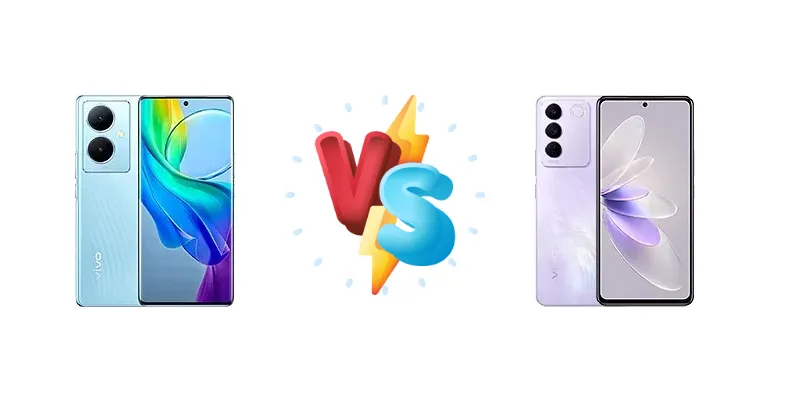
Choosing a new smartphone can be overwhelming, especially with so many options from vivo. The Y78+ and S16e are both compelling mid-range contenders, but cater to slightly different users. This comprehensive comparison will help you decide which one is right for you.
🏆 Quick Verdict
The vivo S16e emerges as the overall winner thanks to its significantly faster Exynos 1080 chipset, faster charging, and generally superior camera capabilities. However, the Y78+ offers a more budget-friendly option with decent performance and a large display, making it a solid choice for value-conscious buyers.
| Network |
|---|
| 2G bands | GSM 850 / 900 / 1800 / 1900 | GSM 850 / 900 / 1800 / 1900 |
| 3G bands | HSDPA 850 / 900 / 2100 | HSDPA 850 / 900 / 2100 |
| 4G bands | 1, 3, 5, 8, 28, 34, 38, 39, 40, 41 | 1, 3, 5, 8, 28, 34, 38, 39, 40, 41 |
| 5G bands | 1, 5, 8, 28, 41, 77, 78 SA/NSA | 1, 5, 8, 28, 41, 77, 78 SA/NSA |
| Speed | HSPA, LTE, 5G | HSPA, LTE, 5G |
| Technology | GSM / CDMA / HSPA / CDMA2000 / LTE / 5G | GSM / CDMA / HSPA / CDMA2000 / LTE / 5G |
| | CDMA2000 1x | CDMA2000 1x |
| Launch |
|---|
| Announced | 2023, April 24 | 2022, December 22 |
| Status | Available. Released 2023, April 26 | Available. Released 2022, December 30 |
| Body |
|---|
| Build | Glass front, plastic frame, plastic back | - |
| Dimensions | 164.3 x 74.8 x 7.9 mm (6.47 x 2.94 x 0.31 in) | 162.5 x 75.8 x 7.7 mm or 7.8 mm |
| SIM | Nano-SIM + Nano-SIM | Nano-SIM + Nano-SIM |
| Weight | 177 g (6.24 oz) | 187.7 g or 189 g (6.63 oz) |
| Display |
|---|
| Resolution | 1080 x 2400 pixels, 20:9 ratio (~388 ppi density) | 1080 x 2400 pixels, 20:9 ratio (~398 ppi density) |
| Size | 6.78 inches, 111.0 cm2 (~90.3% screen-to-body ratio) | 6.62 inches, 105.8 cm2 (~85.9% screen-to-body ratio) |
| Type | AMOLED, 120Hz, 1300 nits (peak) | AMOLED, 120Hz, HDR10+, 1300 nits (peak) |
| Platform |
|---|
| CPU | Octa-core (2x2.2 GHz Kryo 660 Gold & 6x1.7 GHz Kryo 660 Silver) | Octa-core (1x2.8 GHz Cortex-A78 & 3x2.6 GHz Cortex-A78 & 4x2.0 GHz Cortex-A55) |
| Chipset | Qualcomm SM6375 Snapdragon 695 5G (6 nm) | Exynos 1080 (5 nm) |
| GPU | Adreno 619 | Mali-G78 MP10 |
| OS | Android 13, OriginOS 3 | Android 11, OriginOS Ocean |
| Memory |
|---|
| Card slot | No | No |
| Internal | 128GB 8GB RAM, 256GB 8GB RAM, 256GB 12GB RAM | 128GB 8GB RAM, 256GB 8GB RAM, 256GB 12GB RAM |
| | UFS 2.2 | UFS 3.1 |
| Main Camera |
|---|
| Dual | 50 MP, f/1.8, (wide), PDAF, OIS
Auxiliary lens | - |
| Features | LED flash, HDR, panorama | Color spectrum sensor, Ring-LED flash, panorama, HDR |
| Single | - | 16 MP, f/2.0, (wide) |
| Triple | - | 50 MP, f/1.8, (wide), PDAF, OIS
2 MP (macro)
Auxiliary lens |
| Video | 1080p@30fps | 4K@30fps, 1080p@30fps |
| Selfie camera |
|---|
| Features | - | Dual-LED flash |
| Single | 8 MP, f/2.0, (wide) | 16 MP, f/2.0, (wide) |
| Video | 1080p@30fps | 1080p@30fps |
| Sound |
|---|
| 3.5mm jack | Yes | No |
| 35mm jack | No | No |
| Loudspeaker | Yes | Yes |
| | - | 24-bit/192kHz audio |
| Comms |
|---|
| Bluetooth | 5.1, A2DP, LE, aptX HD, aptX Adaptive | 5.2, A2DP, LE, aptX HD |
| NFC | No | Yes |
| Positioning | GPS (L1), GLONASS (G1), BDS (B1I+B1c), GALILEO (E1), QZSS (L1) | GPS, GLONASS, GALILEO, BDS |
| Radio | No | No |
| USB | USB Type-C 2.0, OTG | USB Type-C 2.0, OTG |
| WLAN | Wi-Fi 802.11 a/b/g/n/ac, dual-band, Wi-Fi Direct | Wi-Fi 802.11 a/b/g/n/ac/6, dual-band, Wi-Fi Direct |
| Features |
|---|
| Sensors | Fingerprint (under display, optical), accelerometer, gyro, proximity, compass | Fingerprint (under display, optical), accelerometer, gyro, proximity, compass |
| Battery |
|---|
| Charging | 44W wired | 66W wired, 50% in 19 min |
| Type | 5000 mAh | 4600 mAh |
| Misc |
|---|
| Colors | Black, Blue, Gold | Black, Green, Purple |
| Models | V2271A | V2239A |
| Price | About 210 EUR | About 280 EUR |
vivo Y78+
- Larger Display
- More Affordable
- Decent Performance for Everyday Tasks
- Reliable Battery Life
- Slower Processor
- Slower Charging
- Less Advanced Camera System
vivo S16e
- Faster Processor (Exynos 1080)
- Faster Charging (66W)
- Superior Camera System
- Sleek Design
- Higher Price
- Potentially Smaller Display
Display Comparison
Both phones feature vibrant OLED displays, but the S16e might have a slightly more refined color accuracy. The Y78+ likely has a larger screen size (around 6.67 inches) compared to the S16e (likely around 6.44 inches), making it better for media consumption. Resolution is likely FHD+ on both.
Camera Comparison
The S16e is expected to have a superior camera system. While the Y78+ likely has a capable main sensor, the S16e's Exynos chipset often enables better image processing and potentially a more advanced camera setup (e.g., improved ultrawide or macro lens). Expect better low-light performance and overall image quality from the S16e.
Performance
The Exynos 1080 in the S16e is a clear winner here. Its architecture and manufacturing process (5nm) provide a substantial performance advantage over the Snapdragon 695 (6nm) in the Y78+. Expect smoother multitasking, faster app loading, and better gaming performance on the S16e.
Battery Life
The Y78+ likely has a slightly larger battery capacity (around 5000mAh) compared to the S16e (likely around 4500mAh). However, the S16e's 66W charging significantly outweighs this difference, allowing it to charge much faster (50% in 19 minutes) than the Y78+'s 44W charging.
Buying Guide
Who should buy the vivo Y78+? Users prioritizing a larger display, a more affordable price point, and reliable everyday performance. Who should buy the vivo S16e? Those seeking a faster processor for gaming and demanding tasks, a better camera system, and significantly faster charging speeds.
Frequently Asked Questions
❓ Is the vivo S16e worth the extra money?
If performance and camera quality are your priorities, then yes. The Exynos 1080 and faster charging make it a worthwhile upgrade. However, if you're on a tighter budget, the Y78+ offers good value.
❓ Which phone is better for gaming?
The vivo S16e is significantly better for gaming due to its more powerful Exynos 1080 chipset. It will handle demanding games with smoother frame rates and less lag.