
vivo Y78 vs Oppo A78: A Detailed Comparison
| Phones Images | |||||
|---|---|---|---|---|---|
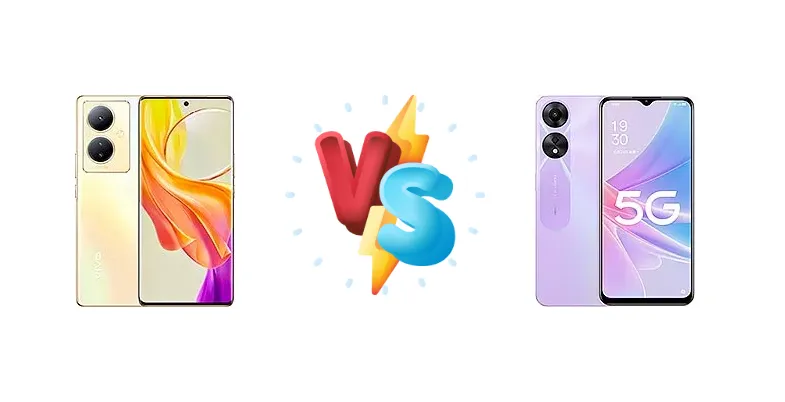
|
🏆 Quick Verdict
The Oppo A78 edges out the vivo Y78 thanks to its faster charging, slightly more efficient chipset, and potentially better software support. While the Y78 offers a solid experience, the A78 provides a more polished and feature-rich package for the price.
| PHONES | ||
|---|---|---|
| Phone Names | vivo Y78 | Oppo A78 |
| Network | ||
|---|---|---|
| 2G bands | GSM 850 / 900 / 1800 / 1900 | GSM 850 / 900 / 1800 / 1900 |
| 3G bands | HSDPA 850 / 900 / 1700(AWS) / 1900 / 2100 | HSDPA 800 / 850 / 900 / 1700(AWS) / 1900 / 2100 |
| 4G bands | 1, 2, 3, 4, 5, 7, 8, 12, 17, 20, 28, 32, 38, 39, 40, 41 | 1, 2, 3, 4, 5, 7, 8, 12, 13, 17, 18, 19, 20, 26, 28, 38, 39, 40, 41, 66 |
| 5G bands | 1, 3, 5, 7, 8, 20, 28, 38, 40, 41, 77, 78 SA/NSA | 1, 3, 5, 7, 8, 20, 28, 38, 40, 41, 66, 77, 78 SA/NSA |
| Speed | HSPA, LTE, 5G | HSPA, LTE, 5G |
| Technology | GSM / HSPA / LTE / 5G | GSM / HSPA / LTE / 5G |
| CDMA2000 1x | IP54 | |
| Launch | ||
|---|---|---|
| Announced | 2023, May 29 | 2023, January 07 |
| Status | Available. Released 2023, June 10 | Available. Released 2023, January 07 |
| Body | ||
|---|---|---|
| Build | Glass front, plastic frame, plastic back | - |
| Dimensions | 164.3 x 74.8 x 7.9 mm (6.47 x 2.94 x 0.31 in) | 163.8 x 75.1 x 8 mm (6.45 x 2.96 x 0.31 in) |
| SIM | Nano-SIM + Nano-SIM | Nano-SIM + Nano-SIM |
| Weight | 177 g (6.24 oz) | 188 g (6.63 oz) |
| Display | ||
|---|---|---|
| Protection | - | Panda glass |
| Resolution | 1080 x 2400 pixels, 20:9 ratio (~388 ppi density) | 720 x 1612 pixels, 20:9 ratio (~269 ppi density) |
| Size | 6.78 inches, 111.0 cm2 (~90.3% screen-to-body ratio) | 6.56 inches, 103.4 cm2 (~84.0% screen-to-body ratio) |
| Type | AMOLED, 120Hz, 1300 nits (peak) | IPS LCD, 90Hz, 480 nits (typ), 600 nits (HBM) |
| Platform | ||
|---|---|---|
| CPU | Octa-core (2x2.2 GHz Kryo 660 Gold & 6x1.7 GHz Kryo 660 Silver) | Octa-core (2x2.2 GHz Cortex-A76 & 6x2.0 GHz Cortex-A55) |
| Chipset | Qualcomm SM6375 Snapdragon 695 5G (6 nm) | Mediatek Dimensity 700 (7 nm) |
| GPU | Adreno 619 | Mali-G57 MC2 |
| OS | Android 13, Funtouch 13 | Android 12, upgradable to Android 14, ColorOS 14 |
| Memory | ||
|---|---|---|
| Card slot | No | microSDXC |
| Internal | 256GB 8GB RAM | 128GB 4GB RAM, 128GB 8GB RAM, 256GB 8GB RAM |
| UFS 2.2 | UFS 2.2 | |
| Main Camera | ||
|---|---|---|
| Dual | 50 MP, f/1.8, (wide), PDAF 2 MP, f/2.4, (depth) | 50 MP, f/1.8, 27mm (wide), PDAF Auxiliary lens |
| Features | LED flash, HDR, panorama | LED flash, HDR, panorama |
| Single | - | 8 MP, f/2.0, 27mm (wide) |
| Triple | 64 MP, f/1.8, (wide), PDAF, OIS 2 MP (macro) Auxiliary lens | - |
| Video | 1080p@30fps | 1080p@30fps |
| Selfie camera | ||
|---|---|---|
| Single | 16 MP, f/2.5, (wide) | 8 MP, f/2.0, 27mm (wide) |
| Video | 1080p@30fps | 1080p@30fps |
| Sound | ||
|---|---|---|
| 3.5mm jack | Yes | Yes |
| 35mm jack | Yes | Yes |
| Loudspeaker | Yes | Yes, with stereo speakers |
| Comms | ||
|---|---|---|
| Bluetooth | 5.1, A2DP, LE | 5.3, A2DP, LE, aptX |
| NFC | Yes | Yes |
| Positioning | GPS (L1), GLONASS (G1), BDS (B1I+B1c), GALILEO (E1), QZSS (L1) | GPS, GALILEO, GLONASS, BDS, QZSS |
| Radio | No | No |
| USB | USB Type-C 2.0, OTG | USB Type-C 2.0, OTG |
| WLAN | Wi-Fi 802.11 a/b/g/n/ac, dual-band | Wi-Fi 802.11 a/b/g/n/ac, dual-band |
| Features | ||
|---|---|---|
| Sensors | Fingerprint (under display, optical), accelerometer, gyro, proximity, compass | Fingerprint (side-mounted), accelerometer, proximity, compass |
| Battery | ||
|---|---|---|
| Charging | 44W wired | 33W wired, PD, 52% in 30 min, 100% in 67 min |
| Type | 5000 mAh | Li-Po 5000 mAh |
| Misc | ||
|---|---|---|
| Colors | Flare Black, Dreamy Gold | Glowing Black, Glowing Purple |
| Models | - | CPH2483, CPH2495 |
| Price | About 180 EUR | € 188.99 / $ 102.92 / ₹ 16,290 |
vivo Y78
- Potentially more vibrant display colors
- Solid overall performance
- Decent camera system
- Slower charging speed
- Less efficient chipset
- Potentially shorter software support
Oppo A78
- Faster 33W charging with PD support
- More efficient Dimensity 700 chipset
- Potentially better software support
- Good value for money
- Display might be slightly less vibrant
- Performance gains over Y78 are moderate
Display Comparison
Both phones feature a 6.7-inch display, likely with an FHD+ resolution. The vivo Y78 might have a slightly more saturated color profile, while the Oppo A78 could offer better brightness and outdoor visibility. Refresh rates are likely 120Hz on both.
Camera Comparison
Camera specs are likely comparable, with both phones featuring a main 50MP sensor. Image quality will depend on software processing. The Oppo A78 might have a slight edge in low-light photography due to its potentially better image processing algorithms. Both likely include ultrawide and macro lenses.
Performance
The Oppo A78's Dimensity 700, built on a 7nm process, generally offers better power efficiency and performance compared to the vivo Y78's Snapdragon 695 (6nm). Expect smoother multitasking and slightly faster app loading times on the Oppo A78. Gaming performance will be similar, but the Oppo might handle more demanding titles slightly better.
Battery Life
The Oppo A78's 33W charging is significantly faster than the vivo Y78's 44W. While both have similar battery capacities (around 5000mAh), the Oppo's faster charging means it will reach full charge much quicker. Battery life itself should be comparable under normal usage.
Buying Guide
The vivo Y78 is a good choice for users prioritizing a slightly larger display and a potentially more vibrant color profile. The Oppo A78 is ideal for those who value faster charging speeds, a more efficient processor, and potentially longer software update support.