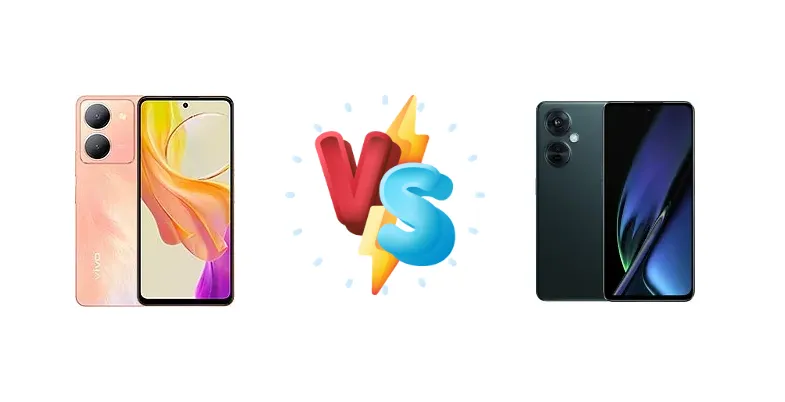
The vivo Y78 (China) and Oppo K11x represent compelling options in the increasingly competitive mid-range 5G smartphone market. Both devices aim to deliver a balanced experience, but they take different approaches to achieving it. The Y78 leverages MediaTek's Dimensity 7020, while the K11x opts for Qualcomm's Snapdragon 695. This comparison will dissect their key differences to help you determine which phone best suits your needs.
🏆 Quick Verdict
For the average user prioritizing rapid charging and a generally smoother user experience, the Oppo K11x emerges as the winner. Its 67W charging significantly outperforms the Y78's 44W, and the Snapdragon 695, while not a performance leader, offers a stable and efficient platform for everyday tasks.
| Network |
|---|
| 2G bands | GSM 850 / 900 / 1800 / 1900 | GSM 850 / 900 / 1800 / 1900 |
| 3G bands | HSDPA 850 / 900 / 2100 | HSDPA 850 / 900 / 1700(AWS) / 2100 |
| 4G bands | 1, 3, 5, 8, 28, 34, 38, 39, 40, 41 | 1, 3, 4, 5, 8, 28, 34, 38, 39, 40, 41 |
| 5G bands | 1, 5, 8, 28, 41, 77, 78 SA/NSA | 1, 5, 8, 28, 41, 77, 78 SA/NSA |
| Speed | HSPA, LTE, 5G | HSPA, LTE, 5G |
| Technology | GSM / CDMA / HSPA / CDMA2000 / LTE / 5G | GSM / HSPA / LTE / 5G |
| Launch |
|---|
| Announced | 2023, May 10 | 2023, May 25 |
| Status | Available. Released 2023, May 13 | Available. Released 2023, May 25 |
| Body |
|---|
| Build | Glass front, plastic frame, plastic back | Glass front, plastic frame, plastic back |
| Dimensions | 164.1 x 76.2 x 8 mm (6.46 x 3.00 x 0.31 in) | 165.5 x 76 x 8.3 mm (6.52 x 2.99 x 0.33 in) |
| SIM | Nano-SIM + Nano-SIM | Nano-SIM + Nano-SIM |
| Weight | 190 g (6.70 oz) | 195 g (6.88 oz) |
| Display |
|---|
| Protection | - | Corning Gorilla Glass |
| Resolution | 1080 x 2388 pixels (~395 ppi density) | 1080 x 2400 pixels, 20:9 ratio (~392 ppi density) |
| Size | 6.64 inches, 106.8 cm2 (~85.4% screen-to-body ratio) | 6.72 inches, 109.0 cm2 (~86.7% screen-to-body ratio) |
| Type | IPS LCD, 120Hz, HDR10 | IPS LCD, 120Hz, 550 nits (typ), 680 nits (peak) |
| Platform |
|---|
| CPU | Octa-core (2x2.2 GHz Cortex-A78 & 6x2.0 GHz Cortex-A55) | Octa-core (2x2.2 GHz Kryo 660 Gold & 6x1.7 GHz Kryo 660 Silver) |
| Chipset | Mediatek Dimensity 7020 (6 nm) | Qualcomm SM6375 Snapdragon 695 5G (6 nm) |
| GPU | IMG BXM-8-256 | Adreno 619 |
| OS | Android 13, OriginOS 3 | Android 13, ColorOS 13.1 |
| Memory |
|---|
| Card slot | No | microSDXC (uses shared SIM slot) |
| Internal | 128GB 8GB RAM, 256GB 8GB RAM, 256GB 12GB RAM | 128GB 8GB RAM, 256GB 8GB RAM, 256GB 12GB RAM |
| Main Camera |
|---|
| Dual | 50 MP, f/1.8, (wide), PDAF
Auxiliary lens | 108 MP, f/1.8, 24mm (wide), 1/1.67", 0.64µm, PDAF
Auxiliary lens |
| Features | LED flash, HDR, panorama | LED flash, HDR, panorama |
| Video | 1080p@30fps | 1080p@30fps |
| Selfie camera |
|---|
| Features | - | HDR, panorama |
| Single | 8 MP, f/2.0, (wide) | 16 MP, f/2.4, (wide), 1.0µm |
| Video | 1080p@30fps | 1080p@30fps |
| Sound |
|---|
| 35mm jack | Yes | Yes |
| Loudspeaker | Yes | Yes, with stereo speakers |
| Comms |
|---|
| Bluetooth | 5.3, A2DP, LE, aptX HD | 5.1, A2DP, LE, aptX HD |
| NFC | No | No |
| Positioning | GPS (L1), GLONASS (G1), BDS (B1I), GALILEO (E1), QZSS (L1) | GPS, GALILEO, GLONASS, BDS, QZSS |
| Radio | No | No |
| USB | USB Type-C 2.0, OTG | USB Type-C 2.0, OTG |
| WLAN | Wi-Fi 802.11 a/b/g/n/ac, dual-band, Wi-Fi Direct | Wi-Fi 802.11 a/b/g/n/ac, dual-band |
| Features |
|---|
| Sensors | Fingerprint (side-mounted), accelerometer, proximity, compass | Fingerprint (side-mounted), accelerometer, gyro, proximity, compass |
| Battery |
|---|
| Charging | 44W wired | 67W wired, 80% in 33 min |
| Type | 5000 mAh | Li-Po 5000 mAh |
| Misc |
|---|
| Colors | Black, Blue, Gold | Jade Black, Pearl Blue |
| Models | V2278A | - |
| Price | About 180 EUR | About 250 EUR |
vivo Y78 (China)
- Potentially stronger CPU single-core performance with Dimensity 7020
- MediaTek's 6nm process offers good efficiency
- May offer a more customized software experience (depending on vivo's UI)
- Slower 44W charging
- Qualcomm's software optimization is generally more refined
- Limited information on display quality
Oppo K11x
- Significantly faster 67W charging (80% in 33 minutes)
- Qualcomm's Snapdragon 695 offers stable 5G connectivity
- Potentially better software support and updates
- Slightly weaker CPU single-core performance compared to Dimensity 7020
- Lower clock speeds on efficiency cores
- Limited information on display quality
Display Comparison
Neither device's display specifications are provided, so a direct comparison is limited. However, given their price points, we can expect both to feature LCD panels with FHD+ resolution. The absence of details like refresh rate or peak brightness suggests neither phone is aiming for display excellence. Users prioritizing vibrant colors and high refresh rates should consider alternatives.
Camera Comparison
Without detailed camera specifications, a meaningful comparison is difficult. Both phones likely feature a multi-camera setup, but the quality will heavily depend on sensor size, aperture, and image processing algorithms. It's reasonable to assume both will include a primary sensor, an ultrawide, and potentially a macro lens. Given the market segment, image quality will likely be adequate for social media sharing but won't compete with flagship devices. The absence of OIS information suggests neither phone will excel in low-light photography.
Performance
The core difference lies in the chipsets. The vivo Y78's MediaTek Dimensity 7020 (6nm) utilizes a dual-cluster configuration with 2x 2.2 GHz Cortex-A78 cores and 6x 2.0 GHz Cortex-A55 cores. The Oppo K11x, powered by the Qualcomm Snapdragon 695 5G (6nm), employs 2x 2.2 GHz Kryo 660 Gold cores and 6x 1.7 GHz Kryo 660 Silver cores. While both CPUs peak at 2.2 GHz, the Cortex-A78 architecture in the Dimensity 7020 generally offers slightly better single-core performance than the Kryo 660 Gold. However, the Snapdragon 695 benefits from Qualcomm's optimized software and modem integration, potentially leading to more consistent 5G connectivity and overall system stability. The lower clock speed of the Silver cores on the K11x may impact multi-threaded performance compared to the Y78.
Battery Life
The Oppo K11x takes a clear lead in charging speed with its 67W wired charging, capable of reaching 80% charge in just 33 minutes. The vivo Y78 is limited to 44W wired charging, meaning a significantly longer time to full charge. While battery capacity isn't specified for either device, the faster charging of the K11x mitigates the impact of a potentially smaller battery. Users who frequently need to quickly top up their phone will greatly benefit from the K11x's charging capabilities.
Buying Guide
Buy the vivo Y78 (China) if you prioritize a potentially more efficient CPU architecture for sustained workloads and are comfortable with slower charging speeds. Buy the Oppo K11x if you value faster charging, a more established Qualcomm ecosystem, and a generally more responsive user interface for common tasks. The K11x is ideal for users who frequently top up their battery throughout the day.
Frequently Asked Questions
❓ Is the Snapdragon 695 in the Oppo K11x powerful enough for demanding games like PUBG Mobile?
The Snapdragon 695 can run PUBG Mobile, but you'll likely need to lower graphics settings to achieve a consistently smooth frame rate. It's not a gaming powerhouse, but it's capable of handling less demanding titles without issue. The Dimensity 7020 in the Y78 might offer slightly better sustained performance, but both phones are best suited for casual gaming.
❓ How much faster is the 67W charging on the Oppo K11x compared to the 44W charging on the vivo Y78 in real-world usage?
The 67W charging on the K11x will significantly reduce your charging time. While a full 0-100% time isn't specified, the K11x reaching 80% in 33 minutes demonstrates a substantial advantage. The Y78's 44W charging will likely take over an hour to reach full charge, making the K11x a much more convenient option for users who need a quick power boost.
❓ Does either phone support expandable storage via microSD card?
This information is not provided in the specifications. However, given the target market, it's possible that one or both phones offer microSD card support. Checking the official product pages or user reviews is recommended to confirm.