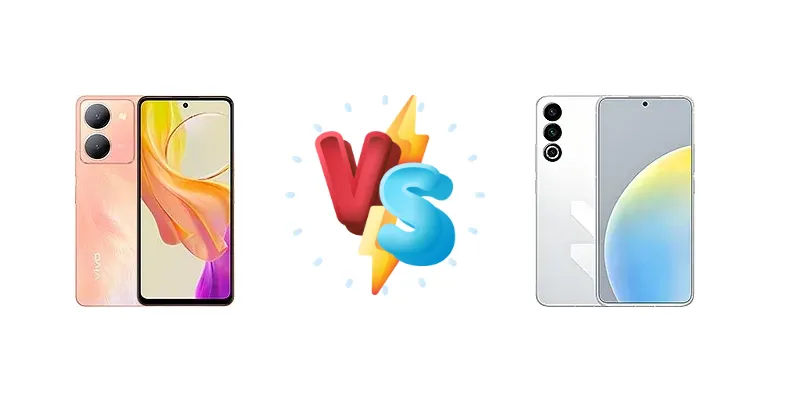
The Meizu 20 Classic and vivo Y78 (China) represent distinct approaches to the smartphone market. The Meizu aims for near-flagship performance with the Snapdragon 8 Gen 2, while the vivo Y78 focuses on delivering a solid experience at a more accessible price point with the Dimensity 7020. This comparison dissects the key differences to help you determine which device best suits your needs.
🏆 Quick Verdict
For users prioritizing raw performance and faster charging, the Meizu 20 Classic is the clear winner. Its Snapdragon 8 Gen 2 chipset offers a substantial leap in processing power and graphics capabilities. However, the vivo Y78 provides a compelling value proposition for budget-conscious buyers who don't require top-tier performance.
| Network |
|---|
| 2G bands | GSM 850 / 900 / 1800 / 1900 | GSM 850 / 900 / 1800 / 1900 |
| 3G bands | HSDPA 850 / 900 / 2100 | HSDPA 800 / 850 / 900 / 1900 / 2100 |
| 4G bands | 1, 3, 5, 8, 28, 34, 38, 39, 40, 41 | 1, 2, 3, 4, 5, 7, 8, 12, 28, 34, 38, 39, 40, 41 |
| 5G bands | 1, 5, 8, 28, 41, 77, 78 SA/NSA | 1, 3, 5, 8, 28, 38, 41, 77, 78 SA/NSA |
| Speed | HSPA, LTE, 5G | HSPA, LTE, 5G |
| Technology | GSM / CDMA / HSPA / CDMA2000 / LTE / 5G | GSM / HSPA / LTE / 5G |
| Launch |
|---|
| Announced | 2023, May 10 | 2023, October 19 |
| Status | Available. Released 2023, May 13 | Available. Released 2023, October 31 |
| Body |
|---|
| Build | Glass front, plastic frame, plastic back | - |
| Dimensions | 164.1 x 76.2 x 8 mm (6.46 x 3.00 x 0.31 in) | 157.9 x 73.5 x 8 mm (6.22 x 2.89 x 0.31 in) |
| SIM | Nano-SIM + Nano-SIM | Nano-SIM + Nano-SIM |
| Weight | 190 g (6.70 oz) | 190 g (6.70 oz) |
| Display |
|---|
| Resolution | 1080 x 2388 pixels (~395 ppi density) | 1080 x 2400 pixels, 20:9 ratio (~402 ppi density) |
| Size | 6.64 inches, 106.8 cm2 (~85.4% screen-to-body ratio) | 6.55 inches, 103.6 cm2 (~89.2% screen-to-body ratio) |
| Type | IPS LCD, 120Hz, HDR10 | OLED, 1B colors, 144Hz, 500 nits (typ), 800 nits (HBM) |
| Platform |
|---|
| CPU | Octa-core (2x2.2 GHz Cortex-A78 & 6x2.0 GHz Cortex-A55) | Octa-core (1x3.2 GHz Cortex-X3 & 2x2.8 GHz Cortex-A715 & 2x2.8 GHz Cortex-A710 & 3x2.0 GHz Cortex-A510) |
| Chipset | Mediatek Dimensity 7020 (6 nm) | Qualcomm SM8550-AB Snapdragon 8 Gen 2 (4 nm) |
| GPU | IMG BXM-8-256 | Adreno 740 |
| OS | Android 13, OriginOS 3 | Android 13, Flyme 10 |
| Memory |
|---|
| Card slot | No | No |
| Internal | 128GB 8GB RAM, 256GB 8GB RAM, 256GB 12GB RAM | 256GB 16GB RAM, 512GB 16GB RAM |
| Main Camera |
|---|
| Dual | 50 MP, f/1.8, (wide), PDAF
Auxiliary lens | - |
| Features | LED flash, HDR, panorama | Ring-LED flash, panorama, HDR |
| Triple | - | 50 MP, f/1.9, 24mm (wide), 1/1.56", PDAF, OIS
16 MP, f/2.4, 16mm, 122˚ (ultrawide)
5 MP, f/2.4 |
| Video | 1080p@30fps | 8K, 4K, 1080p; gyro-EIS |
| Selfie camera |
|---|
| Features | - | HDR |
| Single | 8 MP, f/2.0, (wide) | 32 MP, f/2.5, (wide) |
| Video | 1080p@30fps | Yes |
| Sound |
|---|
| 35mm jack | Yes | No |
| Loudspeaker | Yes | Yes, with stereo speakers |
| Comms |
|---|
| Bluetooth | 5.3, A2DP, LE, aptX HD | 5.3, A2DP, LE |
| NFC | No | Yes |
| Positioning | GPS (L1), GLONASS (G1), BDS (B1I), GALILEO (E1), QZSS (L1) | GPS (L1+L5), GLONASS, BDS (B1I+B1c+B2a), GALILEO, QZSS |
| Radio | No | No |
| USB | USB Type-C 2.0, OTG | USB Type-C, OTG |
| WLAN | Wi-Fi 802.11 a/b/g/n/ac, dual-band, Wi-Fi Direct | Wi-Fi 802.11 а/b/g/n/ac/6e/7, dual-band |
| Features |
|---|
| Sensors | Fingerprint (side-mounted), accelerometer, proximity, compass | Fingerprint (under display, ultrasonic), accelerometer, gyro, proximity, compass |
| Battery |
|---|
| Charging | 44W wired | 67W wired, PD3 PPS, QC4+ |
| Type | 5000 mAh | Li-Po 4700 mAh |
| Misc |
|---|
| Colors | Black, Blue, Gold | Gray, Silver, Green |
| Models | V2278A | - |
| Price | About 180 EUR | About 400 EUR |
vivo Y78 (China)
- Significantly faster processor with Snapdragon 8 Gen 2
- Faster 67W charging with advanced protocols
- Superior image processing capabilities
- More efficient 4nm process node
- Likely higher price point
- Potential for more heat under extreme load (though mitigated by 4nm)
Meizu 20 Classic
- More affordable price
- Decent performance for everyday tasks
- Reliable Mediatek Dimensity 7020 chipset
- 44W fast charging
- Noticeably slower processor compared to Snapdragon 8 Gen 2
- Less efficient 6nm process node
Display Comparison
While display specifications are missing for the vivo Y78, the Meizu 20 Classic is expected to feature a high-quality AMOLED panel. The core difference lies in the processing power driving the visuals. The Snapdragon 8 Gen 2’s Adreno 740 GPU will deliver significantly smoother frame rates in graphically intensive games compared to the Mali-G610 MC4 in the Dimensity 7020. The Meizu’s display is likely to benefit from the chipset’s superior image signal processor (ISP) for more accurate color reproduction and dynamic range.
Camera Comparison
Without detailed camera specs for either device, it’s difficult to make a definitive judgment. However, the Snapdragon 8 Gen 2’s ISP in the Meizu 20 Classic offers advanced image processing capabilities, including improved noise reduction, dynamic range, and detail preservation. This suggests the Meizu will likely produce superior image quality, particularly in challenging lighting conditions. The vivo Y78’s camera will likely be adequate for casual photography, but won’t match the Meizu’s potential for professional-looking results. The Meizu’s ISP also supports more advanced features like 8K video recording, which the Y78 likely lacks.
Performance
The performance gap is substantial. The Qualcomm SM8550-AB Snapdragon 8 Gen 2 (4nm) in the Meizu 20 Classic boasts a prime Cortex-X3 core clocked at 3.2 GHz, alongside high-performance Cortex-A715 and A710 cores. This contrasts sharply with the vivo Y78’s Mediatek Dimensity 7020 (6nm), which relies on older Cortex-A78 and A55 cores. The 4nm process node of the Snapdragon 8 Gen 2 provides superior power efficiency, translating to less thermal throttling during sustained workloads. This means the Meizu 20 Classic will maintain peak performance for longer periods, crucial for gamers and power users. The Dimensity 7020 is still capable, but will struggle with the most demanding tasks.
Battery Life
The Meizu 20 Classic’s 67W wired charging with PD3 PPS and QC4+ support is a significant advantage. This allows for a much faster 0-100% charge time compared to the vivo Y78’s 44W charging. While battery capacity is unknown for both devices, the Snapdragon 8 Gen 2’s superior power efficiency means the Meizu 20 Classic is likely to offer comparable or even better battery life despite potentially having a smaller battery. The faster charging also minimizes downtime, a crucial benefit for users who rely heavily on their smartphones.
Buying Guide
Buy the vivo Y78 (China) if you need a reliable daily driver with decent performance for everyday tasks, social media, and light gaming, and prioritize affordability. Buy the Meizu 20 Classic if you demand the fastest possible performance for demanding games, video editing, or multitasking, and value faster charging speeds and a more premium experience.
Frequently Asked Questions
❓ Will the Dimensity 7020 in the vivo Y78 struggle with demanding games like Genshin Impact?
Yes, the Dimensity 7020 will likely require significant graphics settings reductions to achieve playable frame rates in Genshin Impact. While it can run the game, expect compromises in visual fidelity and potential stuttering. The Snapdragon 8 Gen 2 in the Meizu 20 Classic will handle Genshin Impact at high settings with ease.
❓ How much faster is the 67W charging on the Meizu 20 Classic compared to the 44W charging on the vivo Y78?
The Meizu 20 Classic’s 67W charging will significantly reduce charging times. Expect a full charge in approximately 40-50 minutes, while the vivo Y78 will likely take closer to 60-75 minutes. The Meizu also supports PD3 PPS and QC4+ for optimized charging with compatible chargers.
❓ Does the Snapdragon 8 Gen 2 in the Meizu 20 Classic generate a lot of heat during prolonged gaming sessions?
While the Snapdragon 8 Gen 2 is a powerful chip, the 4nm manufacturing process helps to mitigate heat generation. The Meizu 20 Classic should be able to sustain peak performance for longer periods than devices with less efficient chipsets, but some heat is inevitable during extended gaming. Effective thermal management design within the phone is crucial.