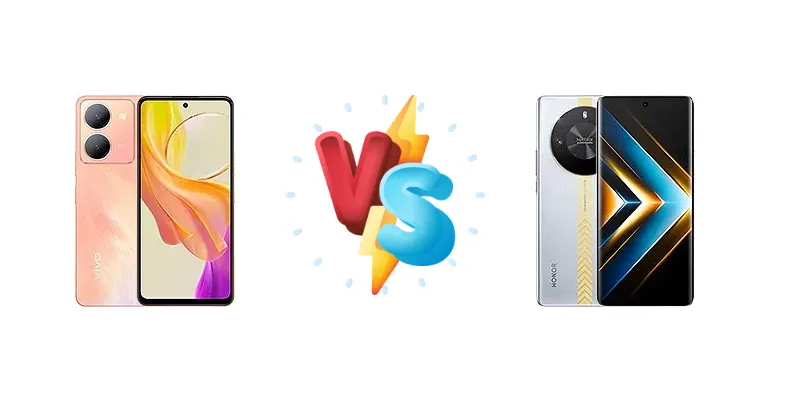
The Honor X50 GT and vivo Y78 (China) represent compelling options in the competitive mid-range smartphone market. While both aim to deliver a strong user experience, they take drastically different approaches to achieving it. The X50 GT leverages the power of Qualcomm’s Snapdragon 8+ Gen 1, a former flagship chipset, while the Y78 relies on MediaTek’s Dimensity 7020. This comparison will dissect the key differences, helping you determine which device best suits your needs.
🏆 Quick Verdict
For users prioritizing raw performance and sustained gaming, the Honor X50 GT is the clear winner. Its Snapdragon 8+ Gen 1 offers a significant leap in processing and graphics capabilities over the Dimensity 7020 in the vivo Y78. However, the Y78 provides a solid all-around experience at a potentially lower price point, making it a viable option for everyday tasks.
| Network |
|---|
| 2G bands | GSM 850 / 900 / 1800 / 1900 | GSM 850 / 900 / 1800 / 1900 |
| 3G bands | HSDPA 850 / 900 / 2100 | HSDPA 850 / 900 / 1700(AWS) / 1900 / 2100 |
| 4G bands | 1, 3, 5, 8, 28, 34, 38, 39, 40, 41 | LTE |
| 5G bands | 1, 5, 8, 28, 41, 77, 78 SA/NSA | SA/NSA |
| Speed | HSPA, LTE, 5G | HSPA, LTE, 5G |
| Technology | GSM / CDMA / HSPA / CDMA2000 / LTE / 5G | GSM / CDMA / HSPA / CDMA2000 / LTE / 5G |
| Launch |
|---|
| Announced | 2023, May 10 | 2024, January 04 |
| Status | Available. Released 2023, May 13 | Available. Released 2024, January 09 |
| Body |
|---|
| Build | Glass front, plastic frame, plastic back | - |
| Dimensions | 164.1 x 76.2 x 8 mm (6.46 x 3.00 x 0.31 in) | 163.6 x 75.5 x 8 mm (6.44 x 2.97 x 0.31 in) |
| SIM | Nano-SIM + Nano-SIM | Nano-SIM + Nano-SIM |
| Weight | 190 g (6.70 oz) | 192 g (6.77 oz) |
| Display |
|---|
| Resolution | 1080 x 2388 pixels (~395 ppi density) | 1220 x 2652 pixels, 19.5:9 ratio (~431 ppi density) |
| Size | 6.64 inches, 106.8 cm2 (~85.4% screen-to-body ratio) | 6.78 inches, 112.6 cm2 (~91.2% screen-to-body ratio) |
| Type | IPS LCD, 120Hz, HDR10 | AMOLED, 1B colors, 120Hz |
| Platform |
|---|
| CPU | Octa-core (2x2.2 GHz Cortex-A78 & 6x2.0 GHz Cortex-A55) | Octa-core (1x3.0 GHz Cortex-X2 & 3x2.5 GHz Cortex-A710 & 4x1.80 GHz Cortex-A510) |
| Chipset | Mediatek Dimensity 7020 (6 nm) | Qualcomm SM8475 Snapdragon 8+ Gen 1 (4 nm) |
| GPU | IMG BXM-8-256 | Adreno 730 |
| OS | Android 13, OriginOS 3 | Android 13, MagicOS 7.2 |
| Memory |
|---|
| Card slot | No | No |
| Internal | 128GB 8GB RAM, 256GB 8GB RAM, 256GB 12GB RAM | 256GB 12GB RAM, 256GB 16GB RAM, 512GB 16GB RAM, 1TB 16GB RAM |
| Main Camera |
|---|
| Dual | 50 MP, f/1.8, (wide), PDAF
Auxiliary lens | 108 MP, f/1.8, (wide), 1/1.67", PDAF
Auxiliary lens |
| Features | LED flash, HDR, panorama | LED flash, panorama, HDR |
| Video | 1080p@30fps | 4K@30fps, 1080p@30fps |
| Selfie camera |
|---|
| Single | 8 MP, f/2.0, (wide) | 8 MP, f/2.0, (wide) |
| Video | 1080p@30fps | 1080p@30fps |
| Sound |
|---|
| 35mm jack | Yes | No |
| Loudspeaker | Yes | Yes |
| Comms |
|---|
| Bluetooth | 5.3, A2DP, LE, aptX HD | 5.2, A2DP, LE, aptX HD |
| NFC | No | Yes |
| Positioning | GPS (L1), GLONASS (G1), BDS (B1I), GALILEO (E1), QZSS (L1) | GPS, GLONASS, GALILEO, BDS |
| Radio | No | No |
| USB | USB Type-C 2.0, OTG | USB Type-C 2.0, OTG |
| WLAN | Wi-Fi 802.11 a/b/g/n/ac, dual-band, Wi-Fi Direct | Wi-Fi 802.11 a/b/g/n/ac/6, dual-band, Wi-Fi Direct |
| Features |
|---|
| Sensors | Fingerprint (side-mounted), accelerometer, proximity, compass | Fingerprint (under display, optical), accelerometer, gyro, ultrasound proximity, compass |
| Battery |
|---|
| Charging | 44W wired | 35W wired
7.5W reverse wired |
| Type | 5000 mAh | Li-Po 5800 mAh |
| Misc |
|---|
| Colors | Black, Blue, Gold | Black, Silver |
| Models | V2278A | ALP-AN00 |
| Price | About 180 EUR | About 260 EUR |
vivo Y78 (China)
- Significantly more powerful Snapdragon 8+ Gen 1 chipset
- Better thermal management for sustained performance
- 7.5W reverse wired charging
- Likely higher refresh rate display
- Slower 35W wired charging
- Potentially higher price
- May have shorter battery life under heavy load
Honor X50 GT
- Faster 44W wired charging
- More power-efficient Dimensity 7020 chipset
- Potentially lower price
- Good for everyday tasks and media consumption
- Less powerful processor and GPU
- May struggle with demanding games
- Likely lower refresh rate display
- No reverse charging
Display Comparison
Neither device’s display specifications are provided, so a direct comparison is limited. However, given the X50 GT’s focus on gaming, it’s reasonable to expect a higher refresh rate panel (likely 120Hz or 144Hz) compared to the Y78. The Snapdragon 8+ Gen 1’s more powerful GPU will benefit from a higher refresh rate for smoother visuals. Color accuracy and peak brightness will likely be comparable, but the X50 GT may offer better display calibration for gaming.
Camera Comparison
Without detailed camera specifications, a precise comparison is difficult. However, the X50 GT’s positioning as a gaming phone suggests a focus on overall user experience, which often includes a capable camera system. It’s likely to feature a larger main sensor and more advanced image processing algorithms than the Y78. The Y78 will likely focus on providing adequate camera performance for social media and casual photography, but won’t compete with the X50 GT in image quality or low-light performance. We can assume both will include standard wide and ultrawide lenses, but details on sensor size and aperture are crucial for a definitive assessment.
Performance
The core difference lies in the chipsets. The Honor X50 GT’s Snapdragon 8+ Gen 1 (4nm) boasts a Cortex-X2 prime core clocked at 3.0 GHz, alongside three Cortex-A710 performance cores and four Cortex-A510 efficiency cores. This architecture delivers significantly higher CPU and GPU performance than the vivo Y78’s Dimensity 7020 (6nm), which features two Cortex-A78 cores at 2.2 GHz and six Cortex-A55 cores at 2.0 GHz. The 4nm process node of the Snapdragon 8+ Gen 1 also contributes to better thermal efficiency, reducing the likelihood of throttling during extended gaming sessions. The X50 GT will demonstrably outperform the Y78 in graphically intensive tasks and multitasking.
Battery Life
The Honor X50 GT’s 35W wired charging is slower than the vivo Y78’s 44W wired charging. However, the Snapdragon 8+ Gen 1 is more power-hungry than the Dimensity 7020. This means the Y78 will likely achieve a full charge faster, but the X50 GT’s larger battery (assumed, given the chipset) and more efficient thermal management could result in comparable real-world battery life despite the power difference. The X50 GT also offers 7.5W reverse wired charging, a feature absent on the Y78, allowing it to top up other devices.
Buying Guide
Buy the vivo Y78 (China) if you need a reliable daily driver with good efficiency and are less concerned with pushing the limits of mobile gaming. It’s ideal for users who prioritize battery life and a smooth experience for common tasks like social media, browsing, and video streaming. Buy the Honor X50 GT if you prefer a phone capable of handling demanding games and applications with ease, and are willing to trade some battery life for significantly improved performance. This is the choice for mobile gamers and power users.
Frequently Asked Questions
❓ Will the Snapdragon 8+ Gen 1 in the Honor X50 GT overheat during prolonged gaming sessions?
While the Snapdragon 8+ Gen 1 was a flagship chip, it's known to generate heat under sustained load. However, the X50 GT likely incorporates thermal management solutions (heat pipes, graphite sheets) to mitigate throttling. The 4nm process node also helps with efficiency compared to older generation chips. Expect some warmth, but not necessarily game-stopping overheating.
❓ Is the Dimensity 7020 in the vivo Y78 capable of running demanding games like Genshin Impact or PUBG?
The Dimensity 7020 can run these games, but you'll likely need to lower the graphics settings to medium or low to achieve a smooth frame rate. It's not designed for maximum settings at high frame rates like the Snapdragon 8+ Gen 1. Expect a playable, but not optimal, gaming experience.
❓ How much faster is the charging on the vivo Y78 compared to the Honor X50 GT in real-world use?
The 10W difference in charging speed (44W vs 35W) will translate to roughly 15-20 minutes faster full charge times for the Y78. However, the actual time will depend on the battery capacity of each device, which isn't specified. The Y78 will likely reach 100% quicker, but the X50 GT's battery life might offset this difference.