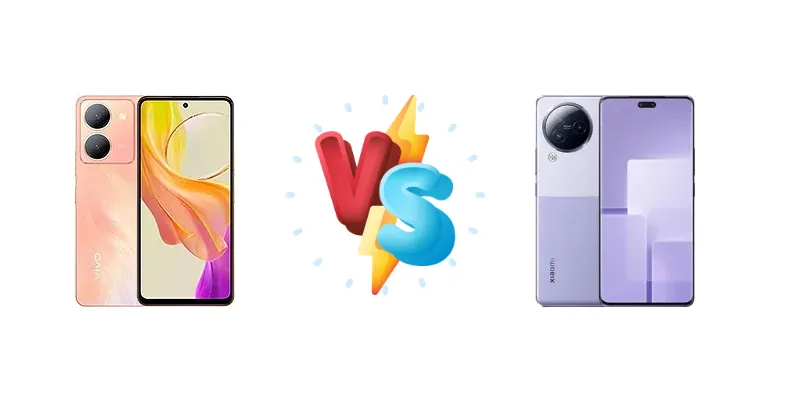
The vivo Y77t and Xiaomi Civi 3 represent compelling options in the increasingly competitive mid-range smartphone market. While both leverage MediaTek's Dimensity series, they target slightly different priorities – the Y77t focusing on a balance of features, while the Civi 3 emphasizes faster charging and a more powerful processor. This comparison dissects their key differences to determine which device delivers the best experience for your needs.
🏆 Quick Verdict
For most users, the Xiaomi Civi 3 emerges as the stronger choice. Its Dimensity 8200 Ultra chipset, built on a more efficient 4nm process, provides a significant performance advantage, and the 67W charging with PD3.0 support drastically reduces downtime. While the Y77t offers a respectable package, the Civi 3’s superior processing power justifies the potential price difference.
| Network |
|---|
| 2G bands | GSM 850 / 900 / 1800 / 1900 | GSM 850 / 900 / 1800 / 1900 |
| 3G bands | HSDPA 850 / 900 / 2100 | HSDPA 800 / 850 / 900 / 1700(AWS) / 1900 / 2100 |
| 4G bands | 1, 3, 5, 8, 28, 34, 38, 39, 40, 41 | 1, 3, 4, 5, 8, 18, 19, 26, 34, 38, 39, 40, 41, 42 |
| 5G bands | 1, 5, 8, 28, 41, 77, 78 SA/NSA | 1, 3, 5, 8, 28, 38, 41, 77, 78 SA/NSA |
| Speed | HSPA, LTE, 5G | HSPA, LTE, 5G |
| Technology | GSM / CDMA / HSPA / CDMA2000 / LTE / 5G | GSM / CDMA / HSPA / CDMA2000 / LTE / 5G |
| Launch |
|---|
| Announced | 2023, August 18 | 2023, May 25 |
| Status | Available. Released 2023, August 18 | Available. Released 2023, May 25 |
| Body |
|---|
| Build | Glass front, plastic frame, plastic back | Glass front (Gorilla Glass 5), glass back, aluminum frame |
| Dimensions | 164.1 x 76.2 x 8 mm (6.46 x 3.00 x 0.31 in) | 158.7 x 71.7 x 7.6 mm (6.25 x 2.82 x 0.30 in) |
| SIM | Nano-SIM + Nano-SIM | Nano-SIM + Nano-SIM |
| Weight | 190 g (6.70 oz) | 174 g (6.14 oz) |
| Display |
|---|
| Protection | - | Corning Gorilla Glass 5 |
| Resolution | 1080 x 2388 pixels (~395 ppi density) | 1080 x 2400 pixels, 20:9 ratio (~402 ppi density) |
| Size | 6.64 inches, 106.8 cm2 (~85.4% screen-to-body ratio) | 6.55 inches, 103.6 cm2 (~91.0% screen-to-body ratio) |
| Type | IPS LCD, 120Hz, HDR10 | AMOLED, 68B colors, 120Hz, Dolby Vision, HDR10+, 1500 nits (peak) |
| Platform |
|---|
| CPU | Octa-core (2x2.2 GHz Cortex-A78 & 6x2.0 GHz Cortex-A55) | Octa-core (1x3.1 GHz Cortex-A78 & 3x3.0 GHz Cortex-A78 & 4x2.0 GHz Cortex-A55) |
| Chipset | Mediatek Dimensity 7020 (6 nm) | Mediatek Dimensity 8200 Ultra (4 nm) |
| GPU | IMG BXM-8-256 | Mali-G610 MC6 |
| OS | Android 13, OriginOS 3 | Android 13, MIUI 14 |
| Memory |
|---|
| Card slot | No | No |
| Internal | 256GB 8GB RAM, 256GB 12GB RAM | 256GB 12GB RAM, 512GB 12GB RAM, 1TB 16GB RAM |
| Main Camera |
|---|
| Dual | 50 MP, f/1.8, (wide), PDAF
Auxiliary lens | - |
| Features | LED flash, HDR, panorama | Color spectrum sensor, Quad-LED dual-tone flash, HDR, panorama |
| Triple | - | 50 MP, f/1.8, (wide), 1/1.49", 1.0µm, PDAF, OIS
8 MP, f/2.2, 115˚ (ultrawide), 1.12µm
2 MP (macro) |
| Video | 1080p@30fps | 4K@30fps, 1080p@30/60/120fps, 720p@960fps; gyro-EIS |
| Selfie camera |
|---|
| Dual | - | 32 MP, f/2.0, 26mm (wide), 1/2.8", 0.8µm, AF
32 MP, f/2.4, 100˚ (ultrawide), 1/2.8", 0.8µm |
| Features | - | 2 Dual-LED dual-tone flash, HDR, panorama |
| Single | 8 MP, f/2.0, (wide) | - |
| Video | 1080p@30fps | 4K@30fps, 1080p@30/60fps; gyro-EIS |
| Sound |
|---|
| 35mm jack | Yes | No |
| Loudspeaker | Yes | Yes, with stereo speakers |
| Comms |
|---|
| Bluetooth | 5.3, A2DP, LE, aptX HD | 5.3, A2DP, LE |
| Infrared port | - | Yes |
| NFC | No | Yes |
| Positioning | GPS (L1), GLONASS (G1), BDS (B1I), GALILEO (E1), QZSS (L1) | GPS (L1), GLONASS (G1), BDS (B1I+B1c), GALILEO (E1), QZSS (L1) |
| Radio | No | No |
| USB | USB Type-C 2.0, OTG | USB Type-C 2.0, OTG |
| WLAN | Wi-Fi 802.11 a/b/g/n/ac, dual-band, Wi-Fi Direct | Wi-Fi 802.11 a/b/g/n/ac/6, dual-band, Wi-Fi Direct |
| Features |
|---|
| Sensors | Fingerprint (side-mounted), accelerometer, proximity, compass | Fingerprint (under display, optical), accelerometer, gyro, proximity, compass |
| Battery |
|---|
| Charging | 44W wired | 67W wired, PD3.0, 100% in 38 minutes |
| Type | 5000 mAh | Li-Po 4500 mAh |
| Misc |
|---|
| Colors | Black, Mint, Gold | Purple, Mint, Gold, Gray |
| Models | - | 23046PNC9C |
| Price | About 170 EUR | About 330 EUR |
vivo Y77t
- Potentially more affordable price point
- Balanced feature set for everyday use
- Reliable MediaTek Dimensity 7020 chipset
- Slower 44W charging
- Less powerful chipset compared to the Civi 3
- Likely less advanced display technology
Xiaomi Civi 3
- Significantly faster 67W charging with PD3.0
- More powerful Dimensity 8200 Ultra chipset (4nm)
- Potentially superior camera performance
- Likely higher price tag
- May experience slightly more heat under extreme load (though 4nm helps)
- Potential for software bloat (typical of Xiaomi)
Display Comparison
Neither device’s display specifications are provided, so a direct comparison is limited. However, given the Civi 3’s positioning, it likely features a higher-quality AMOLED panel with potentially higher peak brightness and color accuracy. The Y77t, being a more budget-focused device, may utilize a slightly less advanced panel. Bezels are likely comparable, but the Civi 3’s design language often prioritizes a more premium aesthetic.
Camera Comparison
Without detailed camera specifications, analysis is limited. However, Xiaomi typically invests more heavily in camera technology for the Civi series. It’s reasonable to assume the Civi 3 features a more capable main sensor and potentially better image processing algorithms. The Y77t likely offers a competent camera system for everyday photography, but may struggle in low-light conditions or with complex scenes. The presence or absence of Optical Image Stabilization (OIS) on either device would be a significant differentiator, but is unknown.
Performance
The core difference lies in the chipsets. The Xiaomi Civi 3’s Dimensity 8200 Ultra (4nm) is a substantial upgrade over the vivo Y77t’s Dimensity 7020 (6nm). The 8200 Ultra boasts a faster prime core (3.1 GHz vs 2.2 GHz) and a more robust GPU configuration. The 4nm fabrication process also translates to improved thermal efficiency, meaning the Civi 3 is less likely to throttle under sustained load. This benefits gamers and users running demanding applications. The Y77t’s CPU, while capable, will exhibit noticeable performance limitations in comparison.
Battery Life
Battery capacity isn’t specified for either device. However, the charging speeds are a clear win for the Xiaomi Civi 3. Its 67W wired charging with PD3.0 support promises a full charge in just 38 minutes, a significant advantage over the Y77t’s 44W charging. While a larger battery capacity on the Y77t could partially offset this, the faster charging of the Civi 3 provides a more convenient user experience, especially for those who frequently find themselves needing a quick top-up.
Buying Guide
Buy the vivo Y77t if you prioritize a balanced feature set and are comfortable with slightly slower charging speeds. It’s ideal for everyday users who need a reliable phone for communication, social media, and light multitasking. Buy the Xiaomi Civi 3 if you demand smoother performance for gaming, video editing, or demanding applications, and value the convenience of significantly faster 67W charging. This phone is geared towards power users and those who frequently rely on their smartphone for intensive tasks.
Frequently Asked Questions
❓ Will the Dimensity 8200 Ultra in the Xiaomi Civi 3 handle demanding games like Genshin Impact at high settings?
Yes, the Dimensity 8200 Ultra is more than capable of running Genshin Impact and other graphically intensive games at high settings. The 4nm process and powerful GPU ensure stable frame rates and reduced thermal throttling compared to the Dimensity 7020 in the Y77t.
❓ How much faster is the 67W charging on the Xiaomi Civi 3 compared to the 44W charging on the vivo Y77t in real-world usage?
The Xiaomi Civi 3’s 67W charging can realistically add several hours of usage in just 15-20 minutes, while the Y77t’s 44W charging will take considerably longer to achieve a similar charge level. The Civi 3’s full 0-100% charge in 38 minutes is a significant time saver for users who are always on the go.
❓ Does the Xiaomi Civi 3 support Power Delivery (PD) charging with other USB-C chargers?
Yes, the Xiaomi Civi 3 explicitly supports PD3.0, meaning you can use a variety of USB-C PD chargers to charge the device, offering flexibility and convenience.
❓ Is the difference in chipset performance between the Dimensity 7020 and 8200 Ultra noticeable for everyday tasks like browsing and social media?
For basic tasks like browsing and social media, the difference may not be immediately apparent. However, the Dimensity 8200 Ultra will provide a smoother and more responsive experience when multitasking or switching between apps, and will age better as app demands increase.