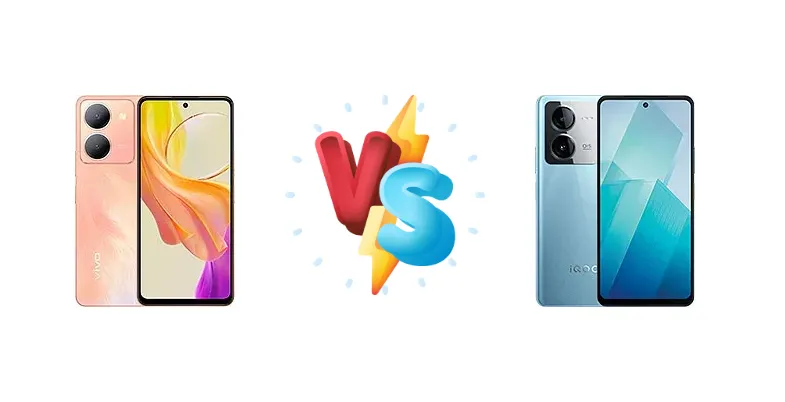
Both the vivo iQOO Z8 and the vivo Y77t represent compelling options within the competitive Chinese mid-range smartphone market. However, they cater to slightly different priorities. The iQOO Z8 aggressively targets performance enthusiasts with a flagship-adjacent chipset and blazing-fast charging, while the Y77t aims for a more balanced experience, potentially prioritizing affordability alongside a solid feature set.
🏆 Quick Verdict
For users prioritizing raw performance and minimal charging downtime, the iQOO Z8 is the clear winner. Its Dimensity 8200 chipset offers a substantial leap over the Y77t’s Dimensity 7020. However, if budget is a primary concern and extreme speed isn't essential, the Y77t provides a capable alternative.
| Network |
|---|
| 2G bands | GSM 850 / 900 / 1800 / 1900 | GSM 850 / 900 / 1800 / 1900 |
| 3G bands | HSDPA 850 / 900 / 2100 | HSDPA 850 / 900 / 2100 |
| 4G bands | 1, 3, 5, 8, 28, 34, 38, 39, 40, 41 | 1, 3, 5, 8, 28, 34, 38, 39, 40, 41 |
| 5G bands | 1, 5, 8, 28, 41, 77, 78 SA/NSA | 1, 5, 8, 28, 41, 77, 78 SA/NSA |
| Speed | HSPA, LTE, 5G | HSPA, LTE, 5G |
| Technology | GSM / CDMA / HSPA / CDMA2000 / LTE / 5G | GSM / CDMA / HSPA / CDMA2000 / LTE / 5G |
| Launch |
|---|
| Announced | 2023, August 18 | 2023, August 31 |
| Status | Available. Released 2023, August 18 | Available. Released 2023, September |
| Body |
|---|
| Build | Glass front, plastic frame, plastic back | - |
| Dimensions | 164.1 x 76.2 x 8 mm (6.46 x 3.00 x 0.31 in) | 164.6 x 75.8 x 8.8 mm (6.48 x 2.98 x 0.35 in) |
| SIM | Nano-SIM + Nano-SIM | Nano-SIM + Nano-SIM |
| Weight | 190 g (6.70 oz) | 200 g (7.05 oz) |
| Display |
|---|
| Resolution | 1080 x 2388 pixels (~395 ppi density) | 1080 x 2388 pixels (~395 ppi density) |
| Size | 6.64 inches, 106.8 cm2 (~85.4% screen-to-body ratio) | 6.64 inches, 106.8 cm2 (~85.6% screen-to-body ratio) |
| Type | IPS LCD, 120Hz, HDR10 | IPS LCD, 120Hz |
| Platform |
|---|
| CPU | Octa-core (2x2.2 GHz Cortex-A78 & 6x2.0 GHz Cortex-A55) | Octa-core (1x3.1 GHz Cortex-A78 & 3x3.0 GHz Cortex-A78 & 4x2.0 GHz Cortex-A55) |
| Chipset | Mediatek Dimensity 7020 (6 nm) | Mediatek Dimensity 8200 (4 nm) |
| GPU | IMG BXM-8-256 | Mali-G610 MC6 |
| OS | Android 13, OriginOS 3 | Android 13, OriginOS 3 |
| Memory |
|---|
| Card slot | No | No |
| Internal | 256GB 8GB RAM, 256GB 12GB RAM | 256GB 8GB RAM, 256GB 12GB RAM, 512GB 12GB RAM |
| Main Camera |
|---|
| Dual | 50 MP, f/1.8, (wide), PDAF
Auxiliary lens | 64 MP, f/1.8, (wide), 1/2.0", 0.7µm, PDAF, OIS
Auxiliary lens |
| Features | LED flash, HDR, panorama | Dual-LED dual-tone flash, HDR, panorama |
| Video | 1080p@30fps | 4K@30fps, 1080p@30fps |
| Selfie camera |
|---|
| Single | 8 MP, f/2.0, (wide) | 16 MP, f/2.5, (wide) |
| Video | 1080p@30fps | 1080p@30fps |
| Sound |
|---|
| 35mm jack | Yes | Yes |
| Loudspeaker | Yes | Yes |
| Comms |
|---|
| Bluetooth | 5.3, A2DP, LE, aptX HD | 5.3, A2DP, LE, aptX HD |
| NFC | No | Yes |
| Positioning | GPS (L1), GLONASS (G1), BDS (B1I), GALILEO (E1), QZSS (L1) | GPS (L1), GLONASS (G1), BDS (B1I+B1c), GALILEO (E1), QZSS (L1) |
| Radio | No | No |
| USB | USB Type-C 2.0, OTG | USB Type-C 2.0, OTG |
| WLAN | Wi-Fi 802.11 a/b/g/n/ac, dual-band, Wi-Fi Direct | Wi-Fi 802.11 a/b/g/n/ac/6, dual-band, Wi-Fi Direct |
| Features |
|---|
| Sensors | Fingerprint (side-mounted), accelerometer, proximity, compass | Fingerprint (side-mounted), accelerometer, gyro, proximity, compass |
| Battery |
|---|
| Charging | 44W wired | 120W wired |
| Type | 5000 mAh | 5000 mAh |
| Misc |
|---|
| Colors | Black, Mint, Gold | Black, Blue, Silver |
| Models | - | V2314A |
| Price | About 170 EUR | About 230 EUR |
vivo Y77t
- More affordable price point
- Balanced feature set for everyday use
- Decent battery life with 44W charging
- Significantly slower performance than the iQOO Z8
- Less advanced camera system (likely)
- 6nm process may lead to more heat under load
vivo iQOO Z8 (China)
- Exceptional performance with Dimensity 8200
- Ultra-fast 120W wired charging
- Superior thermal efficiency (4nm process)
- Likely higher price tag
- Potentially shorter battery life due to higher power consumption
- May require a more robust charger (sold separately)
Display Comparison
While specific display details (resolution, panel type) are missing, the core difference lies in the overall system performance impacting UI responsiveness. Both likely utilize LCD panels given the price bracket. However, the iQOO Z8’s more powerful chipset will translate to smoother animations and faster app loading, enhancing the perceived display experience. Bezels are likely comparable, and color accuracy will depend on software calibration, a factor not specified in the provided data.
Camera Comparison
Without detailed camera specifications, it’s difficult to make a definitive judgment. However, the iQOO Z8, positioned as a performance-focused device, is more likely to feature a higher-quality main sensor and potentially more advanced image processing algorithms. The Dimensity 8200’s ISP (Image Signal Processor) is also more capable than the 7020’s, potentially resulting in better dynamic range and low-light performance. We can assume both phones will include standard features like portrait mode and night mode, but the Z8 is expected to deliver superior image quality overall.
Performance
The performance gap is the most significant differentiator. The iQOO Z8’s Dimensity 8200 (4nm) is a substantial upgrade over the Y77t’s Dimensity 7020 (6nm). The 8200 features a more powerful Cortex-A78 prime core clocked at 3.1 GHz versus 2.2 GHz on the 7020, and a tri-core cluster of A78s at 3.0GHz, offering a significant advantage in multi-threaded tasks and gaming. The 4nm process node of the 8200 also provides superior thermal efficiency, reducing the likelihood of throttling during sustained workloads. This benefits gamers and users running demanding applications. The Y77t’s Dimensity 7020 is still a capable chip, but it won’t match the Z8’s responsiveness.
Battery Life
The iQOO Z8’s 120W wired charging is a game-changer. This technology can fully charge a typical smartphone battery in under 20 minutes, a massive advantage over the Y77t’s 44W charging. While battery capacity isn’t specified, the faster charging speed significantly reduces downtime. The Dimensity 8200’s improved efficiency may partially offset the faster charging, but the Z8 will still likely offer a more convenient charging experience. The Y77t’s 44W charging is respectable, but it’s considerably slower.
Buying Guide
Buy the vivo Y77t if you need a reliable daily driver with good battery life and don't demand the absolute fastest performance. It's ideal for everyday tasks, social media, and casual gaming. Buy the vivo iQOO Z8 (China) if you prioritize gaming, demanding applications, and want to minimize time spent tethered to a charger. It’s the better choice for power users and those who value speed above all else.
Frequently Asked Questions
❓ Will the iQOO Z8’s Dimensity 8200 handle demanding games like Genshin Impact at high settings?
Yes, the Dimensity 8200 is more than capable of running Genshin Impact and other graphically intensive games at high settings. The 4nm process and powerful GPU will provide a smooth and stable gaming experience, even during prolonged sessions. Expect significantly better frame rates and reduced throttling compared to the Y77t.
❓ How long does it *actually* take to charge the iQOO Z8 from 0% to 100% with the 120W charger?
With the 120W charger (often sold separately), the iQOO Z8 can typically charge from 0% to 100% in around 25-30 minutes. This is a substantial improvement over the Y77t’s 44W charging, which would likely take over an hour.
❓ Is the difference in performance between the Dimensity 7020 and 8200 noticeable for everyday tasks like browsing and social media?
While both chips are capable of handling everyday tasks, the Dimensity 8200 in the iQOO Z8 will provide a noticeably smoother and more responsive experience. App loading times will be faster, animations will be smoother, and multitasking will be more fluid. The difference is most apparent when switching between apps or performing demanding tasks.
❓ Does the iQOO Z8 have any cooling features to prevent overheating during gaming?
While the provided data doesn't specify, iQOO phones often incorporate vapor chamber cooling or other thermal management solutions. The Dimensity 8200’s 4nm process also contributes to better thermal efficiency, reducing the likelihood of significant throttling during extended gaming sessions.