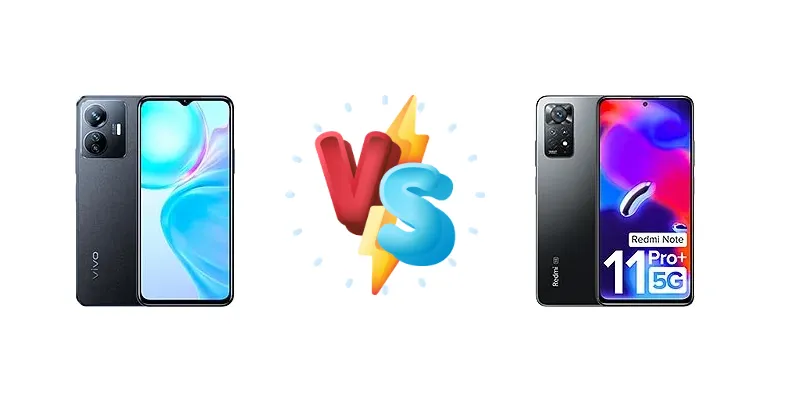
Both the vivo Y77e (t1) and the Xiaomi Redmi Note 11 Pro+ 5G target the competitive mid-range 5G smartphone market in India. However, they approach this segment with different chipsets and a significant disparity in charging capabilities, making a direct comparison crucial for budget-conscious buyers seeking optimal performance and convenience.
🏆 Quick Verdict
For the average user prioritizing fast charging and a generally smoother experience, the Xiaomi Redmi Note 11 Pro+ 5G is the better choice. Its 67W charging significantly outperforms the vivo Y77e’s 18W, and the Snapdragon 695 offers a slightly more refined experience despite similar core counts.
| Network |
|---|
| 2G bands | GSM 850 / 900 / 1800 / 1900 | GSM 850 / 900 / 1800 / 1900 - SIM 1 & SIM 2 |
| 3G bands | HSDPA 850 / 900 / 2100 | HSDPA 850 / 900 / 1900 / 2100 |
| 4G bands | 1, 3, 5, 8, 28, 34, 38, 39, 40, 41 | 1, 3, 5, 8, 40, 41 |
| 5G bands | 1, 5, 8, 28, 41, 77, 78 SA/NSA | 1, 3, 5, 8, 28, 40, 78 SA/NSA |
| Speed | HSPA, LTE, 5G | HSPA, LTE-A (CA), 5G |
| Technology | GSM / CDMA / HSPA / CDMA2000 / LTE / 5G | GSM / HSPA / LTE / 5G |
| | CDMA2000 1x | - |
| Launch |
|---|
| Announced | 2022, August 19 | 2022, March 09 |
| Status | Cancelled | Available. Released 2022, March 15 |
| Body |
|---|
| Build | Glass front, plastic frame, plastic back | Glass front (Gorilla Glass 5), glass back |
| Dimensions | 164 x 75.8 x 8.3 mm (6.46 x 2.98 x 0.33 in) | 164.2 x 76.1 x 8.1 mm (6.46 x 3.00 x 0.32 in) |
| SIM | Nano-SIM + Nano-SIM | Hybrid Dual SIM (Nano-SIM, dual stand-by) |
| Weight | 194 g (6.84 oz) | 202 g (7.13 oz) |
| | - | IP53, dust and splash resistant |
| Display |
|---|
| Protection | - | Corning Gorilla Glass 5 |
| Resolution | 1080 x 2408 pixels, 20:9 ratio (~401 ppi density) | 1080 x 2400 pixels, 20:9 ratio (~395 ppi density) |
| Size | 6.58 inches, 104.3 cm2 (~83.9% screen-to-body ratio) | 6.67 inches, 107.4 cm2 (~86.0% screen-to-body ratio) |
| Type | IPS LCD | Super AMOLED, 120Hz, 700 nits, 1200 nits (peak) |
| Platform |
|---|
| CPU | Octa-core (2x2.4 GHz Cortex-A76 & 6x2.0 GHz Cortex-A55) | Octa-core (2x2.2 GHz Kryo 660 Gold & 6x1.7 GHz Kryo 660 Silver) |
| Chipset | Mediatek Dimensity 810 (6 nm) | Qualcomm SM6375 Snapdragon 695 5G (6 nm) |
| GPU | Mali-G57 MC2 | Adreno 619 |
| OS | Android 12, OriginOS Ocean | Android 11, MIUI 13 |
| Memory |
|---|
| Card slot | microSDXC (uses shared SIM slot) | microSDXC (uses shared SIM slot) |
| Internal | 256GB 8GB RAM | 64GB 6GB RAM, 128GB 6GB RAM, 128GB 8GB RAM, 256GB 8GB RAM |
| | UFS 2.2 | UFS 2.2 |
| Main Camera |
|---|
| Dual | 50 MP, f/1.8, (wide), PDAF
2 MP (macro) | - |
| Features | LED flash, HDR, panorama | LED flash, HDR, panorama |
| Single | 8 MP, f/2.0, (wide) | - |
| Triple | - | 108 MP, f/1.9, 26mm (wide), 1/1.52", 0.7µm, PDAF
8 MP, f/2.2, 118˚ (ultrawide)
2 MP, f/2.4, (macro) |
| Video | 1080p@30fps | 1080p@30fps |
| Selfie camera |
|---|
| Single | 8 MP, f/2.0, (wide) | 16 MP, f/2.5, (wide), 1/3.06" 1.0µm |
| Video | 1080p@30fps | 1080p@30fps |
| Sound |
|---|
| 3.5mm jack | Yes | Yes |
| 35mm jack | Yes | - |
| Loudspeaker | Yes | Yes, with stereo speakers |
| | - | 24-bit/192kHz audio |
| Comms |
|---|
| Bluetooth | 5.1, A2DP, LE, aptX HD | 5.1, A2DP, LE |
| Infrared port | - | Yes |
| NFC | No | No |
| Positioning | GPS, GLONASS, GALILEO, BDS, QZSS | GPS, GLONASS, BDS, GALILEO |
| Radio | No | Unspecified |
| USB | USB Type-C 2.0, OTG | USB Type-C 2.0, OTG |
| WLAN | Wi-Fi 802.11 a/b/g/n/ac, dual-band, Wi-Fi Direct | Wi-Fi 802.11 a/b/g/n/ac, dual-band, Wi-Fi Direct |
| Features |
|---|
| Sensors | Fingerprint (side-mounted), accelerometer, proximity, compass | Fingerprint (side-mounted), accelerometer, gyro, proximity, compass |
| Battery |
|---|
| Charging | 18W wired | 67W wired, PD3.0, QC3, 50% in 15 min, 100% in 42 min (advertised) |
| Type | 5000 mAh | Li-Po 5000 mAh, non-removable |
| Misc |
|---|
| Colors | Black, Blue gradient, Pink | Mirage Blue, Phantom White, Stealth Black |
| Models | V2166BA | 2201116SI |
| Price | About 260 EUR | About 250 EUR |
vivo Y77e (t1)
- Potentially better power efficiency with Dimensity 810.
- Slightly lower price point (likely).
- Clean software experience (typical of vivo).
- Significantly slower 18W charging.
- Chipset performance slightly behind Snapdragon 695.
Xiaomi Redmi Note 11 Pro+ 5G (India)
- 67W fast charging – a major convenience factor.
- Qualcomm Snapdragon 695 offers optimized performance.
- Potentially better camera image processing.
- May run slightly warmer under sustained load.
- Xiaomi’s MIUI can be resource-intensive.
Display Comparison
Neither device boasts a flagship-level display. While specific panel details (like peak brightness or color gamut coverage) are absent, both utilize 6nm chipsets suggesting a focus on efficiency over pushing display boundaries. The absence of high refresh rates on either device indicates a cost-saving measure. Bezels are likely comparable, typical of this price bracket. Color accuracy will likely be standard for the segment, leaning towards vibrant rather than color-accurate.
Camera Comparison
Without detailed camera specs, a direct comparison is limited. Both phones likely feature a multi-camera setup, but the Redmi Note 11 Pro+’s marketing often emphasizes camera capabilities. The Snapdragon 695’s ISP (Image Signal Processor) is generally considered capable, potentially offering better image processing than the Dimensity 810’s ISP. The presence of OIS (Optical Image Stabilization) on the Redmi Note 11 Pro+ would be a significant advantage, especially in low-light conditions. The ubiquitous 2MP macro cameras on both devices are largely marketing filler and offer limited practical value.
Performance
The core difference lies in the chipsets: Mediatek’s Dimensity 810 in the vivo Y77e (t1) versus Qualcomm’s Snapdragon 695 5G in the Redmi Note 11 Pro+. Both are octa-core CPUs built on a 6nm process, promising good efficiency. However, the Snapdragon 695’s Kryo 660 Gold cores, clocked at 2.2 GHz, offer a slight edge over the Dimensity 810’s 2.4 GHz Cortex-A76 cores. This isn’t a massive difference in raw clock speed, but Qualcomm’s architectural optimizations and software integration often translate to smoother multitasking and gaming. RAM configurations are likely similar, but the Redmi Note 11 Pro+ benefits from Qualcomm’s optimizations for memory management.
Battery Life
The Redmi Note 11 Pro+ 5G’s 67W charging is the standout feature. Advertised figures claim a 50% charge in 15 minutes and a full charge in 42 minutes – a substantial advantage over the vivo Y77e’s 18W charging. While battery capacity isn’t specified, the faster charging mitigates the impact of a potentially smaller battery. The Dimensity 810’s efficiency might offer slightly better battery life during light usage, but the Redmi Note 11 Pro+’s quick top-ups provide greater convenience.
Buying Guide
Buy the vivo Y77e (t1) if you prioritize a slightly more power-efficient chipset for extended daily use and are comfortable with slower charging speeds. Buy the Xiaomi Redmi Note 11 Pro+ 5G (India) if you value rapid charging – getting you from 0 to 100% in under an hour – and a chipset that, while comparable, benefits from Qualcomm’s software optimizations.
Frequently Asked Questions
❓ Will the Snapdragon 695 in the Redmi Note 11 Pro+ 5G overheat during prolonged gaming sessions?
The Snapdragon 695 is a relatively efficient chipset. While it may get warm during extended gaming, it’s unlikely to experience significant thermal throttling due to its 6nm process and Qualcomm’s thermal management features. The vivo Y77e’s Dimensity 810 will likely exhibit similar thermal behavior.
❓ Is the 18W charging on the vivo Y77e (t1) sufficient for daily use?
18W charging is functional, but significantly slower than the 67W on the Redmi Note 11 Pro+. Expect a full charge to take well over two hours. This is acceptable for overnight charging, but inconvenient if you need a quick top-up during the day.
❓ Does the Redmi Note 11 Pro+ 5G support Power Delivery (PD) charging with third-party chargers?
Yes, the Redmi Note 11 Pro+ 5G supports PD3.0, allowing you to use compatible USB-C chargers for faster charging speeds. This provides flexibility and avoids being locked into Xiaomi’s proprietary charging solutions.