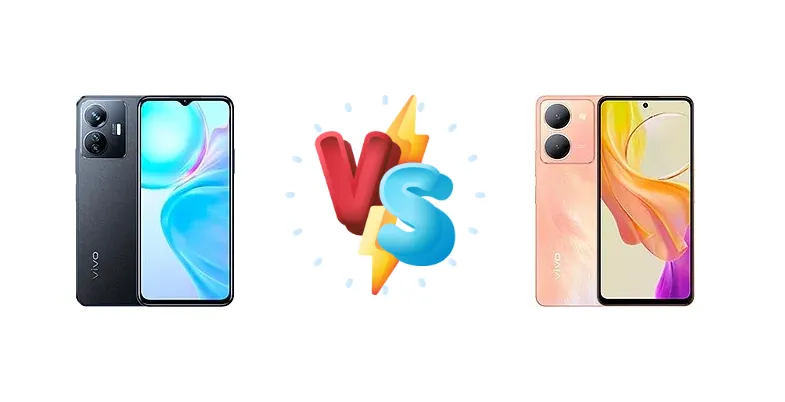
The vivo Y77 series targets the budget-conscious smartphone user, offering a blend of features and affordability. The Y77e (t1) and Y77t represent two points within this segment, with the 't' variant introducing a newer chipset and faster charging. This comparison dissects the key differences to help you determine which model best suits your needs.
🏆 Quick Verdict
For most users, the vivo Y77t is the superior choice. Its Dimensity 7020 chipset provides a noticeable performance uplift over the Y77e's Dimensity 810, and the 44W charging significantly reduces downtime. While the Y77e remains a viable option, the Y77t offers better future-proofing and a more responsive user experience.
| Network |
|---|
| 2G bands | GSM 850 / 900 / 1800 / 1900 | GSM 850 / 900 / 1800 / 1900 |
| 3G bands | HSDPA 850 / 900 / 2100 | HSDPA 850 / 900 / 2100 |
| 4G bands | 1, 3, 5, 8, 28, 34, 38, 39, 40, 41 | 1, 3, 5, 8, 28, 34, 38, 39, 40, 41 |
| 5G bands | 1, 5, 8, 28, 41, 77, 78 SA/NSA | 1, 5, 8, 28, 41, 77, 78 SA/NSA |
| Speed | HSPA, LTE, 5G | HSPA, LTE, 5G |
| Technology | GSM / CDMA / HSPA / CDMA2000 / LTE / 5G | GSM / CDMA / HSPA / CDMA2000 / LTE / 5G |
| | CDMA2000 1x | - |
| Launch |
|---|
| Announced | 2022, August 19 | 2023, August 18 |
| Status | Cancelled | Available. Released 2023, August 18 |
| Body |
|---|
| Build | Glass front, plastic frame, plastic back | Glass front, plastic frame, plastic back |
| Dimensions | 164 x 75.8 x 8.3 mm (6.46 x 2.98 x 0.33 in) | 164.1 x 76.2 x 8 mm (6.46 x 3.00 x 0.31 in) |
| SIM | Nano-SIM + Nano-SIM | Nano-SIM + Nano-SIM |
| Weight | 194 g (6.84 oz) | 190 g (6.70 oz) |
| Display |
|---|
| Resolution | 1080 x 2408 pixels, 20:9 ratio (~401 ppi density) | 1080 x 2388 pixels (~395 ppi density) |
| Size | 6.58 inches, 104.3 cm2 (~83.9% screen-to-body ratio) | 6.64 inches, 106.8 cm2 (~85.4% screen-to-body ratio) |
| Type | IPS LCD | IPS LCD, 120Hz, HDR10 |
| Platform |
|---|
| CPU | Octa-core (2x2.4 GHz Cortex-A76 & 6x2.0 GHz Cortex-A55) | Octa-core (2x2.2 GHz Cortex-A78 & 6x2.0 GHz Cortex-A55) |
| Chipset | Mediatek Dimensity 810 (6 nm) | Mediatek Dimensity 7020 (6 nm) |
| GPU | Mali-G57 MC2 | IMG BXM-8-256 |
| OS | Android 12, OriginOS Ocean | Android 13, OriginOS 3 |
| Memory |
|---|
| Card slot | microSDXC (uses shared SIM slot) | No |
| Internal | 256GB 8GB RAM | 256GB 8GB RAM, 256GB 12GB RAM |
| | UFS 2.2 | - |
| Main Camera |
|---|
| Dual | 50 MP, f/1.8, (wide), PDAF
2 MP (macro) | 50 MP, f/1.8, (wide), PDAF
Auxiliary lens |
| Features | LED flash, HDR, panorama | LED flash, HDR, panorama |
| Single | 8 MP, f/2.0, (wide) | - |
| Video | 1080p@30fps | 1080p@30fps |
| Selfie camera |
|---|
| Single | 8 MP, f/2.0, (wide) | 8 MP, f/2.0, (wide) |
| Video | 1080p@30fps | 1080p@30fps |
| Sound |
|---|
| 3.5mm jack | Yes | - |
| 35mm jack | Yes | Yes |
| Loudspeaker | Yes | Yes |
| Comms |
|---|
| Bluetooth | 5.1, A2DP, LE, aptX HD | 5.3, A2DP, LE, aptX HD |
| NFC | No | No |
| Positioning | GPS, GLONASS, GALILEO, BDS, QZSS | GPS (L1), GLONASS (G1), BDS (B1I), GALILEO (E1), QZSS (L1) |
| Radio | No | No |
| USB | USB Type-C 2.0, OTG | USB Type-C 2.0, OTG |
| WLAN | Wi-Fi 802.11 a/b/g/n/ac, dual-band, Wi-Fi Direct | Wi-Fi 802.11 a/b/g/n/ac, dual-band, Wi-Fi Direct |
| Features |
|---|
| Sensors | Fingerprint (side-mounted), accelerometer, proximity, compass | Fingerprint (side-mounted), accelerometer, proximity, compass |
| Battery |
|---|
| Charging | 18W wired | 44W wired |
| Type | 5000 mAh | 5000 mAh |
| Misc |
|---|
| Colors | Black, Blue gradient, Pink | Black, Mint, Gold |
| Models | V2166BA | - |
| Price | About 260 EUR | About 170 EUR |
vivo Y77e (t1)
- Potentially lower price point
- Slightly higher CPU clock speeds (on paper)
- Good for basic smartphone tasks
- Slower charging speed (18W)
- Older Dimensity 810 chipset
- Less efficient CPU architecture
vivo Y77t
- Faster 44W wired charging
- More modern Dimensity 7020 chipset
- Improved ISP for better image processing
- Better sustained performance
- Likely a higher price tag
- Potentially slightly lower peak CPU clock speeds
Display Comparison
Both devices utilize 6.58-inch LCD panels, but detailed specifications like resolution and refresh rate are missing. However, the core difference lies in the processing power driving them. The Dimensity 7020 in the Y77t has a more capable ISP (Image Signal Processor) which *could* translate to slightly better image processing for display, though this is difficult to quantify without direct comparison. Bezels and color accuracy are likely similar given their shared market positioning.
Camera Comparison
Without detailed camera sensor information, a direct comparison is limited. However, the Dimensity 7020’s improved ISP in the Y77t is a key advantage. This translates to faster image processing, better noise reduction, and potentially improved dynamic range. While both phones likely feature similar camera setups targeting the budget segment, the Y77t’s ISP will likely yield more refined images, especially in challenging lighting conditions. The absence of OIS on either device suggests reliance on software stabilization.
Performance
The vivo Y77t’s Mediatek Dimensity 7020 represents a generational leap over the Y77e’s Dimensity 810. While both are 6nm chips, the 7020 features Cortex-A78 cores clocked at 2.2 GHz, compared to the Y77e’s Cortex-A76 cores at 2.4 GHz. Although the Y77e's cores have a slightly higher clock speed, the A78 architecture is more efficient and delivers better sustained performance. This means the Y77t will handle demanding apps and games with less throttling. The CPU configuration of 2x2.2GHz and 6x2.0GHz on the 7020 versus 2x2.4GHz and 6x2.0GHz on the 810 suggests a more balanced approach to power and efficiency, benefiting users who frequently switch between applications.
Battery Life
The battery capacity is not specified, but the most significant difference is the charging speed. The Y77e supports 18W wired charging, while the Y77t boasts 44W wired charging. This difference is substantial. 44W charging will dramatically reduce charging times, allowing users to quickly top up their battery during short breaks. Even with a similar battery capacity, the Y77t’s faster charging provides a more convenient user experience, minimizing downtime and maximizing usability.
Buying Guide
Buy the vivo Y77e (t1) if you prioritize maximizing value and are comfortable with slower charging speeds. It's ideal for users who primarily browse, use social media, and make occasional calls. Buy the vivo Y77t if you demand smoother multitasking, enjoy mobile gaming, and value the convenience of rapid charging – even if it means a slightly higher upfront cost.
Frequently Asked Questions
❓ Will the Dimensity 7020 in the Y77t handle demanding games like PUBG Mobile smoothly?
Yes, the Dimensity 7020 is a capable chipset for gaming. While it won't deliver flagship-level performance, it should handle PUBG Mobile at medium to high settings with stable frame rates. The improved CPU and GPU architecture compared to the Dimensity 810 in the Y77e will result in a smoother and more consistent gaming experience.
❓ How much faster is the 44W charging on the Y77t compared to the 18W charging on the Y77e?
The 44W charging on the Y77t will significantly reduce charging times. While exact 0-100% times depend on battery capacity (which isn't specified), you can expect the Y77t to charge roughly twice as fast as the Y77e. This means a quick top-up during a short break is far more practical with the Y77t.
❓ Does the Y77t experience overheating during prolonged gaming sessions?
The Dimensity 7020's 6nm process and improved efficiency should mitigate overheating issues. However, sustained gaming will inevitably generate heat. The Y77t's thermal management system will likely throttle performance slightly to prevent overheating, but it should still provide a playable experience for extended periods.