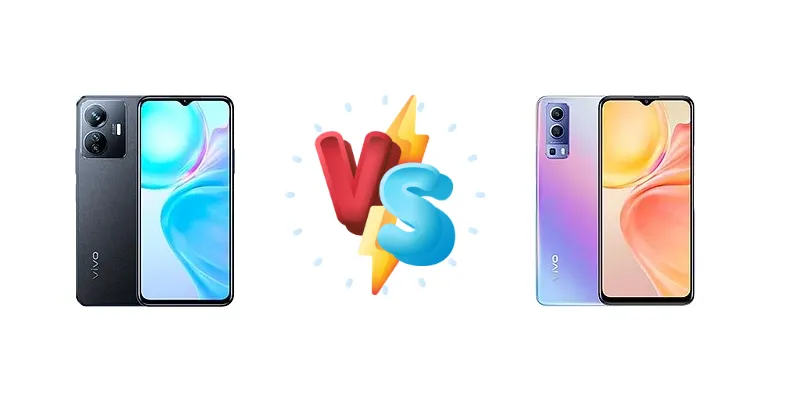
The vivo Y77e (t1) and Y75s represent vivo’s commitment to delivering affordable smartphones. Both devices utilize Mediatek Dimensity chipsets, but a closer look reveals key differences in processing power and efficiency. This comparison dissects the nuances between the Dimensity 810 in the Y77e (t1) and the Dimensity 700 in the Y75s, helping you determine which phone best suits your needs.
🏆 Quick Verdict
For most users, the vivo Y77e (t1) offers a slight edge due to its more powerful Dimensity 810 chipset. While both phones share the same 18W charging, the Y77e (t1)'s processor provides a noticeable performance boost in demanding tasks and gaming, making it the better all-around choice.
| Network |
|---|
| 2G bands | GSM 850 / 900 / 1800 / 1900 | GSM 850 / 900 / 1800 / 1900 |
| 3G bands | HSDPA 850 / 900 / 2100 | HSDPA 850 / 900 / 1700(AWS) / 1900 / 2100 |
| 4G bands | 1, 3, 5, 8, 28, 34, 38, 39, 40, 41 | 1, 3, 4, 5, 8, 28, 38, 39, 40, 41 |
| 5G bands | 1, 5, 8, 28, 41, 77, 78 SA/NSA | 1, 8, 28, 41, 77, 78 SA/NSA |
| Speed | HSPA, LTE, 5G | HSPA, LTE, 5G |
| Technology | GSM / CDMA / HSPA / CDMA2000 / LTE / 5G | GSM / CDMA / HSPA / CDMA2000 / LTE / 5G |
| | CDMA2000 1x | CDMA2000 1x |
| Launch |
|---|
| Announced | 2022, August 19 | 2022, September 07 |
| Status | Cancelled | Available. Released 2022, November |
| Body |
|---|
| Build | Glass front, plastic frame, plastic back | - |
| Dimensions | 164 x 75.8 x 8.3 mm (6.46 x 2.98 x 0.33 in) | 164 x 75.3 x 8.5 mm (6.46 x 2.96 x 0.33 in) |
| SIM | Nano-SIM + Nano-SIM | Nano-SIM + Nano-SIM |
| Weight | 194 g (6.84 oz) | 193 g (6.81 oz) |
| Display |
|---|
| Resolution | 1080 x 2408 pixels, 20:9 ratio (~401 ppi density) | 1080 x 2408 pixels, 20:9 ratio (~401 ppi density) |
| Size | 6.58 inches, 104.3 cm2 (~83.9% screen-to-body ratio) | 6.58 inches, 104.3 cm2 (~84.5% screen-to-body ratio) |
| Type | IPS LCD | IPS LCD |
| Platform |
|---|
| CPU | Octa-core (2x2.4 GHz Cortex-A76 & 6x2.0 GHz Cortex-A55) | Octa-core (2x2.2 GHz Cortex-A76 & 6x2.0 GHz Cortex-A55) |
| Chipset | Mediatek Dimensity 810 (6 nm) | Mediatek Dimensity 700 (7 nm) |
| GPU | Mali-G57 MC2 | Mali-G57 MC2 |
| OS | Android 12, OriginOS Ocean | Android 11, OriginOS Ocean |
| Memory |
|---|
| Card slot | microSDXC (uses shared SIM slot) | microSDXC (uses shared SIM slot) |
| Internal | 256GB 8GB RAM | 256GB 8GB RAM, 256GB 12GB RAM |
| | UFS 2.2 | UFS 2.2 |
| Main Camera |
|---|
| Dual | 50 MP, f/1.8, (wide), PDAF
2 MP (macro) | - |
| Features | LED flash, HDR, panorama | LED flash, HDR, panorama |
| Single | 8 MP, f/2.0, (wide) | 8 MP, f/2.0, (wide) |
| Triple | - | 64 MP, f/1.8, (wide), PDAF
8 MP, f/2.2, 120˚, 16mm (ultrawide), 1/4.0", 1.12µm
2 MP (macro) |
| Video | 1080p@30fps | 4K@30fps, 1080p@30fps, gyro-EIS |
| Selfie camera |
|---|
| Features | - | HDR |
| Single | 8 MP, f/2.0, (wide) | 8 MP, f/2.0, (wide) |
| Video | 1080p@30fps | 1080p@30fps |
| Sound |
|---|
| 3.5mm jack | Yes | Yes |
| 35mm jack | Yes | Yes |
| Loudspeaker | Yes | Yes |
| Comms |
|---|
| Bluetooth | 5.1, A2DP, LE, aptX HD | 5.1, A2DP, LE, aptX HD |
| NFC | No | No |
| Positioning | GPS, GLONASS, GALILEO, BDS, QZSS | GPS, GLONASS, GALILEO, BDS |
| Radio | No | No |
| USB | USB Type-C 2.0, OTG | USB Type-C, OTG |
| WLAN | Wi-Fi 802.11 a/b/g/n/ac, dual-band, Wi-Fi Direct | Wi-Fi 802.11 a/b/g/n/ac, dual-band, Wi-Fi Direct |
| Features |
|---|
| Sensors | Fingerprint (side-mounted), accelerometer, proximity, compass | Fingerprint (side-mounted), accelerometer, gyro, proximity, compass |
| Battery |
|---|
| Charging | 18W wired | 18W wired |
| Type | 5000 mAh | 5000 mAh |
| Misc |
|---|
| Colors | Black, Blue gradient, Pink | Black, Gradient |
| Models | V2166BA | - |
| Price | About 260 EUR | About 270 EUR |
vivo Y77e (t1)
- More powerful Dimensity 810 chipset
- Potentially better power efficiency
- Slightly improved multitasking performance
- May be slightly more expensive
- No significant advantage in camera quality (without sensor details)
vivo Y75s
- Generally more affordable
- Sufficient performance for basic tasks
- Similar charging speed to the Y77e (t1)
- Less powerful Dimensity 700 chipset
- Lower sustained performance under load
- May struggle with demanding games
Display Comparison
Unfortunately, detailed display specifications are unavailable. However, given the price points of both devices, we can assume both utilize LCD panels. The focus here is on processing power, not display fidelity. Bezels are likely comparable, and color accuracy will be standard for this segment. The absence of high refresh rate panels is expected.
Camera Comparison
Without detailed camera sensor information, a direct comparison is difficult. It’s reasonable to assume both phones feature a multi-camera setup with a primary sensor, depth sensor, and potentially a macro lens. The image processing capabilities will likely be similar, relying on vivo’s software algorithms. The Dimensity 810’s slightly more powerful ISP *could* offer marginally faster image processing, but the impact will be minimal without knowing the sensor specifications. We can expect similar low-light performance given the likely sensor quality in this price bracket.
Performance
The core difference lies in the chipsets. The vivo Y77e (t1) boasts the Mediatek Dimensity 810 (6nm), featuring a CPU configuration of 2x2.4 GHz Cortex-A76 and 6x2.0 GHz Cortex-A55 cores. The Y75s utilizes the Dimensity 700 (7nm) with a similar CPU layout of 2x2.2 GHz Cortex-A76 and 6x2.0 GHz Cortex-A55 cores. The 6nm process node of the Dimensity 810 generally translates to better power efficiency and potentially higher sustained performance compared to the 7nm Dimensity 700. While the core count is identical, the higher clock speed of the A76 cores in the Y77e (t1) provides a measurable performance uplift in CPU-intensive applications. Both phones likely feature similar RAM configurations, but the chipset difference will be the primary determinant of overall responsiveness.
Battery Life
Both the vivo Y77e (t1) and Y75s are equipped with 18W wired charging. While the battery capacity isn't specified, the Dimensity 810’s improved power efficiency in the Y77e (t1) could translate to slightly longer battery life despite potentially similar battery sizes. The 18W charging speed will likely result in a 0-100% charge time of around 2-3 hours for both devices, making charging speed a non-differentiator.
Buying Guide
Buy the vivo Y77e (t1) if you prioritize smoother multitasking, occasional gaming, and a generally more responsive user experience. Its Dimensity 810 offers a tangible performance advantage. Buy the vivo Y75s if you are on a tighter budget and primarily need a phone for basic communication, social media, and light web browsing; the Dimensity 700 is sufficient for these everyday tasks.
Frequently Asked Questions
❓ Will the vivo Y77e (t1) handle demanding games like PUBG Mobile smoothly?
The Dimensity 810 in the Y77e (t1) offers a noticeable performance boost over the Dimensity 700. While it won't deliver flagship-level gaming, it should be capable of running PUBG Mobile at medium settings with acceptable frame rates. Expect some frame drops during intense action, but it will be a more playable experience than on the Y75s.
❓ Is the difference in chipset performance noticeable for everyday tasks like browsing and social media?
For basic tasks like browsing, social media, and messaging, the difference between the Dimensity 810 and 700 will be minimal. Both phones will handle these tasks adequately. However, the Y77e (t1) will feel more responsive when switching between apps or opening multiple tabs due to its more powerful processor.
❓ Does either phone support fast charging beyond the 18W specification?
Neither the vivo Y77e (t1) nor the Y75s officially support charging speeds beyond 18W. While some chargers may attempt to deliver more power, the phones are limited to 18W input. Expect a full charge to take approximately 2-3 hours.