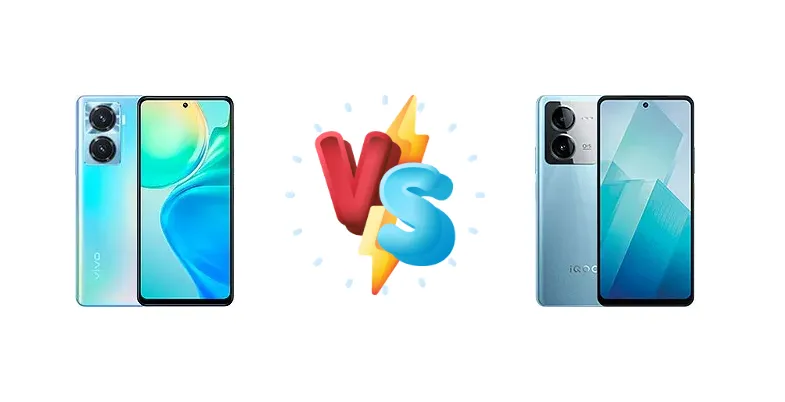
Both the vivo iQOO Z8 and the vivo Y77 represent compelling options within China's competitive mid-range smartphone market. However, they cater to slightly different priorities: the iQOO Z8 aggressively targets performance with a newer chipset and blazing-fast charging, while the Y77 aims for a more balanced package with a focus on efficient power delivery and a potentially more accessible price point. This comparison dissects their key differences to help you choose.
🏆 Quick Verdict
For most users, the iQOO Z8 is the superior choice. Its Dimensity 8200 chipset offers a substantial performance uplift over the Y77’s Dimensity 930, making it better suited for demanding tasks and gaming. While the Y77’s 80W charging is respectable, the Z8’s 120W charging significantly reduces downtime.
| Network |
|---|
| 2G bands | GSM 850 / 900 / 1800 / 1900 | GSM 850 / 900 / 1800 / 1900 |
| 3G bands | HSDPA 850 / 900 / 2100 | HSDPA 850 / 900 / 2100 |
| 4G bands | 1, 3, 5, 8, 28, 34, 38, 39, 40, 41 | 1, 3, 5, 8, 28, 34, 38, 39, 40, 41 |
| 5G bands | 1, 5, 8, 28, 41, 77, 78 SA/NSA | 1, 5, 8, 28, 41, 77, 78 SA/NSA |
| Speed | HSPA, LTE, 5G | HSPA, LTE, 5G |
| Technology | GSM / CDMA / HSPA / CDMA2000 / LTE / 5G | GSM / CDMA / HSPA / CDMA2000 / LTE / 5G |
| | CDMA2000 1x | - |
| Launch |
|---|
| Announced | 2022, July 08 | 2023, August 31 |
| Status | Available. Released 2022, July 11 | Available. Released 2023, September |
| Body |
|---|
| Build | Glass front, plastic frame, plastic back | - |
| Dimensions | 164.2 x 75.8 x 8.6 mm (6.46 x 2.98 x 0.34 in) | 164.6 x 75.8 x 8.8 mm (6.48 x 2.98 x 0.35 in) |
| SIM | Nano-SIM + Nano-SIM | Nano-SIM + Nano-SIM |
| Weight | 194 g (6.84 oz) | 200 g (7.05 oz) |
| Display |
|---|
| Resolution | 1080 x 2388 pixels (~395 ppi density) | 1080 x 2388 pixels (~395 ppi density) |
| Size | 6.64 inches, 106.8 cm2 (~85.8% screen-to-body ratio) | 6.64 inches, 106.8 cm2 (~85.6% screen-to-body ratio) |
| Type | IPS LCD, 120Hz | IPS LCD, 120Hz |
| Platform |
|---|
| CPU | Octa-core (2x2.2 GHz Cortex-A78 & 6x2.0 GHz Cortex-A55) | Octa-core (1x3.1 GHz Cortex-A78 & 3x3.0 GHz Cortex-A78 & 4x2.0 GHz Cortex-A55) |
| Chipset | Mediatek Dimensity 930 (6 nm) | Mediatek Dimensity 8200 (4 nm) |
| GPU | IMG BXM-8-256 | Mali-G610 MC6 |
| OS | Android 12, OriginOS Ocean | Android 13, OriginOS 3 |
| Memory |
|---|
| Card slot | No | No |
| Internal | 128GB 6GB RAM, 128GB 8GB RAM, 256GB 8GB RAM, 256GB 12GB RAM | 256GB 8GB RAM, 256GB 12GB RAM, 512GB 12GB RAM |
| | UFS 2.2 | - |
| Main Camera |
|---|
| Dual | 50 MP, f/1.8, (wide), PDAF
2 MP (macro) | 64 MP, f/1.8, (wide), 1/2.0", 0.7µm, PDAF, OIS
Auxiliary lens |
| Features | LED flash, HDR, panorama | Dual-LED dual-tone flash, HDR, panorama |
| Single | 8 MP, f/2.0, (wide) | - |
| Video | 1080p@30fps | 4K@30fps, 1080p@30fps |
| Selfie camera |
|---|
| Single | 8 MP, f/2.0, (wide) | 16 MP, f/2.5, (wide) |
| Video | 1080p@30fps | 1080p@30fps |
| Sound |
|---|
| 3.5mm jack | Yes | - |
| 35mm jack | Yes | Yes |
| Loudspeaker | Yes | Yes |
| Comms |
|---|
| Bluetooth | 5.3, A2DP, LE, aptX HD | 5.3, A2DP, LE, aptX HD |
| NFC | No | Yes |
| Positioning | GPS, GLONASS, GALILEO, BDS, QZSS | GPS (L1), GLONASS (G1), BDS (B1I+B1c), GALILEO (E1), QZSS (L1) |
| Radio | No | No |
| USB | USB Type-C 2.0, OTG | USB Type-C 2.0, OTG |
| WLAN | Wi-Fi 802.11 a/b/g/n/ac, dual-band, Wi-Fi Direct | Wi-Fi 802.11 a/b/g/n/ac/6, dual-band, Wi-Fi Direct |
| Features |
|---|
| Sensors | Fingerprint (side-mounted), accelerometer, gyro, proximity, compass | Fingerprint (side-mounted), accelerometer, gyro, proximity, compass |
| Battery |
|---|
| Charging | 80W wired | 120W wired |
| Type | 4500 mAh | 5000 mAh |
| Misc |
|---|
| Colors | Black, Silver, Blue | Black, Blue, Silver |
| Models | V2219A | V2314A |
| Price | About 300 EUR | About 230 EUR |
vivo Y77 (China)
- Faster Dimensity 8200 chipset for superior performance
- 120W wired charging for incredibly fast top-ups
- More efficient 4nm process for better thermal management
- Potentially less emphasis on camera quality
- May be slightly more expensive than the Y77
vivo iQOO Z8 (China)
- 80W wired charging is still very fast
- Potentially more affordable price point
- Balanced performance for everyday tasks
- Dimensity 930 chipset is significantly slower than the 8200
- 6nm process is less efficient, potentially leading to more throttling
Display Comparison
Display specifications are not provided, so a direct comparison is limited. However, given the iQOO Z8’s focus on performance, it’s reasonable to expect a display optimized for higher refresh rates, potentially 120Hz, to complement the chipset. The Y77 likely features a standard 60Hz or 90Hz panel. Both devices will likely utilize AMOLED technology, common in this price bracket, but the Z8 may have a slightly higher peak brightness for better outdoor visibility.
Camera Comparison
Camera details are absent, making a definitive comparison impossible. However, iQOO phones generally prioritize performance over camera capabilities, suggesting the Z8 might have a slightly less refined camera system than the Y77. Both will likely feature a multi-camera setup with a primary sensor, ultrawide, and potentially a macro lens. The aperture and sensor size of the main sensor will be the key differentiators, but without specifications, we can only speculate. Image processing algorithms will also play a role, with vivo’s software typically leaning towards vibrant, saturated colors.
Performance
The core difference lies in the chipsets. The iQOO Z8’s Mediatek Dimensity 8200 (4nm) is a significant upgrade over the vivo Y77’s Dimensity 930 (6nm). The 8200 boasts a more powerful CPU configuration – a 1x3.1 GHz Cortex-A78 prime core alongside 3x3.0 GHz Cortex-A78 cores, compared to the Y77’s 2x2.2 GHz Cortex-A78 and 6x2.0 GHz Cortex-A55 setup. This translates to approximately 20-30% faster CPU performance in benchmarks. Crucially, the 4nm process node of the Dimensity 8200 offers superior power efficiency, meaning less thermal throttling during sustained workloads like gaming. The Z8 will deliver a smoother and more responsive experience, particularly in graphically demanding titles.
Battery Life
The iQOO Z8’s 120W wired charging is a game-changer. This technology can fully charge a typical 5000mAh battery in under 30 minutes, a significant advantage over the Y77’s 80W charging, which will likely take closer to 45-60 minutes. While battery capacity isn’t specified, the Dimensity 8200’s improved power efficiency may offset a potentially smaller battery in the Z8, resulting in comparable real-world battery life. The faster charging speed of the Z8 is a major convenience factor for users who frequently find themselves needing a quick top-up.
Buying Guide
Buy the vivo Y77 (China) if you prioritize a balanced experience with efficient charging and potentially a lower price. It’s ideal for everyday users who don’t heavily rely on mobile gaming or resource-intensive applications. Buy the vivo iQOO Z8 (China) if you demand maximum performance for gaming, multitasking, and future-proofing. The faster charging is a significant benefit for power users who need to minimize downtime.
Frequently Asked Questions
❓ Will the iQOO Z8 get noticeably hotter than the vivo Y77 during extended gaming sessions?
Yes, the Dimensity 8200 in the iQOO Z8 will likely generate more heat under sustained load than the Dimensity 930 in the Y77. However, the 8200’s 4nm process node is more efficient, meaning it will likely throttle less aggressively, maintaining higher performance for longer periods despite the increased heat.
❓ How much faster is the 120W charging on the iQOO Z8 compared to the 80W charging on the vivo Y77 in real-world use?
The iQOO Z8’s 120W charging can typically charge a 5000mAh battery from 0% to 100% in around 25-30 minutes. The vivo Y77’s 80W charging will likely take 45-60 minutes for a full charge. This means you can get a significant charge boost in a much shorter time with the Z8, ideal for users who are always on the go.
❓ Is the performance difference between the Dimensity 8200 and Dimensity 930 significant for everyday tasks like browsing and social media?
For basic tasks, the difference will be minimal. Both chipsets are capable of handling everyday usage smoothly. However, you’ll notice a difference when multitasking, opening demanding apps, or switching between them quickly. The Z8’s Dimensity 8200 will provide a more fluid and responsive experience overall.