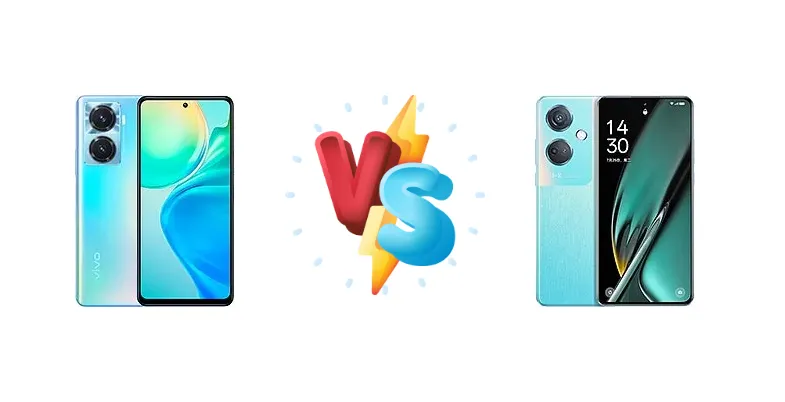
The Oppo K11 and vivo Y77 (China) represent compelling options in the increasingly competitive mid-range smartphone market. Both devices prioritize performance and fast charging, but diverge in their chipset choices – Qualcomm’s Snapdragon 782G in the K11 versus MediaTek’s Dimensity 930 in the Y77. This comparison dissects these key differences to determine which phone delivers the best value for your money.
🏆 Quick Verdict
For most users, the Oppo K11 emerges as the stronger choice. Its Snapdragon 782G offers a slight edge in CPU performance, particularly in sustained loads, and the 100W charging is significantly faster than the Y77’s 80W, reaching 100% in just 26 minutes. While the Y77 is still a capable device, the K11’s advantages justify the potential price difference.
| Network |
|---|
| 2G bands | GSM 850 / 900 / 1800 / 1900 | GSM 850 / 900 / 1800 / 1900 |
| 3G bands | HSDPA 850 / 900 / 2100 | HSDPA 850 / 900 / 1700(AWS) / 1900 / 2100 |
| 4G bands | 1, 3, 5, 8, 28, 34, 38, 39, 40, 41 | 1, 2, 3, 4, 5, 7, 8, 28, 34, 38, 39, 40, 41 |
| 5G bands | 1, 5, 8, 28, 41, 77, 78 SA/NSA | 1, 3, 5, 8, 28, 40, 41, 77, 78 SA/NSA |
| Speed | HSPA, LTE, 5G | HSPA, LTE, 5G |
| Technology | GSM / CDMA / HSPA / CDMA2000 / LTE / 5G | GSM / CDMA / HSPA / CDMA2000 / LTE / 5G |
| | CDMA2000 1x | - |
| Launch |
|---|
| Announced | 2022, July 08 | 2023, July 25 |
| Status | Available. Released 2022, July 11 | Available. Released 2023, August 01 |
| Body |
|---|
| Build | Glass front, plastic frame, plastic back | Glass front, plastic frame, plastic back |
| Dimensions | 164.2 x 75.8 x 8.6 mm (6.46 x 2.98 x 0.34 in) | 162.7 x 75.5 x 8.2 mm (6.41 x 2.97 x 0.32 in) |
| SIM | Nano-SIM + Nano-SIM | Nano-SIM + Nano-SIM |
| Weight | 194 g (6.84 oz) | 184 g (6.49 oz) |
| Display |
|---|
| Protection | - | Corning Gorilla Glass 5 |
| Resolution | 1080 x 2388 pixels (~395 ppi density) | 1080 x 2400 pixels, 20:9 ratio (~393 ppi density) |
| Size | 6.64 inches, 106.8 cm2 (~85.8% screen-to-body ratio) | 6.7 inches, 108.4 cm2 (~88.2% screen-to-body ratio) |
| Type | IPS LCD, 120Hz | AMOLED, 1B colors, 120Hz, HDR10+, 500 nits (typical), 1100 nits (peak) |
| Platform |
|---|
| CPU | Octa-core (2x2.2 GHz Cortex-A78 & 6x2.0 GHz Cortex-A55) | Octa-core (1x2.7 GHz Cortex-A78 & 3x2.4 GHz Cortex-A78 & 4x1.8 GHz Cortex-A55) |
| Chipset | Mediatek Dimensity 930 (6 nm) | Qualcomm Snapdragon 782G (6 nm) |
| GPU | IMG BXM-8-256 | Adreno 642L |
| OS | Android 12, OriginOS Ocean | Android 13, ColorOS 13.1 |
| Memory |
|---|
| Card slot | No | microSDXC (dedicated slot) |
| Internal | 128GB 6GB RAM, 128GB 8GB RAM, 256GB 8GB RAM, 256GB 12GB RAM | 256GB 8GB RAM, 256GB 12GB RAM, 512GB 12GB RAM |
| | UFS 2.2 | - |
| Main Camera |
|---|
| Dual | 50 MP, f/1.8, (wide), PDAF
2 MP (macro) | - |
| Features | LED flash, HDR, panorama | LED flash, HDR, panorama |
| Single | 8 MP, f/2.0, (wide) | - |
| Triple | - | 50 MP, f/1.8, 24mm (wide), 1/1.56", 1.0µm, multi-directional PDAF, OIS
8 MP, f/2.2, 112˚ (ultrawide), 1/4.0", 1.12µm
2 MP (macro) |
| Video | 1080p@30fps | 4K@30fps, 1080p@30/60/120fps, gyro-EIS |
| Selfie camera |
|---|
| Features | - | HDR |
| Single | 8 MP, f/2.0, (wide) | 16 MP, f/2.4, 24mm (wide), 1.0µm |
| Video | 1080p@30fps | 1080p@30fps, gyro-EIS |
| Sound |
|---|
| 3.5mm jack | Yes | - |
| 35mm jack | Yes | No |
| Loudspeaker | Yes | Yes, with stereo speakers |
| Comms |
|---|
| Bluetooth | 5.3, A2DP, LE, aptX HD | 5.2, A2DP, LE, aptX HD |
| NFC | No | Yes |
| Positioning | GPS, GLONASS, GALILEO, BDS, QZSS | GPS, GLONASS, GALILEO, BDS, QZSS |
| Radio | No | No |
| USB | USB Type-C 2.0, OTG | USB Type-C 2.0, OTG |
| WLAN | Wi-Fi 802.11 a/b/g/n/ac, dual-band, Wi-Fi Direct | Wi-Fi 802.11 a/b/g/n/ac/6, dual-band, Wi-Fi Direct |
| Features |
|---|
| Sensors | Fingerprint (side-mounted), accelerometer, gyro, proximity, compass | Fingerprint (under display, optical), accelerometer, gyro, proximity, compass |
| Battery |
|---|
| Charging | 80W wired | 100W wired, 100% in 26 min |
| Type | 4500 mAh | Li-Po 5000 mAh |
| Misc |
|---|
| Colors | Black, Silver, Blue | Moonshadow Gray; Glacier Blue |
| Models | V2219A | PJC110 |
| Price | About 300 EUR | - |
vivo Y77 (China)
- Faster 100W charging (26 minutes to full)
- More powerful Snapdragon 782G CPU
- Potentially better sustained performance due to Qualcomm architecture
- Potentially higher price
- Oppo’s image processing may not appeal to all users
Oppo K11
- Potentially lower price
- MediaTek’s Dimensity 930 offers good all-around performance
- Vivo’s image processing aims for a more natural look
- Slower 80W charging
- Dimensity 930 may throttle more under sustained load
Display Comparison
Neither device’s display specifications are provided, so a direct comparison is limited. However, given their price bracket, both likely feature AMOLED panels with FHD+ resolution. The absence of LTPO technology suggests standard 60Hz or 120Hz refresh rates. The user experience will likely hinge on color calibration and peak brightness, areas where Oppo historically performs well. Bezels are expected to be minimal on both, reflecting current design trends.
Camera Comparison
Without detailed camera specifications, a definitive comparison is difficult. However, both phones likely feature a multi-camera setup with a primary sensor, ultrawide, and potentially a macro lens. The image processing algorithms will be a key differentiator. Oppo’s camera software is known for its vibrant colors and aggressive sharpening, while vivo often aims for a more natural look. Sensor size and aperture are crucial; a larger sensor with a wider aperture will capture more light, resulting in better low-light performance. The absence of OIS information suggests neither phone prioritizes optical image stabilization.
Performance
The core difference lies in the chipsets. The Oppo K11’s Snapdragon 782G (6nm) boasts a 1x2.7 GHz Cortex-A78 prime core, complemented by 3x2.4 GHz Cortex-A78 cores and 4x1.8 GHz Cortex-A55 efficiency cores. This configuration provides a performance advantage over the vivo Y77’s Dimensity 930 (6nm), which uses 2x2.2 GHz Cortex-A78 cores and 6x2.0 GHz Cortex-A55 cores. The Snapdragon 782G’s higher clock speeds and more powerful core configuration translate to faster app loading times and smoother multitasking. While both use a 6nm process, Qualcomm’s architecture generally offers better sustained performance and thermal management. The K11 is likely to exhibit less throttling during extended gaming sessions.
Battery Life
The Oppo K11’s 100W wired charging is a significant advantage, fully charging the device in just 26 minutes. The vivo Y77’s 80W charging is still fast, but noticeably slower. While battery capacity isn’t specified, the faster charging of the K11 mitigates any potential disadvantage from a slightly smaller battery. Users who frequently top up their phones will greatly benefit from the K11’s speed. The 6nm process node of both chipsets contributes to improved power efficiency, extending battery life during typical usage.
Buying Guide
Buy the vivo Y77 (China) if you prioritize a potentially lower price point and are comfortable with slightly less raw CPU power. Buy the Oppo K11 if you value faster charging speeds, a more robust CPU architecture for demanding tasks, and potentially better long-term software support from Oppo’s established ecosystem.
Frequently Asked Questions
❓ Will the Snapdragon 782G in the Oppo K11 handle demanding games like Genshin Impact at high settings?
The Snapdragon 782G is capable of running Genshin Impact at medium to high settings with playable frame rates. However, expect some frame drops during intense combat scenarios. The K11’s thermal management will be crucial for sustained performance; the 6nm process helps, but prolonged gaming may still lead to throttling.
❓ How much faster is the 100W charging on the Oppo K11 compared to the 80W charging on the vivo Y77 in real-world use?
The Oppo K11’s 100W charging can take a phone from 0% to 100% in approximately 26 minutes. The vivo Y77’s 80W charging will likely take around 35-45 minutes for a full charge. This translates to roughly 10-20 minutes saved per charge, a significant benefit for users who frequently need to top up their battery.
❓ Does the Oppo K11 support 5G connectivity?
While not explicitly stated in the provided data, the Snapdragon 782G chipset inherently supports 5G connectivity. Therefore, the Oppo K11 is highly likely to support 5G networks, provided it's compatible with your carrier's bands.