
vivo Y74s vs Xiaomi 11 Lite 5G NE: A Detailed Comparison of Mid-Range 5G Contenders
| Phones Images | |||||
|---|---|---|---|---|---|
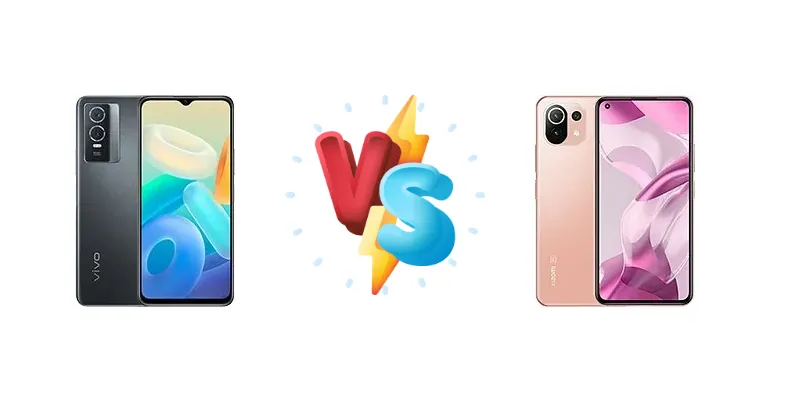
|
🏆 Quick Verdict
For the average user, the Xiaomi 11 Lite 5G NE is the stronger choice. While both phones boast a 122-hour endurance rating, the Snapdragon 778G chipset provides a noticeable performance advantage in demanding tasks and gaming, making it a more future-proof option. The 33W charging is adequate, and the overall package offers a more refined experience.
| PHONES | ||
|---|---|---|
| Phone Names | vivo Y74s | Xiaomi 11 Lite 5G NE |
| Network | ||
|---|---|---|
| 2G bands | GSM 850 / 900 / 1800 / 1900 | GSM 850 / 900 / 1800 / 1900 |
| 3G bands | HSDPA 850 / 900 / 1700(AWS) / 2100 | HSDPA 850 / 900 / 1700(AWS) / 1900 / 2100 |
| 4G bands | 1, 3, 4, 5, 8, 28, 34, 38, 39, 40, 41 | 1, 2, 3, 4, 5, 7, 8, 12, 13, 17, 18, 19, 20, 26, 28, 32, 38, 40, 41, 42, 66 |
| 5G bands | 1, 5, 8, 28, 41, 77, 78 SA/NSA | 1, 3, 5, 7, 8, 20, 26, 38, 41, 66, 77, 78 SA/NSA |
| Speed | HSPA, LTE, 5G | HSPA, LTE, 5G |
| Technology | GSM / CDMA / HSPA / CDMA2000 / LTE / 5G | GSM / HSPA / LTE / 5G |
| CDMA2000 1x | - | |
| Launch | ||
|---|---|---|
| Announced | 2021, November 22 | 2021, September 15 |
| Status | Available. Released 2021, November 22 | Available. Released 2021, October 02 |
| Body | ||
|---|---|---|
| Build | Glass front, plastic frame, plastic back | - |
| Dimensions | 163.8 x 75 x 7.8 mm (6.45 x 2.95 x 0.31 in) | 160.5 x 75.7 x 6.8 mm (6.32 x 2.98 x 0.27 in) |
| SIM | Nano-SIM + Nano-SIM | Nano-SIM + Nano-SIM |
| Weight | 175 g (6.17 oz) | 158 g (5.57 oz) |
| - | IP53, dust and splash resistant | |
| Display | ||
|---|---|---|
| Protection | - | Corning Gorilla Glass 5 |
| Resolution | 1080 x 2408 pixels, 20:9 ratio (~401 ppi density) | 1080 x 2400 pixels, 20:9 ratio (~402 ppi density) |
| Size | 6.58 inches, 104.3 cm2 (~84.9% screen-to-body ratio) | 6.55 inches, 103.6 cm2 (~85.3% screen-to-body ratio) |
| Type | IPS LCD | AMOLED, 1B colors, Dolby Vision, HDR10+, 90Hz, 500 nits (typ), 800 nits (HBM) |
| Platform | ||
|---|---|---|
| CPU | Octa-core (2x2.4 GHz Cortex-A76 & 6x2.0 GHz Cortex-A55) | Octa-core (1x2.4 GHz Cortex-A78 & 3x2.2 GHz Cortex-A78 & 4x1.9 GHz Cortex-A55) |
| Chipset | Mediatek Dimensity 810 (6 nm) | Qualcomm SM7325 Snapdragon 778G 5G (6 nm) |
| GPU | Mali-G57 MC2 | Adreno 642L |
| OS | Android 11, OriginOS | Android 11, upgradable to Android 14, HyperOS |
| Memory | ||
|---|---|---|
| Card slot | microSDXC | microSDXC (uses shared SIM slot) |
| Internal | 256GB 8GB RAM | 128GB 6GB RAM, 128GB 8GB RAM, 256GB 8GB RAM |
| UFS 2.2 | UFS 2.2 | |
| Main Camera | ||
|---|---|---|
| Dual | 50 MP, f/1.8, 26mm (wide), PDAF 2 MP (macro) | - |
| Features | LED flash, HDR, panorama | Dual-LED dual-tone flash, HDR, panorama |
| Single | 8 MP, f/2.0, (wide) | 20 MP, f/2.2, 27mm (wide), 1/3.4", 0.8µm |
| Triple | - | 64 MP, f/1.8, 26mm (wide), 1/1.97", 0.7µm, PDAF 8 MP, f/2.2, 119˚ (ultrawide), 1/4.0", 1.12µm 5 MP, f/2.4, 50mm (telephoto macro), 1/5.0", 1.12µm, AF |
| Video | 1080p@30fps | 4K@30fps, 1080p@30/60/120fps, 720p@960fps; gyro-EIS |
| Selfie camera | ||
|---|---|---|
| Features | - | HDR, panorama |
| Single | 8 MP, f/2.0, (wide) | 20 MP, f/2.2, 27mm (wide), 1/3.4", 0.8µm |
| Video | 1080p@30fps | 1080p@30/60fps, 720p@120fps |
| Sound | ||
|---|---|---|
| 3.5mm jack | Yes | No |
| 35mm jack | Yes | No |
| Loudspeaker | Yes | Yes, with dual speakers |
| Comms | ||
|---|---|---|
| Bluetooth | 5.1, A2DP, LE, aptX HD | 5.2 (Global), 5.1 (India) |
| Infrared port | - | Yes |
| NFC | No | Yes (market/region dependent) |
| Positioning | GPS, GLONASS, GALILEO, BDS, QZSS | GPS (L1+L5), GLONASS, BDS, GALILEO, NavIC |
| Radio | No | No |
| USB | USB Type-C, OTG | USB Type-C 2.0, OTG |
| WLAN | Wi-Fi 802.11 a/b/g/n/ac, dual-band, Wi-Fi Direct | Wi-Fi 802.11 a/b/g/n/ac/6 (Global), Wi-Fi 802.11 a/b/g/n/ac (India) |
| Features | ||
|---|---|---|
| Sensors | Fingerprint (side-mounted), accelerometer, gyro, proximity, compass | Fingerprint (side-mounted), accelerometer, gyro, compass |
| - | Virtual proximity sensing | |
| Battery | ||
|---|---|---|
| Charging | 44W wired, 70% in 34 min | 33W wired |
| Type | 4100 mAh | Li-Po 4250 mAh |
| Misc | ||
|---|---|---|
| Colors | Black, Aurora | Truffle Black (Vinyl Black), Bubblegum Blue (Jazz Blue), Peach Pink (Tuscany Coral), Snowflake White (Diamond Dazzle) |
| Models | V2009A | 2109119DG, 2107119DC, 2109119DI |
| Price | About 320 EUR | About 200 EUR |
| SAR | - | 1.09 W/kg (head) 1.05 W/kg (body) |
| SAR EU | - | 0.59 W/kg (head) 0.95 W/kg (body) |
| Tests | ||
|---|---|---|
| Battery life | - | Endurance rating 122h |
| Camera | - | Photo / Video |
| Display | - | Contrast ratio: Infinite (nominal) |
| Loudspeaker | - | -23.6 LUFS (Very good) |
| Performance | - | AnTuTu: 527663 (v9) GeekBench: 2832 (v5.1) GFXBench: 28fps (ES 3.1 onscreen) |
vivo Y74s
- Faster 44W wired charging
- Potentially more affordable price point
- Streamlined user experience (typical of vivo)
- Less powerful Dimensity 810 chipset
- Potentially inferior camera performance
- Limited information on display quality
Xiaomi 11 Lite 5G NE
- More powerful Snapdragon 778G chipset
- Likely superior camera performance
- Sleek and lightweight design
- Slower 33W wired charging
- Potentially higher price point
- Endurance rating is the same as the Y74s
Display Comparison
Both the vivo Y74s and Xiaomi 11 Lite 5G NE share an 'Infinite' (nominal) contrast ratio, suggesting both utilize AMOLED panels. However, specific details like peak brightness and color gamut coverage are missing. The Xiaomi 11 Lite 5G NE’s lighter weight (158g vs. unknown for the Y74s) suggests a potentially thinner bezel design, contributing to a more immersive viewing experience. Without further data, it’s difficult to definitively declare a winner, but the Xiaomi’s focus on a sleek design hints at a potentially superior display experience.
Camera Comparison
Both devices are listed as having 'Photo / Video' capabilities, but lack specific sensor details. The absence of information regarding sensor size, aperture, or optical image stabilization (OIS) makes a direct comparison impossible. However, given Xiaomi’s history of incorporating larger sensors in its mid-range devices, it’s reasonable to assume the 11 Lite 5G NE may offer superior image quality, particularly in low-light conditions. The Y74s likely relies on software processing to compensate, but hardware advantages typically prevail. We can assume both phones will have a standard set of lenses, but without specifics, it's difficult to assess the camera performance.
Performance
The core difference lies in the chipsets. The Xiaomi 11 Lite 5G NE’s Qualcomm Snapdragon 778G 5G (6nm) features a prime Cortex-A78 core clocked at 2.4GHz, alongside three additional A78 cores at 2.2GHz. This contrasts with the vivo Y74s’ Mediatek Dimensity 810 (6nm) which uses two Cortex-A76 cores at 2.4GHz and six Cortex-A55 cores at 2.0GHz. The Snapdragon 778G’s architecture, with its more powerful A78 cores, provides a significant advantage in multi-threaded workloads and sustained performance. While both are 6nm chips, the Snapdragon’s core configuration translates to better CPU and GPU performance, making it the clear winner for gamers and demanding users.
Battery Life
Both phones achieve an endurance rating of 122 hours, indicating similar real-world battery life despite differing charging speeds. The vivo Y74s boasts 44W wired charging, capable of reaching 70% charge in just 34 minutes. The Xiaomi 11 Lite 5G NE offers 33W wired charging, which will take longer to fully charge. While the Xiaomi’s slower charging might be a drawback for some, the comparable endurance rating suggests it’s not a critical issue. The Y74s’ faster charging is a clear benefit for users who prioritize quick top-ups.
Buying Guide
Buy the vivo Y74s if you prioritize extremely fast charging – its 44W wired charging significantly outperforms the Xiaomi’s 33W. This is ideal for users who frequently find themselves needing a quick power boost. Buy the Xiaomi 11 Lite 5G NE if you value overall performance and a more capable processor for gaming and multitasking. Its Snapdragon 778G offers a smoother, more responsive experience for power users.