
vivo Y74s vs Samsung Galaxy A52s 5G: A Deep Dive into Mid-Range 5G Contenders
| Phones Images | |||||
|---|---|---|---|---|---|
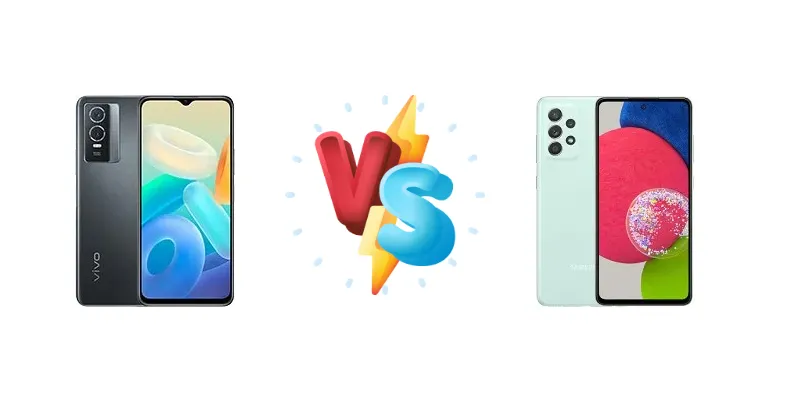
|
🏆 Quick Verdict
For most users, the Samsung Galaxy A52s 5G is the superior choice. While the vivo Y74s boasts faster 44W charging, the A52s 5G’s Snapdragon 778G provides a noticeable performance advantage in both CPU and GPU tasks, coupled with a brighter, more refined display experience.
| PHONES | ||
|---|---|---|
| Phone Names | vivo Y74s | Samsung Galaxy A52s 5G |
| Network | ||
|---|---|---|
| 2G bands | GSM 850 / 900 / 1800 / 1900 | GSM 850 / 900 / 1800 / 1900 |
| 3G bands | HSDPA 850 / 900 / 1700(AWS) / 2100 | HSDPA 850 / 900 / 1700(AWS) / 1900 / 2100 |
| 4G bands | 1, 3, 4, 5, 8, 28, 34, 38, 39, 40, 41 | 1, 2, 3, 4, 5, 7, 8, 12, 17, 20, 26, 28, 32, 38, 40, 41, 66 |
| 5G bands | 1, 5, 8, 28, 41, 77, 78 SA/NSA | 1, 3, 5, 7, 8, 20, 28, 38, 40, 41, 66, 78 SA/NSA/Sub6 |
| Speed | HSPA, LTE, 5G | HSPA 42.2/5.76 Mbps, LTE Cat18 1200/150 Mbps, 5G |
| Technology | GSM / CDMA / HSPA / CDMA2000 / LTE / 5G | GSM / HSPA / LTE / 5G |
| CDMA2000 1x | - | |
| Launch | ||
|---|---|---|
| Announced | 2021, November 22 | 2021, August 17 |
| Status | Available. Released 2021, November 22 | Available. Released 2021, September 01 |
| Body | ||
|---|---|---|
| Build | Glass front, plastic frame, plastic back | Glass front (Gorilla Glass 5), plastic back |
| Dimensions | 163.8 x 75 x 7.8 mm (6.45 x 2.95 x 0.31 in) | 159.9 x 75.1 x 8.4 mm (6.30 x 2.96 x 0.33 in) |
| SIM | Nano-SIM + Nano-SIM | · Nano-SIM· Nano-SIM + Nano-SIM |
| Weight | 175 g (6.17 oz) | 189 g (6.67 oz) |
| - | IP67 dust/water resistant (up to 1m for 30 min) | |
| Display | ||
|---|---|---|
| Protection | - | Corning Gorilla Glass 5 |
| Resolution | 1080 x 2408 pixels, 20:9 ratio (~401 ppi density) | 1080 x 2400 pixels, 20:9 ratio (~405 ppi density) |
| Size | 6.58 inches, 104.3 cm2 (~84.9% screen-to-body ratio) | 6.5 inches, 102.0 cm2 (~84.9% screen-to-body ratio) |
| Type | IPS LCD | Super AMOLED, 120Hz, 800 nits (HBM) |
| Platform | ||
|---|---|---|
| CPU | Octa-core (2x2.4 GHz Cortex-A76 & 6x2.0 GHz Cortex-A55) | Octa-core (1x2.4 GHz Cortex-A78 & 3x2.2 GHz Cortex-A78 & 4x1.9 GHz Cortex-A55) |
| Chipset | Mediatek Dimensity 810 (6 nm) | Qualcomm SM7325 Snapdragon 778G 5G (6 nm) |
| GPU | Mali-G57 MC2 | Adreno 642L |
| OS | Android 11, OriginOS | Android 11, upgradable to Android 14, One UI 6 |
| Memory | ||
|---|---|---|
| Card slot | microSDXC | microSDXC (uses shared SIM slot) |
| Internal | 256GB 8GB RAM | 128GB 4GB RAM, 128GB 6GB RAM, 128GB 8GB RAM, 256GB 6GB RAM, 256GB 8GB RAM |
| UFS 2.2 | - | |
| Main Camera | ||
|---|---|---|
| Dual | 50 MP, f/1.8, 26mm (wide), PDAF 2 MP (macro) | - |
| Features | LED flash, HDR, panorama | LED flash, panorama, HDR |
| Quad | - | 64 MP, f/1.8, 26mm (wide), 1/1.7", 0.8µm, PDAF, OIS 12 MP, f/2.2, 123˚ (ultrawide), 1.12µm 5 MP (macro) Auxiliary lens |
| Single | 8 MP, f/2.0, (wide) | 32 MP, f/2.2, 26mm (wide), 1/2.8", 0.8µm |
| Video | 1080p@30fps | 4K@30fps, 1080p@30/60fps; gyro-EIS |
| Selfie camera | ||
|---|---|---|
| Features | - | HDR |
| Single | 8 MP, f/2.0, (wide) | 32 MP, f/2.2, 26mm (wide), 1/2.8", 0.8µm |
| Video | 1080p@30fps | 4K@30fps, 1080p@30/60fps |
| Sound | ||
|---|---|---|
| 3.5mm jack | Yes | Yes |
| 35mm jack | Yes | Yes |
| Loudspeaker | Yes | Yes, with stereo speakers |
| Comms | ||
|---|---|---|
| Bluetooth | 5.1, A2DP, LE, aptX HD | 5.0, A2DP, LE |
| NFC | No | Yes (market/region dependent) |
| Positioning | GPS, GLONASS, GALILEO, BDS, QZSS | GPS, GLONASS, GALILEO, BDS, QZSS |
| Radio | No | No |
| USB | USB Type-C, OTG | USB Type-C 2.0, OTG |
| WLAN | Wi-Fi 802.11 a/b/g/n/ac, dual-band, Wi-Fi Direct | Wi-Fi 802.11 a/b/g/n/ac/6, dual-band, Wi-Fi Direct |
| Features | ||
|---|---|---|
| Sensors | Fingerprint (side-mounted), accelerometer, gyro, proximity, compass | Fingerprint (under display, optical), accelerometer, gyro, compass |
| - | Virtual Proximity Sensing | |
| Battery | ||
|---|---|---|
| Charging | 44W wired, 70% in 34 min | 25W wired |
| Type | 4100 mAh | Li-Ion 4500 mAh |
| Misc | ||
|---|---|---|
| Colors | Black, Aurora | Awesome Black, Awesome White, Awesome Purple, Awesome Mint |
| Models | V2009A | SM-A528B, SM-A528B/DS, SM-A528N |
| Price | About 320 EUR | £ 112.98 / € 249.47 |
| SAR | - | 0.72 W/kg (head) |
| SAR EU | - | 0.88 W/kg (head) 0.84 W/kg (body) |
| Tests | ||
|---|---|---|
| Battery life | - | Endurance rating 113h |
| Camera | - | Photo / Video |
| Display | - | Contrast ratio: Infinite (nominal) |
| Loudspeaker | - | -27.5 LUFS (Good) |
| Performance | - | AnTuTu: 429675 (v8), 506432(v9) GeekBench: 11060 (v4.4), 2801 (v5.1) GFXBench: 28fps (ES 3.1 onscreen) |
vivo Y74s
- Significantly faster 44W charging
- Competitive price point
- Adequate performance for everyday tasks
- Inferior CPU and GPU performance compared to Snapdragon 778G
- Likely lower display brightness and quality
- Less established brand reputation
Samsung Galaxy A52s 5G
- Superior performance with Snapdragon 778G 5G
- Brighter and more vibrant display
- Optical Image Stabilization (OIS) for improved camera performance
- Slower 25W charging
- Potentially higher price
- Software updates may be less frequent than some competitors
Display Comparison
The Samsung Galaxy A52s 5G holds a clear advantage in the display department, boasting a measured peak brightness of 800 nits. While the vivo Y74s’ display specifications are not provided, it’s unlikely to match this level of brightness, impacting outdoor visibility. The A52s 5G’s ‘Infinite’ contrast ratio (nominal) suggests a superior AMOLED panel, delivering deeper blacks and more vibrant colors. The lack of detailed display specs for the Y74s makes a precise comparison difficult, but Samsung’s history with AMOLED technology suggests a more refined viewing experience.
Camera Comparison
Both devices offer photo and video capabilities, but detailed sensor information is lacking for the vivo Y74s. The Samsung Galaxy A52s 5G likely benefits from Samsung’s established image processing pipeline and potentially a larger main sensor (typical for the A-series). Without specific aperture and sensor size details for the Y74s, it’s difficult to assess its low-light performance. The A52s 5G’s OIS (Optical Image Stabilization) is a significant advantage, resulting in sharper images and smoother videos, especially in challenging conditions. The presence of a 2MP macro camera on both devices is largely inconsequential, offering limited practical benefit.
Performance
The Qualcomm Snapdragon 778G 5G in the Galaxy A52s 5G is architecturally superior to the Mediatek Dimensity 810 in the vivo Y74s. The A52s 5G utilizes a 1x2.4 GHz Cortex-A78 core alongside 3x2.2 GHz Cortex-A78 cores, offering higher single-core performance than the Y74s’ 2x2.4 GHz Cortex-A76 configuration. Furthermore, the A52s 5G’s Adreno 642L GPU is expected to deliver significantly better graphics performance. Both chips are fabricated on a 6nm process, but Qualcomm’s optimizations generally result in better sustained performance and thermal management. The Y74s will handle daily tasks adequately, but the A52s 5G is the clear winner for gaming and demanding applications.
Battery Life
Both the vivo Y74s and Samsung Galaxy A52s 5G achieve an endurance rating of 113 hours, indicating similar overall battery life. However, the charging speeds differ significantly. The Y74s supports 44W wired charging, achieving 70% charge in just 34 minutes, while the A52s 5G is limited to 25W. This faster charging is a key advantage for the Y74s, reducing downtime. Despite the slower charging, the A52s 5G’s efficient Snapdragon 778G and optimized software contribute to its comparable endurance rating.
Buying Guide
Buy the vivo Y74s if you prioritize extremely fast charging and are primarily focused on everyday tasks like social media and light browsing. The 44W charging will minimize downtime. Buy the Samsung Galaxy A52s 5G if you value smoother performance for gaming and demanding applications, a brighter and more vibrant display, and a more established brand reputation with robust software support.