
vivo Y74s vs Motorola Edge 20 Fusion: A Deep Dive into Mid-Range Performance
| Phones Images | |||||
|---|---|---|---|---|---|
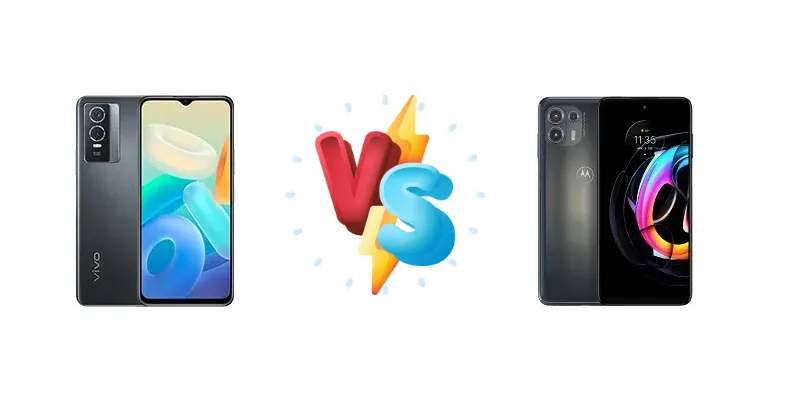
|
🏆 Quick Verdict
For most users, the vivo Y74s emerges as the slightly stronger choice. Its newer Dimensity 810 chipset, built on a more efficient 6nm process, offers a marginal performance advantage and potentially better thermal management, coupled with significantly faster 44W charging. While the Edge 20 Fusion remains a capable device, the Y74s provides a more modern foundation.
| PHONES | ||
|---|---|---|
| Phone Names | vivo Y74s | Motorola Edge 20 Fusion |
| Network | ||
|---|---|---|
| 2G bands | GSM 850 / 900 / 1800 / 1900 | GSM 850 / 900 / 1800 / 1900 |
| 3G bands | HSDPA 850 / 900 / 1700(AWS) / 2100 | HSDPA 850 / 900 / 1700(AWS) / 1900 / 2100 |
| 4G bands | 1, 3, 4, 5, 8, 28, 34, 38, 39, 40, 41 | 1, 2, 3, 4, 5, 7, 8, 12, 13, 17, 18, 19, 20, 26, 28, 32, 34, 38, 39, 40, 41, 42, 43, 66 |
| 5G bands | 1, 5, 8, 28, 41, 77, 78 SA/NSA | 1, 3, 5, 7, 8, 20, 28, 38, 40, 41, 77, 78, 66 SA/NSA/Sub6 |
| Speed | HSPA, LTE, 5G | HSPA 42.2/5.76 Mbps, LTE Cat18 1200/150 Mbps, 5G |
| Technology | GSM / CDMA / HSPA / CDMA2000 / LTE / 5G | GSM / HSPA / LTE / 5G |
| CDMA2000 1x | - | |
| Launch | ||
|---|---|---|
| Announced | 2021, November 22 | 2021, August 17 |
| Status | Available. Released 2021, November 22 | Available. Released 2021, August 27 |
| Body | ||
|---|---|---|
| Build | Glass front, plastic frame, plastic back | Glass front |
| Dimensions | 163.8 x 75 x 7.8 mm (6.45 x 2.95 x 0.31 in) | 166 x 76 x 8.3 mm (6.54 x 2.99 x 0.33 in) |
| SIM | Nano-SIM + Nano-SIM | Nano-SIM + Nano-SIM |
| Weight | 175 g (6.17 oz) | 185 g (6.53 oz) |
| - | Water-repellent design | |
| Display | ||
|---|---|---|
| Resolution | 1080 x 2408 pixels, 20:9 ratio (~401 ppi density) | 1080 x 2400 pixels, 20:9 ratio (~393 ppi density) |
| Size | 6.58 inches, 104.3 cm2 (~84.9% screen-to-body ratio) | 6.7 inches, 108.4 cm2 (~85.9% screen-to-body ratio) |
| Type | IPS LCD | OLED, 1B colors, 90Hz, HDR10+ |
| Platform | ||
|---|---|---|
| CPU | Octa-core (2x2.4 GHz Cortex-A76 & 6x2.0 GHz Cortex-A55) | Octa-core (2x2.4 GHz Cortex-A76 & 6x2.0 GHz Cortex-A55) |
| Chipset | Mediatek Dimensity 810 (6 nm) | Mediatek Dimensity 800U (7 nm) |
| GPU | Mali-G57 MC2 | Mali-G57 MC3 |
| OS | Android 11, OriginOS | Android 11 |
| Memory | ||
|---|---|---|
| Card slot | microSDXC | microSDXC |
| Internal | 256GB 8GB RAM | 128GB 6GB RAM, 128GB 8GB RAM |
| UFS 2.2 | - | |
| Main Camera | ||
|---|---|---|
| Dual | 50 MP, f/1.8, 26mm (wide), PDAF 2 MP (macro) | - |
| Features | LED flash, HDR, panorama | LED flash, HDR, panorama |
| Single | 8 MP, f/2.0, (wide) | - |
| Triple | - | 108 MP, f/1.9, (wide), 1/1.52", 0.7µm, PDAF 8 MP, f/2.2, 118˚ (ultrawide) Auxiliary lens |
| Video | 1080p@30fps | 4K@30fps, 1080p@30/60/120fps, gyro-EIS |
| Selfie camera | ||
|---|---|---|
| Features | - | HDR |
| Single | 8 MP, f/2.0, (wide) | 32 MP, f/2.3, (wide), 0.7µm |
| Video | 1080p@30fps | 1080p@30fps |
| Sound | ||
|---|---|---|
| 3.5mm jack | Yes | Yes |
| 35mm jack | Yes | Yes |
| Loudspeaker | Yes | Yes |
| Comms | ||
|---|---|---|
| Bluetooth | 5.1, A2DP, LE, aptX HD | 5.0, A2DP, LE |
| NFC | No | Yes |
| Positioning | GPS, GLONASS, GALILEO, BDS, QZSS | GPS, GLONASS, GALILEO |
| Radio | No | FM radio |
| USB | USB Type-C, OTG | USB Type-C 2.0 |
| WLAN | Wi-Fi 802.11 a/b/g/n/ac, dual-band, Wi-Fi Direct | Wi-Fi 802.11 a/b/g/n/ac, dual-band, Wi-Fi Direct |
| Features | ||
|---|---|---|
| Sensors | Fingerprint (side-mounted), accelerometer, gyro, proximity, compass | Fingerprint (side-mounted), accelerometer, gyro, proximity, compass |
| Battery | ||
|---|---|---|
| Charging | 44W wired, 70% in 34 min | 30W wired |
| Type | 4100 mAh | Li-Po 5000 mAh |
| Misc | ||
|---|---|---|
| Colors | Black, Aurora | Electric Graphite, Cyber Teal |
| Models | V2009A | - |
| Price | About 320 EUR | About 250 EUR |
vivo Y74s
- Faster 44W charging
- More efficient 6nm Dimensity 810 chipset
- Potentially better thermal management
- Software experience may be less refined than Motorola
- Display specifications likely standard for the price range
Motorola Edge 20 Fusion
- Near-stock Android experience
- Established Motorola brand reputation
- Potentially competitive pricing
- Slower 30W charging
- Older 7nm Dimensity 800U chipset
- May exhibit more thermal throttling under load
Display Comparison
Neither device boasts a standout display. Given the context data focuses on processing, we can infer both likely utilize standard 60Hz LCD panels common in this price bracket. The absence of high refresh rates or AMOLED technology means display quality won't be a major differentiator. Bezels are likely comparable, and color accuracy will depend on software calibration – a factor not specified in the provided data. Users seeking vibrant visuals should consider alternatives.
Camera Comparison
Without detailed camera specifications, a direct comparison is limited. However, the market positioning suggests both phones will feature a multi-camera setup with a primary sensor, ultrawide, and potentially a macro lens. The absence of information regarding sensor size or optical image stabilization (OIS) makes it difficult to assess image quality. We can assume Motorola's image processing leans towards a more natural look, while vivo often employs more vibrant, saturated colors. The usefulness of any included 2MP macro lens on either device is questionable.
Performance
The core difference lies in the chipsets: the vivo Y74s features the Mediatek Dimensity 810 (6nm) while the Motorola Edge 20 Fusion uses the Dimensity 800U (7nm). While both CPUs share the same core configuration (2x2.4 GHz Cortex-A76 & 6x2.0 GHz Cortex-A55), the 6nm fabrication process of the Dimensity 810 offers improved power efficiency. This translates to potentially lower temperatures under sustained load, reducing the likelihood of performance throttling during extended gaming sessions. The GPU performance is likely similar, but the Y74s has a slight edge in overall efficiency.
Battery Life
The Motorola Edge 20 Fusion's 30W charging is noticeably slower than the vivo Y74s' 44W charging. Vivo claims a 70% charge in 34 minutes, indicating a full charge in approximately 48-50 minutes. The Edge 20 Fusion will likely take over an hour to reach 100%. While battery capacity isn't specified, the Dimensity 810's improved efficiency in the Y74s could offset a potentially smaller battery size, resulting in comparable real-world battery life. The faster charging of the Y74s is a significant convenience factor.
Buying Guide
Buy the vivo Y74s if you prioritize faster charging speeds and a slightly more modern chipset for sustained performance during gaming or demanding tasks. This phone is ideal for users who frequently top up their battery throughout the day and appreciate a responsive experience. Buy the Motorola Edge 20 Fusion if you value a potentially more established software experience (Motorola's near-stock Android) and are less concerned with maximizing charging speed or squeezing every last bit of performance from the processor.