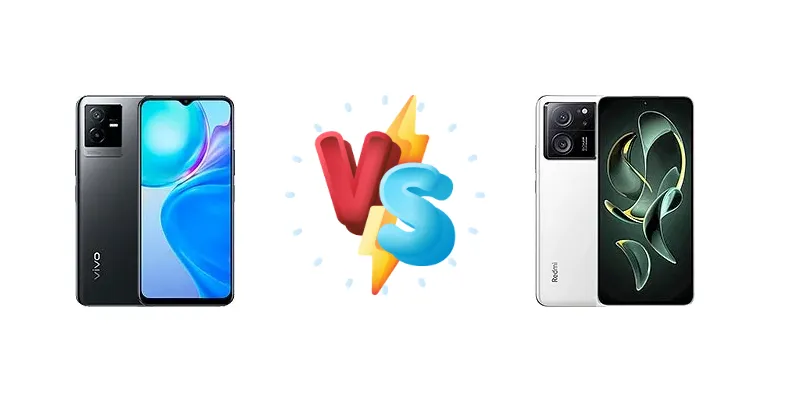
The Xiaomi Redmi K60 Ultra and vivo Y73t represent distinct approaches to the mid-range smartphone market. The K60 Ultra aims for near-flagship performance at a competitive price, while the Y73t prioritizes affordability and essential features. This comparison dissects their key differences, focusing on the impact of their contrasting chipsets and charging capabilities.
🏆 Quick Verdict
For users prioritizing raw performance and rapid charging, the Xiaomi Redmi K60 Ultra is the clear winner. Its Dimensity 9200+ chipset delivers a significantly more responsive experience, and the 120W charging is a game-changer. However, the vivo Y73t remains a viable option for budget-conscious users who don't demand top-tier speed.
| Network |
|---|
| 2G bands | GSM 850 / 900 / 1800 / 1900 | GSM 850 / 900 / 1800 / 1900 |
| 3G bands | HSDPA 850 / 900 / 1700(AWS) / 2100 | HSDPA 800 / 850 / 900 / 1700(AWS) / 2100 |
| 4G bands | 1, 3, 4, 5, 8, 28, 34, 38, 39, 40, 41 | 1, 3, 4, 5, 8, 18, 19, 26, 34, 38, 39, 40, 41, 42, 66 |
| 5G bands | 1, 5, 8, 28, 41, 77, 78 SA/NSA | 1, 3, 5, 8, 28, 38, 41, 66, 77, 78 SA/NSA |
| Speed | HSPA, LTE, 5G | HSPA, LTE, 5G |
| Technology | GSM / CDMA / HSPA / CDMA2000 / LTE / 5G | GSM / CDMA / HSPA / CDMA2000 / LTE / 5G |
| | CDMA2000 1x | - |
| Launch |
|---|
| Announced | 2022, September 29 | 2023, August 15 |
| Status | Available. Released 2022, September 29 | Available. Released 2023, August 15 |
| Body |
|---|
| Build | Glass front, plastic frame, plastic back | - |
| Dimensions | 163.9 x 75.3 x 9.2 mm (6.45 x 2.96 x 0.36 in) | 162.2 x 75.7 x 8.5 mm (6.39 x 2.98 x 0.33 in) |
| SIM | Nano-SIM + Nano-SIM | Nano-SIM + Nano-SIM |
| Weight | 201.5 g (7.13 oz) | 204 g (7.20 oz) |
| Display |
|---|
| Protection | - | Unspecified |
| Resolution | 1080 x 2408 pixels, 20:9 ratio (~401 ppi density) | 1220 x 2712 pixels, 20:9 ratio (~446 ppi density) |
| Size | 6.58 inches, 104.3 cm2 (~84.5% screen-to-body ratio) | 6.67 inches, 107.4 cm2 (~87.5% screen-to-body ratio) |
| Type | IPS LCD | OLED, 68B colors, 144Hz, Dolby Vision, HDR10+, 2600 nits (peak) |
| Platform |
|---|
| CPU | Octa-core (2x2.2 GHz Cortex-A76 & 6x2.0 GHz Cortex-A55) | Octa-core (1x3.35 GHz Cortex-X3 & 3x3.0 GHz Cortex-A715 & 4x2.0 GHz Cortex-A510) |
| Chipset | Mediatek Dimensity 700 (7 nm) | Mediatek Dimensity 9200+ (4 nm) |
| GPU | Mali-G57 MC2 | Immortalis-G715 MC11 |
| OS | Android 11, OriginOS 11 | Android 13, MIUI 14 |
| Memory |
|---|
| Card slot | No | No |
| Internal | 128GB 8GB RAM, 256GB 8GB RAM, 256GB 12GB RAM | 256GB 12GB RAM, 256GB 16GB RAM, 512GB 16GB RAM, 1TB 16GB RAM, 1TB 24GB RAM |
| | UFS 2.1 | - |
| Main Camera |
|---|
| Dual | 50 MP, f/1.8, 26mm (wide), PDAF
2 MP (macro) | - |
| Features | Dual-LED dual-tone flash, HDR, panorama | Color spectrum sensor, Dual-LED dual-tone flash, HDR, panorama |
| Single | 8 MP, f/2.0, (wide) | - |
| Triple | - | 50 MP, f/1.7, (wide), 1/1.49", 1.0µm, PDAF, OIS
8 MP, 119˚ (ultrawide), 1/4.0", 1.12µm
2 MP (macro) |
| Video | 1080p@30fps | 8K@24fps, 4K@30/60fps, 1080p@30/60/120/240/960fps, gyro-EIS, HDR10+, 10-bit |
| Selfie camera |
|---|
| Features | - | HDR |
| Single | 8 MP, f/2.0, (wide) | 20 MP, (wide), 1/2.0", 0.8µm |
| Video | 1080p@30fps | 1080p@30/120fps |
| Sound |
|---|
| 3.5mm jack | Yes | - |
| 35mm jack | Yes | No |
| Loudspeaker | Yes | Yes, with stereo speakers |
| Comms |
|---|
| Bluetooth | 5.1, A2DP, LE, aptX HD | 5.4, A2DP, LE |
| Infrared port | - | Yes |
| NFC | No | Yes |
| Positioning | GPS, GLONASS, GALILEO, BDS, QZSS | GPS (L1+L5), GLONASS (G1), BDS (B1I+B1C+B2a+B2b), GALILEO (E1+E5a), QZSS (L1+L5), NavIC |
| Radio | - | Unspecified |
| USB | USB Type-C, OTG | USB Type-C, OTG |
| WLAN | Wi-Fi 802.11 a/b/g/n/ac, dual-band, Wi-Fi Direct | Wi-Fi 802.11 a/b/g/n/ac/6e, dual-band, Wi-Fi Direct |
| Features |
|---|
| Sensors | Fingerprint (side-mounted), accelerometer, proximity, compass | Fingerprint (under display, optical), accelerometer, gyro, proximity, compass |
| Battery |
|---|
| Charging | 44W wired, 50% in 33 min | 120W wired, PD3.0, 100% in 19 min |
| Type | 6000 mAh | Li-Po 5000 mAh |
| Misc |
|---|
| Colors | Black, Blue, Orange | Black, White, Green |
| Models | V2164PA | 23078RKD5C |
| Price | About 200 EUR | About 330 EUR |
vivo Y73t
- Affordable price point
- Reliable Mediatek Dimensity 700 chipset for everyday tasks
- Decent 44W charging speed
- Older chipset architecture limits performance in demanding apps
- Likely lacks advanced display features like high refresh rate
Xiaomi Redmi K60 Ultra
- Flagship-level Dimensity 9200+ performance
- Ultra-fast 120W charging with PD3.0 support
- Likely superior display quality and camera system
- Higher price compared to the vivo Y73t
- Potentially more heat generation under sustained load (though the 4nm process helps)
Display Comparison
While display specifications aren't provided, the Redmi K60 Ultra, positioned as a higher-tier device, likely features a superior panel. Expect a higher peak brightness and potentially a higher refresh rate compared to the Y73t. The K60 Ultra's display is likely to benefit from the processing power of the Dimensity 9200+ for smoother animations and better HDR performance. The Y73t will likely offer a standard LCD experience, sufficient for everyday use but lacking the vibrancy of an AMOLED panel.
Camera Comparison
Without specific camera specs, we can infer that the Redmi K60 Ultra, being a more premium device, will likely feature a more capable camera system. Expect a larger main sensor with a wider aperture, resulting in better low-light performance and improved dynamic range. The Dimensity 9200+ also includes a more advanced Image Signal Processor (ISP), enabling faster image processing and potentially more sophisticated computational photography features. The Y73t will likely offer a basic camera setup suitable for casual snapshots, but will likely fall short in challenging lighting conditions.
Performance
The core difference lies in the chipsets. The Xiaomi Redmi K60 Ultra’s Mediatek Dimensity 9200+ (4nm) is a substantial upgrade over the vivo Y73t’s Dimensity 700 (7nm). The 9200+ boasts a Cortex-X3 prime core clocked at 3.35 GHz, offering significantly improved single-core performance crucial for responsive app launches and smooth multitasking. The Dimensity 700’s Cortex-A76 cores, while capable, are older architecture and operate at a lower frequency (2.2 GHz). The 4nm process node of the 9200+ also translates to better power efficiency and reduced thermal throttling during sustained workloads, making the K60 Ultra the superior choice for gamers and power users. The K60 Ultra likely utilizes faster LPDDR5x RAM, further enhancing performance.
Battery Life
The Redmi K60 Ultra’s 120W charging is a standout feature, capable of fully charging the device in just 19 minutes. This is a massive advantage over the vivo Y73t’s 44W charging, which takes 33 minutes to reach 50%. While battery capacity isn't specified, the faster charging of the K60 Ultra effectively mitigates any potential disadvantage from a slightly smaller battery. The K60 Ultra also supports PD3.0, offering wider compatibility with chargers and accessories.
Buying Guide
Buy the vivo Y73t if you need a reliable, everyday smartphone for basic tasks like browsing, social media, and light gaming, and your budget is a primary concern. Buy the Xiaomi Redmi K60 Ultra if you prioritize demanding mobile gaming, content creation, and require the fastest possible charging speeds, even if it means spending more upfront.
Frequently Asked Questions
❓ Will the Redmi K60 Ultra get noticeably hotter than the vivo Y73t during extended gaming sessions?
The Dimensity 9200+ is a more powerful chip and will generate more heat under load. However, the 4nm manufacturing process and likely improved thermal management in the K60 Ultra should mitigate excessive overheating. The Y73t's Dimensity 700 will run cooler, but at the cost of performance.
❓ Is the 120W charging of the Redmi K60 Ultra safe for the battery's long-term health?
Xiaomi incorporates battery health management features to protect the battery from degradation caused by fast charging. While fast charging generates more heat, the K60 Ultra's charging system is designed to optimize the charging process and minimize long-term battery wear.
❓ Can the vivo Y73t handle popular games like PUBG Mobile and Call of Duty Mobile?
The Y73t can run these games, but you'll likely need to lower the graphics settings to achieve a smooth frame rate. The Dimensity 700 is not optimized for demanding gaming experiences, and you may encounter occasional stuttering or lag.
❓ Does the Redmi K60 Ultra support 5G connectivity?
The Dimensity 9200+ chipset inherently supports 5G connectivity. However, 5G availability depends on your carrier and region. The Y73t also supports 5G, but the 9200+ will provide faster 5G speeds.