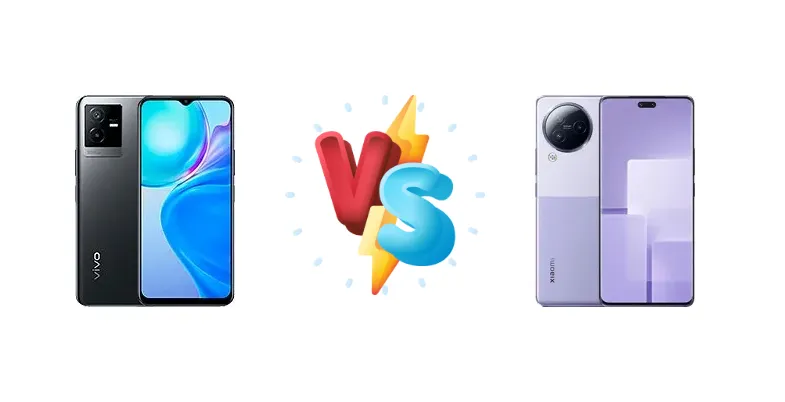
The Xiaomi Civi 3 and vivo Y73t represent distinct approaches to the mid-range smartphone market. The Civi 3 aims for a more premium experience with a flagship-adjacent chipset, while the Y73t focuses on delivering essential features at an aggressively competitive price. This comparison dissects their key differences to help you determine which device best suits your needs.
🏆 Quick Verdict
For users prioritizing performance and future-proofing, the Xiaomi Civi 3 is the clear winner thanks to its significantly more powerful Dimensity 8200 Ultra. However, the vivo Y73t remains a viable option for budget-conscious buyers who prioritize affordability over raw speed, offering a functional experience at a lower cost.
| Network |
|---|
| 2G bands | GSM 850 / 900 / 1800 / 1900 | GSM 850 / 900 / 1800 / 1900 |
| 3G bands | HSDPA 850 / 900 / 1700(AWS) / 2100 | HSDPA 800 / 850 / 900 / 1700(AWS) / 1900 / 2100 |
| 4G bands | 1, 3, 4, 5, 8, 28, 34, 38, 39, 40, 41 | 1, 3, 4, 5, 8, 18, 19, 26, 34, 38, 39, 40, 41, 42 |
| 5G bands | 1, 5, 8, 28, 41, 77, 78 SA/NSA | 1, 3, 5, 8, 28, 38, 41, 77, 78 SA/NSA |
| Speed | HSPA, LTE, 5G | HSPA, LTE, 5G |
| Technology | GSM / CDMA / HSPA / CDMA2000 / LTE / 5G | GSM / CDMA / HSPA / CDMA2000 / LTE / 5G |
| | CDMA2000 1x | - |
| Launch |
|---|
| Announced | 2022, September 29 | 2023, May 25 |
| Status | Available. Released 2022, September 29 | Available. Released 2023, May 25 |
| Body |
|---|
| Build | Glass front, plastic frame, plastic back | Glass front (Gorilla Glass 5), glass back, aluminum frame |
| Dimensions | 163.9 x 75.3 x 9.2 mm (6.45 x 2.96 x 0.36 in) | 158.7 x 71.7 x 7.6 mm (6.25 x 2.82 x 0.30 in) |
| SIM | Nano-SIM + Nano-SIM | Nano-SIM + Nano-SIM |
| Weight | 201.5 g (7.13 oz) | 174 g (6.14 oz) |
| Display |
|---|
| Protection | - | Corning Gorilla Glass 5 |
| Resolution | 1080 x 2408 pixels, 20:9 ratio (~401 ppi density) | 1080 x 2400 pixels, 20:9 ratio (~402 ppi density) |
| Size | 6.58 inches, 104.3 cm2 (~84.5% screen-to-body ratio) | 6.55 inches, 103.6 cm2 (~91.0% screen-to-body ratio) |
| Type | IPS LCD | AMOLED, 68B colors, 120Hz, Dolby Vision, HDR10+, 1500 nits (peak) |
| Platform |
|---|
| CPU | Octa-core (2x2.2 GHz Cortex-A76 & 6x2.0 GHz Cortex-A55) | Octa-core (1x3.1 GHz Cortex-A78 & 3x3.0 GHz Cortex-A78 & 4x2.0 GHz Cortex-A55) |
| Chipset | Mediatek Dimensity 700 (7 nm) | Mediatek Dimensity 8200 Ultra (4 nm) |
| GPU | Mali-G57 MC2 | Mali-G610 MC6 |
| OS | Android 11, OriginOS 11 | Android 13, MIUI 14 |
| Memory |
|---|
| Card slot | No | No |
| Internal | 128GB 8GB RAM, 256GB 8GB RAM, 256GB 12GB RAM | 256GB 12GB RAM, 512GB 12GB RAM, 1TB 16GB RAM |
| | UFS 2.1 | - |
| Main Camera |
|---|
| Dual | 50 MP, f/1.8, 26mm (wide), PDAF
2 MP (macro) | - |
| Features | Dual-LED dual-tone flash, HDR, panorama | Color spectrum sensor, Quad-LED dual-tone flash, HDR, panorama |
| Single | 8 MP, f/2.0, (wide) | - |
| Triple | - | 50 MP, f/1.8, (wide), 1/1.49", 1.0µm, PDAF, OIS
8 MP, f/2.2, 115˚ (ultrawide), 1.12µm
2 MP (macro) |
| Video | 1080p@30fps | 4K@30fps, 1080p@30/60/120fps, 720p@960fps; gyro-EIS |
| Selfie camera |
|---|
| Dual | - | 32 MP, f/2.0, 26mm (wide), 1/2.8", 0.8µm, AF
32 MP, f/2.4, 100˚ (ultrawide), 1/2.8", 0.8µm |
| Features | - | 2 Dual-LED dual-tone flash, HDR, panorama |
| Single | 8 MP, f/2.0, (wide) | - |
| Video | 1080p@30fps | 4K@30fps, 1080p@30/60fps; gyro-EIS |
| Sound |
|---|
| 3.5mm jack | Yes | - |
| 35mm jack | Yes | No |
| Loudspeaker | Yes | Yes, with stereo speakers |
| Comms |
|---|
| Bluetooth | 5.1, A2DP, LE, aptX HD | 5.3, A2DP, LE |
| Infrared port | - | Yes |
| NFC | No | Yes |
| Positioning | GPS, GLONASS, GALILEO, BDS, QZSS | GPS (L1), GLONASS (G1), BDS (B1I+B1c), GALILEO (E1), QZSS (L1) |
| Radio | - | No |
| USB | USB Type-C, OTG | USB Type-C 2.0, OTG |
| WLAN | Wi-Fi 802.11 a/b/g/n/ac, dual-band, Wi-Fi Direct | Wi-Fi 802.11 a/b/g/n/ac/6, dual-band, Wi-Fi Direct |
| Features |
|---|
| Sensors | Fingerprint (side-mounted), accelerometer, proximity, compass | Fingerprint (under display, optical), accelerometer, gyro, proximity, compass |
| Battery |
|---|
| Charging | 44W wired, 50% in 33 min | 67W wired, PD3.0, 100% in 38 minutes |
| Type | 6000 mAh | Li-Po 4500 mAh |
| Misc |
|---|
| Colors | Black, Blue, Orange | Purple, Mint, Gold, Gray |
| Models | V2164PA | 23046PNC9C |
| Price | About 200 EUR | About 330 EUR |
vivo Y73t
- Significantly faster processor for gaming and multitasking
- Faster 67W charging with PD3.0 support
- More efficient 4nm chipset for better battery life
- Likely higher price point
- May lack features found in higher-end devices
Xiaomi Civi 3
- More affordable price
- Functional for basic smartphone tasks
- Decent 44W charging
- Slower processor struggles with demanding apps
- Less efficient 7nm chipset
Display Comparison
While both devices likely feature LCD panels given their price points, detailed display specs are unavailable. However, the focus should be on the performance difference. The chipset in the Civi 3 will allow for smoother scrolling and faster rendering of graphics, indirectly improving the perceived display quality. Bezels are likely comparable, and color accuracy will depend on software calibration, a factor not specified in the provided data.
Camera Comparison
Without detailed camera specifications, a direct comparison is limited. However, the processing power of the Dimensity 8200 Ultra in the Civi 3 will enable more sophisticated image processing algorithms, potentially resulting in better dynamic range, noise reduction, and overall image quality. The Y73t will likely rely on simpler algorithms due to its limited processing capabilities. The absence of information regarding sensor sizes and OIS makes it difficult to assess low-light performance, but the Civi 3’s superior chipset provides a foundation for a more capable camera system.
Performance
The core difference lies in the chipsets. The Xiaomi Civi 3’s Mediatek Dimensity 8200 Ultra (4nm) is a substantial upgrade over the vivo Y73t’s Dimensity 700 (7nm). The 8200 Ultra boasts a prime Cortex-A78 core clocked at 3.1 GHz, alongside three additional A78 cores at 3.0 GHz, offering significantly improved single-core and multi-core performance. The Dimensity 700’s configuration of two Cortex-A76 cores at 2.2 GHz and six A55 cores at 2.0 GHz is adequate for basic tasks but will struggle with demanding games and multitasking. The 4nm process node of the 8200 Ultra also translates to better power efficiency and reduced thermal throttling during sustained workloads.
Battery Life
The Xiaomi Civi 3’s 67W wired charging with PD3.0 support is a significant advantage, promising a full charge in 38 minutes. The vivo Y73t’s 44W charging, while respectable, takes longer to reach 50% (33 minutes) and lacks the versatility of PD3.0. While battery capacity isn’t specified, the more efficient Dimensity 8200 Ultra in the Civi 3 could potentially offset a slightly smaller battery size, delivering comparable real-world battery life despite the faster charging speeds.
Buying Guide
Buy the vivo Y73t if you need a reliable daily driver for basic tasks like calling, texting, social media, and light web browsing, and your budget is a primary concern. Buy the Xiaomi Civi 3 if you prefer a smoother, more responsive experience for demanding applications, mobile gaming, and content creation, and are willing to spend a bit more for enhanced performance.
Frequently Asked Questions
❓ Will the Dimensity 700 in the vivo Y73t struggle with graphically intensive games like PUBG Mobile?
Yes, the Dimensity 700 is likely to struggle with PUBG Mobile at higher settings. You'll likely need to reduce graphics settings to low and frame rates to achieve a playable experience. The Dimensity 8200 Ultra in the Civi 3 will provide a much smoother and more consistent gaming experience.
❓ Does the Xiaomi Civi 3 support faster data transfer speeds compared to the vivo Y73t?
While not explicitly stated, the Dimensity 8200 Ultra in the Civi 3 generally supports faster 5G and data transfer speeds than the Dimensity 700 in the Y73t. This means quicker downloads, smoother streaming, and a more responsive online experience.
❓ Is the 67W charging on the Civi 3 compatible with all USB-PD chargers?
The Xiaomi Civi 3's 67W charging supports the USB Power Delivery (PD) 3.0 standard, meaning it *should* be compatible with most USB-PD chargers. However, to achieve the full 67W charging speed, you'll need a charger specifically rated for that wattage and supporting PD 3.0.