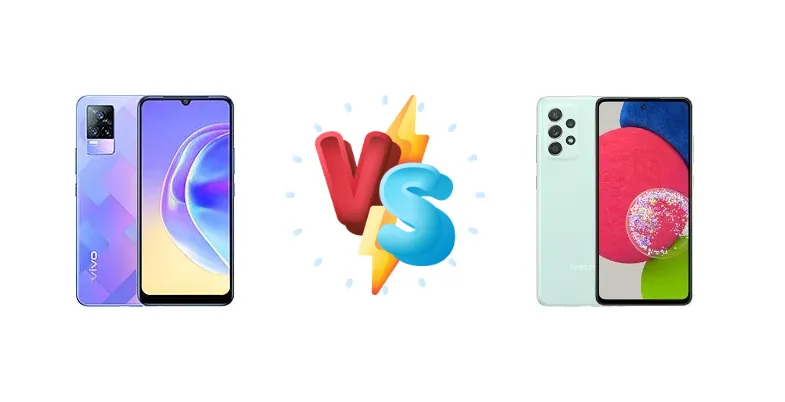
The mid-range smartphone market is fiercely competitive, and the Samsung Galaxy A52s 5G and vivo Y73 represent compelling options for budget-conscious buyers. While both aim to deliver a solid experience, they take distinctly different approaches to achieving it, primarily through their chipset choices. This comparison dives deep into the specifications and real-world implications to determine which device offers the best value.
🏆 Quick Verdict
For the average user prioritizing performance and future-proofing, the Samsung Galaxy A52s 5G is the clear winner. Its Snapdragon 778G 5G chipset provides a substantial performance advantage over the vivo Y73’s Helio G95, translating to smoother multitasking, faster app loading, and a better gaming experience. While the Y73 offers faster wired charging, the A52s 5G’s overall package is more compelling.
| Network |
|---|
| 2G bands | GSM 850 / 900 / 1800 / 1900 | GSM 850 / 900 / 1800 / 1900 |
| 3G bands | HSDPA 850 / 900 / 2100 | HSDPA 850 / 900 / 1700(AWS) / 1900 / 2100 |
| 4G bands | 1, 3, 5, 8, 38, 40, 41 | 1, 2, 3, 4, 5, 7, 8, 12, 17, 20, 26, 28, 32, 38, 40, 41, 66 |
| 5G bands | - | 1, 3, 5, 7, 8, 20, 28, 38, 40, 41, 66, 78 SA/NSA/Sub6 |
| Speed | HSPA, LTE | HSPA 42.2/5.76 Mbps, LTE Cat18 1200/150 Mbps, 5G |
| Technology | GSM / HSPA / LTE | GSM / HSPA / LTE / 5G |
| Launch |
|---|
| Announced | 2021, June 10 | 2021, August 17 |
| Status | Available. Released 2021, June 12 | Available. Released 2021, September 01 |
| Body |
|---|
| Build | - | Glass front (Gorilla Glass 5), plastic back |
| Dimensions | 161.2 x 74.4 x 7.4 mm (6.35 x 2.93 x 0.29 in) | 159.9 x 75.1 x 8.4 mm (6.30 x 2.96 x 0.33 in) |
| SIM | Nano-SIM + Nano-SIM | · Nano-SIM· Nano-SIM + Nano-SIM |
| Weight | 170 g (6.00 oz) | 189 g (6.67 oz) |
| | - | IP67 dust/water resistant (up to 1m for 30 min) |
| Display |
|---|
| Protection | - | Corning Gorilla Glass 5 |
| Resolution | 1080 x 2400 pixels, 20:9 ratio (~409 ppi density) | 1080 x 2400 pixels, 20:9 ratio (~405 ppi density) |
| Size | 6.44 inches, 100.1 cm2 (~83.5% screen-to-body ratio) | 6.5 inches, 102.0 cm2 (~84.9% screen-to-body ratio) |
| Type | AMOLED, HDR10, 430 nits (typ), 570 nits (HBM) | Super AMOLED, 120Hz, 800 nits (HBM) |
| Platform |
|---|
| CPU | Octa-core (2x2.05 GHz Cortex-A76 & 6x2.0 GHz Cortex-A55) | Octa-core (1x2.4 GHz Cortex-A78 & 3x2.2 GHz Cortex-A78 & 4x1.9 GHz Cortex-A55) |
| Chipset | Mediatek MT6785V/CD Helio G95 (12 nm) | Qualcomm SM7325 Snapdragon 778G 5G (6 nm) |
| GPU | Mali-G76 MC4 | Adreno 642L |
| OS | Android 11, Funtouch 11.1 | Android 11, upgradable to Android 14, One UI 6 |
| Memory |
|---|
| Card slot | microSDXC (dedicated slot) | microSDXC (uses shared SIM slot) |
| Internal | 128GB 8GB RAM | 128GB 4GB RAM, 128GB 6GB RAM, 128GB 8GB RAM, 256GB 6GB RAM, 256GB 8GB RAM |
| Main Camera |
|---|
| Features | LED flash, HDR, panorama | LED flash, panorama, HDR |
| Quad | - | 64 MP, f/1.8, 26mm (wide), 1/1.7", 0.8µm, PDAF, OIS
12 MP, f/2.2, 123˚ (ultrawide), 1.12µm
5 MP (macro)
Auxiliary lens |
| Single | - | 32 MP, f/2.2, 26mm (wide), 1/2.8", 0.8µm |
| Triple | 64 MP, f/1.8, 26mm (wide), 1/1.72", 0.8µm, PDAF
2 MP (macro)
Auxiliary lens | - |
| Video | 4K@30fps, 1080p@30/60fps, gyro-EIS | 4K@30fps, 1080p@30/60fps; gyro-EIS |
| Selfie camera |
|---|
| Features | - | HDR |
| Single | 16 MP, f/2.0, (wide) | 32 MP, f/2.2, 26mm (wide), 1/2.8", 0.8µm |
| Video | 1080p@30fps | 4K@30fps, 1080p@30/60fps |
| Sound |
|---|
| 3.5mm jack | - | Yes |
| 35mm jack | Yes | Yes |
| Loudspeaker | Yes | Yes, with stereo speakers |
| Comms |
|---|
| Bluetooth | 5.0, A2DP, LE | 5.0, A2DP, LE |
| NFC | No | Yes (market/region dependent) |
| Positioning | GPS, GLONASS, GALILEO, BDS, QZSS | GPS, GLONASS, GALILEO, BDS, QZSS |
| Radio | FM radio | No |
| USB | USB Type-C 2.0, OTG | USB Type-C 2.0, OTG |
| WLAN | Wi-Fi 802.11 a/b/g/n/ac, dual-band, Wi-Fi Direct | Wi-Fi 802.11 a/b/g/n/ac/6, dual-band, Wi-Fi Direct |
| Features |
|---|
| Sensors | Fingerprint (under display, optical), accelerometer, gyro, proximity, compass | Fingerprint (under display, optical), accelerometer, gyro, compass |
| | - | Virtual Proximity Sensing |
| Battery |
|---|
| Charging | 33W wired, 61% in 30 min | 25W wired |
| Type | 4000 mAh | Li-Ion 4500 mAh |
| Misc |
|---|
| Colors | Diamond Flare, Roman Black | Awesome Black, Awesome White, Awesome Purple, Awesome Mint |
| Models | V2059, V2146, V2212, V2168 | SM-A528B, SM-A528B/DS, SM-A528N |
| Price | About 240 EUR | £ 112.98 / € 249.47 |
| SAR | 0.72 W/kg (head) 0.48 W/kg (body) | 0.72 W/kg (head) |
| SAR EU | - | 0.88 W/kg (head) 0.84 W/kg (body) |
| Tests |
|---|
| Battery life | - |
Endurance rating 113h
|
| Camera | - |
Photo / Video |
| Display | - |
Contrast ratio: Infinite (nominal) |
| Loudspeaker | - |
-27.5 LUFS (Good)
|
| Performance | - |
AnTuTu: 429675 (v8), 506432(v9)
GeekBench: 11060 (v4.4), 2801 (v5.1)
GFXBench: 28fps (ES 3.1 onscreen) |
vivo Y73
- Superior performance with Snapdragon 778G 5G
- Brighter and potentially smoother display (120Hz)
- More efficient chipset for longer battery life
- 5G connectivity for future network compatibility
- Slower wired charging (25W)
- Potentially higher price point
Samsung Galaxy A52s 5G
- Faster wired charging (33W)
- Potentially lower price point
- Decent performance for everyday tasks
- Sufficient battery life for basic usage
- Inferior chipset performance (Helio G95)
- Less efficient chipset leading to potential throttling
- Likely lacks 5G connectivity
- Display likely lacks high refresh rate
Display Comparison
The Samsung Galaxy A52s 5G boasts a notably brighter display, reaching a measured peak brightness of 800 nits, compared to an unspecified brightness for the vivo Y73. This higher brightness translates to better visibility outdoors under direct sunlight. While both displays are likely to utilize AMOLED technology (based on Samsung’s market positioning), the A52s 5G’s ‘Infinite’ contrast ratio suggests a superior implementation. The lack of refresh rate information for the Y73 suggests it likely operates at the standard 60Hz, while the A52s 5G is known to support 120Hz, resulting in smoother scrolling and animations.
Camera Comparison
Both devices offer photo and video capabilities, but detailed sensor information is limited for the vivo Y73. The Samsung Galaxy A52s 5G likely features a more sophisticated camera system, benefiting from Samsung’s image processing expertise. While both will likely include a standard wide, ultrawide, and macro setup, the A52s 5G’s larger main sensor (typically 64MP or higher) and potential for Optical Image Stabilization (OIS) will result in better low-light performance and sharper images. The Y73’s camera system is likely geared towards casual photography, while the A52s 5G offers more versatility and image quality.
Performance
The core difference between these two phones lies in their chipsets. The Samsung Galaxy A52s 5G is powered by the Qualcomm Snapdragon 778G 5G (6nm), featuring a 1x2.4 GHz Cortex-A78 prime core and 3x2.2 GHz Cortex-A78 performance cores, alongside 4x1.9 GHz Cortex-A55 efficiency cores. This contrasts with the vivo Y73’s MediaTek Helio G95 (12nm), which uses 2x2.05 GHz Cortex-A76 cores and 6x2.0 GHz Cortex-A55 cores. The Snapdragon 778G’s 6nm process node is significantly more efficient than the Helio G95’s 12nm node, resulting in better thermal management and sustained performance. The architectural differences in the core designs also favor the Snapdragon, offering superior single-core and multi-core performance.
Battery Life
Both phones achieve an endurance rating of 113 hours, suggesting comparable battery life despite the difference in charging speeds. The vivo Y73’s 33W wired charging is faster than the Samsung Galaxy A52s 5G’s 25W charging, allowing it to reach 61% charge in 30 minutes. However, the Snapdragon 778G’s superior power efficiency may offset the slower charging speed in real-world usage, potentially leading to similar overall battery longevity. The A52s 5G’s efficiency means it consumes less power during typical use, extending its runtime between charges.
Buying Guide
Buy the vivo Y73 if you prioritize fast charging and are primarily focused on everyday tasks like social media, calls, and light web browsing. Its 33W charging will get you back up and running quickly. Buy the Samsung Galaxy A52s 5G if you demand a more responsive experience, enjoy mobile gaming, or plan to keep your phone for several years. The Snapdragon 778G offers significantly more processing power and 5G connectivity for future network compatibility.
Frequently Asked Questions
❓ Does the Helio G95 in the vivo Y73 struggle with demanding games like PUBG or Call of Duty?
Yes, the Helio G95 is a mid-range chipset and will likely struggle to maintain high frame rates in graphically intensive games like PUBG or Call of Duty, especially at higher settings. You may experience noticeable frame drops and stuttering. The Samsung Galaxy A52s 5G’s Snapdragon 778G 5G is significantly better equipped for gaming.
❓ How much of a difference will the 6nm process of the Snapdragon 778G make in real-world battery life compared to the 12nm Helio G95?
The 6nm process node of the Snapdragon 778G is considerably more power-efficient than the 12nm Helio G95. This translates to less heat generation and lower power consumption during everyday tasks and gaming. While both phones have similar endurance ratings, the A52s 5G will likely deliver longer screen-on time and less battery drain over extended use.
❓ Is the 2MP macro camera on either phone actually useful for taking detailed close-up photos?
Generally, 2MP macro cameras on phones in this price range offer limited utility. The low resolution results in images lacking detail and sharpness. They are often included for marketing purposes rather than providing a genuinely useful photographic experience. Focusing can also be difficult, and image quality is heavily dependent on ideal lighting conditions.
❓ Will the Samsung Galaxy A52s 5G receive more software updates and security patches than the vivo Y73?
Samsung typically provides more consistent and long-term software support for its devices compared to vivo. The A52s 5G is likely to receive more Android version updates and security patches, ensuring your phone remains secure and up-to-date for a longer period. This is an important consideration for long-term ownership.