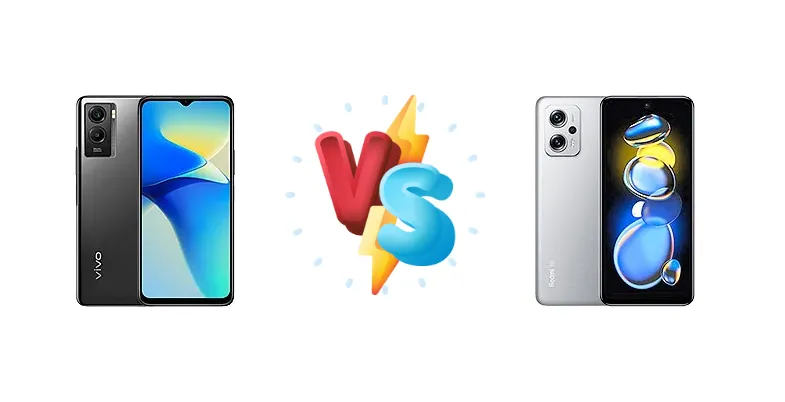
These two phones represent different approaches to the mid-range market. The vivo Y72t aims for affordability, while the Xiaomi Redmi Note 11T Pro+ prioritizes performance and convenience with its blazing-fast charging. This comparison dissects the key differences to help you determine which device best suits your needs.
🏆 Quick Verdict
For most users, the Xiaomi Redmi Note 11T Pro+ is the clear winner. Its Dimensity 8100 chipset delivers a significantly smoother experience, and the 120W charging is a game-changer. The vivo Y72t remains a viable option for those on a very tight budget, but compromises are substantial.
| Network |
|---|
| 2G bands | GSM 850 / 900 / 1800 / 1900 | GSM 850 / 900 / 1800 / 1900 - SIM 1 & SIM 2 |
| 3G bands | HSDPA 850 / 900 / 1700(AWS) / 2100 | HSDPA 800 / 850 / 900 / 2100 |
| 4G bands | 1, 3, 4, 5, 8, 28, 34, 38, 39, 40, 41 | 1, 3, 5, 8, 19, 34, 38, 39, 40, 41, 42 |
| 5G bands | 1, 5, 8, 28, 41, 77, 78 SA/NSA | 1, 3, 5, 8, 28, 38, 41, 77, 78 SA/NSA |
| Speed | HSPA, LTE, 5G | HSPA, LTE-A (CA), 5G |
| Technology | GSM / CDMA / HSPA / CDMA2000 / LTE / 5G | GSM / CDMA / HSPA / EVDO / LTE / 5G |
| | CDMA2000 1x | CDMA2000 1xEV-DO |
| Launch |
|---|
| Announced | 2022, May 23 | 2022, May 24 |
| Status | Available. Released 2022, May 23 | Available. Released 2022, May 31 |
| Body |
|---|
| Build | Glass front, plastic frame, plastic back | - |
| Dimensions | 163.9 x 75.3 x 9.2 mm (6.45 x 2.96 x 0.36 in) | 163.6 x 74.3 x 8.9 mm (6.44 x 2.93 x 0.35 in) |
| SIM | Nano-SIM + Nano-SIM | Dual SIM (Nano-SIM, dual stand-by) |
| Weight | 199.8 g (7.05 oz) | 198 g (6.98 oz) |
| | - | IP53, dust and splash resistant |
| Display |
|---|
| Resolution | 1080 x 2408 pixels, 20:9 ratio (~401 ppi density) | 1080 x 2460 pixels (~407 ppi density) |
| Size | 6.58 inches, 104.3 cm2 (~84.5% screen-to-body ratio) | 6.6 inches, 103.4 cm2 (~85.1% screen-to-body ratio) |
| Type | IPS LCD | IPS LCD, 144Hz, HDR10, Dolby Vision, 650 nits (typ) |
| Platform |
|---|
| CPU | Octa-core (2x2.2 GHz Cortex-A76 & 6x2.0 GHz Cortex-A55) | Octa-core (4x2.85 GHz Cortex-A78 & 4x2.0 GHz Cortex-A55) |
| Chipset | Mediatek Dimensity 700 (7 nm) | Mediatek Dimensity 8100 (5 nm) |
| GPU | Mali-G57 MC2 | Mali-G610 MC6 |
| OS | Android 11, OriginOS 11 | Android 12, MIUI 13 |
| Memory |
|---|
| Card slot | No | No |
| Internal | 128GB 8GB RAM, 256GB 8GB RAM | 128GB 8GB RAM, 256GB 8GB RAM, 512GB 8GB RAM |
| | UFS 2.1 | UFS 3.1 |
| Main Camera |
|---|
| Dual | 50 MP, f/1.8, 26mm (wide), PDAF
2 MP (macro) | - |
| Features | LED flash, HDR, panorama | LED flash, HDR, panorama |
| Single | 8 MP, f/1.8, (wide) | 16 MP, (wide) |
| Triple | - | 64 MP, (wide), 1/1.72", 0.8µm, PDAF
8 MP, 120˚, (ultrawide)
2 MP, (macro) |
| Video | 1080p@30fps | 4K@30fps, 1080p@30/60/120fps, 720p@960fps |
| Selfie camera |
|---|
| Single | 8 MP, f/1.8, (wide) | 16 MP, (wide) |
| Video | 1080p@30fps | 1080p@30/60fps |
| Sound |
|---|
| 3.5mm jack | Yes | Yes |
| 35mm jack | Yes | - |
| Loudspeaker | Yes | Yes, with stereo speakers |
| | - | 24-bit/192kHz audio |
| Comms |
|---|
| Bluetooth | 5.1, A2DP, LE, aptX HD | 5.3, A2DP, LE |
| Infrared port | - | Yes |
| NFC | No | Yes |
| Positioning | GPS, GLONASS, GALILEO, BDS, QZSS | GPS (L1), GLONASS (G1), BDS (B1I+B1c), GALILEO (E1), QZSS (L1) |
| Radio | - | No |
| USB | USB Type-C, OTG | USB Type-C 2.0, OTG |
| WLAN | Wi-Fi 802.11 a/b/g/n/ac, dual-band, Wi-Fi Direct | Wi-Fi 802.11 a/b/g/n/ac/6, dual-band, Wi-Fi Direct |
| Features |
|---|
| Sensors | Fingerprint (side-mounted), accelerometer, proximity, compass | Fingerprint (side-mounted), accelerometer, proximity, gyro, compass, color spectrum |
| Battery |
|---|
| Charging | 18W wired | 120W wired, PD3.0, 50% in 10 min, 100% in 19 min (advertised) |
| Type | 6000 mAh | Li-Po 4400 mAh, non-removable |
| Misc |
|---|
| Colors | Black, Blue, Pink | Blue, Silver, Black |
| Models | V2164A | 22041216UC |
| Price | About 200 EUR | About 300 EUR |
vivo Y72t
- More affordable price point
- Functional for basic smartphone tasks
- Potentially longer software support (vivo's track record)
- Significantly slower performance
- Slow 18W charging
- Likely inferior camera quality
Xiaomi Redmi Note 11T Pro+
- Blazing-fast 120W charging
- Superior performance with Dimensity 8100
- Likely better camera system
- Higher price tag
- Potential for more heat under sustained load (though mitigated by 5nm)
- Xiaomi's MIUI software can be polarizing
Display Comparison
Neither device's display specifications are provided, so a direct comparison is limited. However, given the Redmi Note 11T Pro+'s positioning, it likely features a higher-quality panel with a faster refresh rate. The Y72t, being a budget device, likely uses a standard 60Hz LCD. Color accuracy and peak brightness are also expected to be superior on the Redmi, contributing to a more vibrant and enjoyable viewing experience.
Camera Comparison
Without detailed camera specs, analysis is limited. However, the Redmi Note 11T Pro+ is likely to feature a more sophisticated camera system. The Dimensity 8100’s ISP (Image Signal Processor) is more advanced, enabling better image processing and potentially supporting higher-resolution sensors. The Y72t, being a budget device, likely relies on a simpler camera setup with a smaller sensor and less advanced image processing algorithms. Expect the Redmi to excel in low-light photography and offer more detailed images overall.
Performance
The core difference lies in the chipsets. The Xiaomi Redmi Note 11T Pro+ boasts the Mediatek Dimensity 8100, fabricated on a 5nm process. This translates to significantly improved power efficiency and performance compared to the vivo Y72t’s Dimensity 700 (7nm). The Dimensity 8100’s octa-core CPU, with its four Cortex-A78 cores clocked at 2.85 GHz, offers a substantial uplift in CPU performance, particularly for multi-threaded tasks and gaming. The Y72t’s Cortex-A76 cores at 2.2 GHz are less capable. While both phones utilize Cortex-A55 efficiency cores, the 5nm process of the 8100 allows for sustained performance without significant thermal throttling, a potential issue for the 7nm Dimensity 700 under heavy load.
Battery Life
The Redmi Note 11T Pro+’s 120W charging is the standout feature. Advertised to reach 100% in just 19 minutes, it drastically reduces downtime. The Y72t’s 18W charging is comparatively slow, requiring significantly longer to fully charge. While battery capacity isn’t specified for either device, the Redmi’s superior charging speed effectively mitigates any potential capacity disadvantage. The 5nm process of the Dimensity 8100 also contributes to better battery life by reducing power consumption.
Buying Guide
Buy the vivo Y72t if you need a functional smartphone for basic tasks like calling, texting, and light social media use, and your budget is extremely limited. Buy the Xiaomi Redmi Note 11T Pro+ if you prioritize smooth performance for gaming and demanding apps, and value the convenience of incredibly fast charging – even if it means spending a bit more.
Frequently Asked Questions
❓ Is the 120W charging on the Redmi Note 11T Pro+ safe for the battery's long-term health?
Xiaomi employs multiple layers of safety protocols, including temperature monitoring and optimized charging algorithms, to mitigate potential battery degradation from fast charging. While all batteries degrade over time, the Redmi Note 11T Pro+'s charging system is designed to minimize this effect.
❓ Will the Dimensity 700 in the vivo Y72t struggle with demanding games like PUBG or Genshin Impact?
Yes, the Dimensity 700 will likely struggle with graphically intensive games like PUBG or Genshin Impact. You'll likely need to lower graphics settings significantly to achieve playable frame rates, and even then, expect occasional stuttering. The Redmi Note 11T Pro+'s Dimensity 8100 is far better suited for gaming.
❓ Does the Redmi Note 11T Pro+ support video recording at 4K resolution?
While not explicitly stated in the provided data, phones with the Dimensity 8100 chipset typically support 4K video recording at 30fps. It's highly probable the Redmi Note 11T Pro+ offers this capability, providing a significant advantage over the Y72t which likely maxes out at 1080p.