
vivo Y72t vs Samsung Galaxy A53 5G: Which Mid-Range 5G Phone Reigns Supreme?
| Phones Images | |||||
|---|---|---|---|---|---|
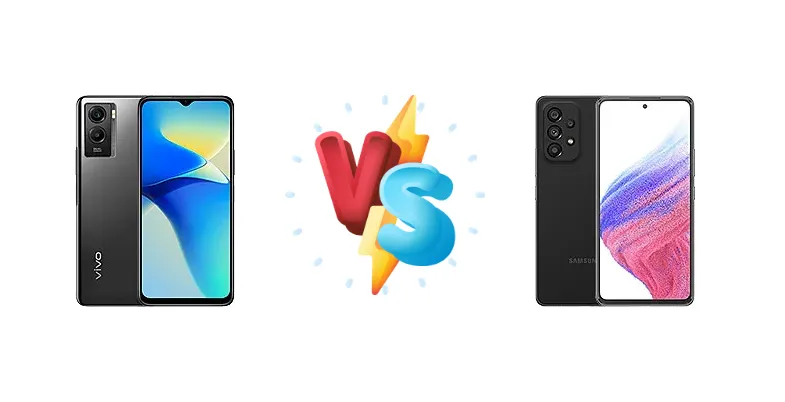
|
🏆 Quick Verdict
For the average user prioritizing display quality and a more refined software experience, the Samsung Galaxy A53 5G is the better choice. Its brighter 830 nit display and Exynos 1280 chipset provide a smoother, more visually appealing experience, despite the Y72t’s lower price point. However, the Y72t remains a viable option for budget-conscious users.
| PHONES | ||
|---|---|---|
| Phone Names | vivo Y72t | Samsung Galaxy A53 5G |
| Network | ||
|---|---|---|
| 2G bands | GSM 850 / 900 / 1800 / 1900 | GSM 850 / 900 / 1800 / 1900 |
| 3G bands | HSDPA 850 / 900 / 1700(AWS) / 2100 | HSDPA 850 / 900 / 1700(AWS) / 1900 / 2100 |
| 4G bands | 1, 3, 4, 5, 8, 28, 34, 38, 39, 40, 41 | 1, 2, 3, 4, 5, 7, 12, 14, 20, 29, 30, 38, 39, 40, 41, 46, 48, 66 - SM-A536U |
| 5G bands | 1, 5, 8, 28, 41, 77, 78 SA/NSA | 2, 5, 41, 66, 77, 78 SA/NSA/Sub6/mmWave - SM-A536U |
| Speed | HSPA, LTE, 5G | HSPA, LTE, 5G |
| Technology | GSM / CDMA / HSPA / CDMA2000 / LTE / 5G | GSM / HSPA / LTE / 5G |
| CDMA2000 1x | 2, 5, 48, 66, 77, 78, 260, 261 SA/NSA/Sub6/mmWave - SM-A536V | |
| Launch | ||
|---|---|---|
| Announced | 2022, May 23 | 2022, March 17 |
| Status | Available. Released 2022, May 23 | Available. Released 2022, March 24 |
| Body | ||
|---|---|---|
| Build | Glass front, plastic frame, plastic back | Glass front (Gorilla Glass 5), plastic frame, plastic back |
| Dimensions | 163.9 x 75.3 x 9.2 mm (6.45 x 2.96 x 0.36 in) | 159.6 x 74.8 x 8.1 mm (6.28 x 2.94 x 0.32 in) |
| SIM | Nano-SIM + Nano-SIM | · Nano-SIM· Nano-SIM + Nano-SIM |
| Weight | 199.8 g (7.05 oz) | 189 g (6.67 oz) |
| - | IP67 dust/water resistant (up to 1m for 30 min) | |
| Display | ||
|---|---|---|
| Protection | - | Corning Gorilla Glass 5 |
| Resolution | 1080 x 2408 pixels, 20:9 ratio (~401 ppi density) | 1080 x 2400 pixels, 20:9 ratio (~405 ppi density) |
| Size | 6.58 inches, 104.3 cm2 (~84.5% screen-to-body ratio) | 6.5 inches, 102.0 cm2 (~85.4% screen-to-body ratio) |
| Type | IPS LCD | Super AMOLED, 120Hz, 800 nits (HBM) |
| Platform | ||
|---|---|---|
| CPU | Octa-core (2x2.2 GHz Cortex-A76 & 6x2.0 GHz Cortex-A55) | Octa-core (2x2.4 GHz Cortex-A78 & 6x2.0 GHz Cortex-A55) |
| Chipset | Mediatek Dimensity 700 (7 nm) | Exynos 1280 (5 nm) |
| GPU | Mali-G57 MC2 | Mali-G68 |
| OS | Android 11, OriginOS 11 | Android 12, up to 4 major Android upgrades, One UI 8 |
| Memory | ||
|---|---|---|
| Card slot | No | microSDXC (uses shared SIM slot) |
| Internal | 128GB 8GB RAM, 256GB 8GB RAM | 128GB 4GB RAM, 128GB 6GB RAM, 128GB 8GB RAM, 256GB 6GB RAM, 256GB 8GB RAM |
| UFS 2.1 | - | |
| Main Camera | ||
|---|---|---|
| Dual | 50 MP, f/1.8, 26mm (wide), PDAF 2 MP (macro) | - |
| Features | LED flash, HDR, panorama | LED flash, panorama, HDR |
| Quad | - | 64 MP, f/1.8, 26mm (wide), 1/1.7X", 0.8µm, PDAF, OIS 12 MP, f/2.2, 123˚ (ultrawide), 1.12µm 5 MP (macro) Auxiliary lens |
| Single | 8 MP, f/1.8, (wide) | 32 MP, f/2.2, 26mm (wide), 1/2.8", 0.8µm |
| Video | 1080p@30fps | 4K@30fps, 1080p@30/60fps; gyro-EIS |
| Selfie camera | ||
|---|---|---|
| Features | - | HDR |
| Single | 8 MP, f/1.8, (wide) | 32 MP, f/2.2, 26mm (wide), 1/2.8", 0.8µm |
| Video | 1080p@30fps | 4K@30fps, 1080p@30fps |
| Sound | ||
|---|---|---|
| 3.5mm jack | Yes | No |
| 35mm jack | Yes | No |
| Loudspeaker | Yes | Yes, with stereo speakers |
| Comms | ||
|---|---|---|
| Bluetooth | 5.1, A2DP, LE, aptX HD | 5.1, A2DP, LE |
| NFC | No | Yes (market/region dependent) |
| Positioning | GPS, GLONASS, GALILEO, BDS, QZSS | GPS, GLONASS, GALILEO, BDS |
| Radio | - | No |
| USB | USB Type-C, OTG | USB Type-C 2.0, OTG |
| WLAN | Wi-Fi 802.11 a/b/g/n/ac, dual-band, Wi-Fi Direct | Wi-Fi 802.11 a/b/g/n/ac, dual-band, Wi-Fi Direct |
| Features | ||
|---|---|---|
| Sensors | Fingerprint (side-mounted), accelerometer, proximity, compass | Fingerprint (under display, optical), accelerometer, gyro, compass, barometer (market/region dependent) |
| - | Virtual proximity sensing | |
| Battery | ||
|---|---|---|
| Charging | 18W wired | 25W wired |
| Type | 6000 mAh | Li-Po 5000 mAh |
| Misc | ||
|---|---|---|
| Colors | Black, Blue, Pink | Black, White, Blue, Peach |
| Models | V2164A | SM-A536B, SM-A536B/DS, SM-A536U, SM-A536U1, SM-A5360, SM-A536E, SM-A536E/DS, SM-A536V, SM-A536W, SM-A536N, SM-S536DL |
| Price | About 200 EUR | $ 151.42 / £ 185.00 / € 169.14 |
| SAR | - | 0.75 W/kg (head) 1.58 W/kg (body) |
| SAR EU | - | 0.89 W/kg (head) 1.60 W/kg (body) |
| Tests | ||
|---|---|---|
| Battery life | - | Endurance rating 113h |
| Camera | - | Photo / Video |
| Display | - | Contrast ratio: Infinite (nominal) |
| Loudspeaker | - | -26.5 LUFS (Good) |
| Performance | - | AnTuTu: 329802 (v8), 379313 (v9) GeekBench: 1891 (v5.1) GFXBench: 19fps (ES 3.1 onscreen) |
vivo Y72t
- More affordable price point
- 5G connectivity
- Acceptable battery life
- Less powerful processor
- Lower display brightness
- Basic camera system
Samsung Galaxy A53 5G
- Brighter, higher-quality display
- More powerful Exynos 1280 chipset
- Faster 25W charging
- Higher price
- Similar battery endurance to Y72t
- Software bloat (potentially)
Display Comparison
The Samsung Galaxy A53 5G boasts a significant advantage in display technology, achieving a measured peak brightness of 830 nits. This is crucial for outdoor visibility, a scenario where the Y72t’s unspecified brightness will likely struggle. While both devices offer a 'photo/video' capable display, the A53’s 'Infinite' contrast ratio (nominal) suggests a superior viewing experience with deeper blacks and more vibrant colors. The Y72t’s display specifications are less detailed, suggesting a more basic panel aimed at cost reduction.
Camera Comparison
Both phones are listed as having 'Photo / Video' capabilities, but this lacks specificity. The A53 5G likely benefits from Samsung’s established image processing algorithms and potentially a larger main sensor (though sensor size is unspecified). The Y72t’s camera system is likely more basic, focusing on providing acceptable image quality in good lighting conditions. The presence of a 2MP macro camera on the Y72t is a common cost-saving measure, offering limited practical benefit due to its low resolution and lack of optical image stabilization (OIS).
Performance
The Exynos 1280 (5nm) in the Galaxy A53 5G represents a clear step up in processing power compared to the Dimensity 700 (7nm) found in the Y72t. The A53’s CPU features 2x2.4 GHz Cortex-A78 cores, offering higher single-core performance than the Y72t’s 2x2.2 GHz Cortex-A76 cores. The 5nm fabrication process of the Exynos 1280 also contributes to improved thermal efficiency, potentially reducing throttling during sustained workloads. While both utilize 6x2.0 GHz Cortex-A55 cores for efficiency, the A53’s overall architecture provides a more responsive and capable experience.
Battery Life
Both the vivo Y72t and Samsung Galaxy A53 5G achieve an endurance rating of 113 hours, indicating similar overall battery life. However, the charging speeds differ significantly. The A53 5G supports 25W wired charging, allowing for faster top-ups compared to the Y72t’s 18W charging. While both phones offer comparable battery endurance, the A53’s faster charging is a convenience advantage, reducing downtime.
Buying Guide
Buy the vivo Y72t if you need a functional 5G smartphone at the lowest possible price and aren't overly concerned with display brightness or camera performance. Buy the Samsung Galaxy A53 5G if you prefer a brighter, more vibrant display, a more powerful processor for smoother multitasking and gaming, and the benefits of Samsung’s software features and longer-term support.