
vivo Y72 5G vs Samsung Galaxy A52 5G: A Detailed Comparison of Mid-Range 5G Contenders
| Phones Images | |||||
|---|---|---|---|---|---|
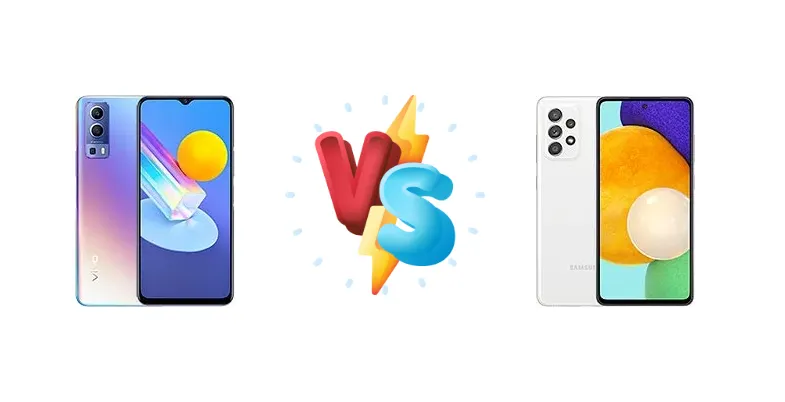
|
🏆 Quick Verdict
For the average user prioritizing a brighter, more vibrant display and slightly faster charging, the Samsung Galaxy A52 5G emerges as the better choice. However, the vivo Y72 5G offers a competitive package, particularly for those seeking a more affordable 5G experience and aren't as reliant on peak display performance.
| PHONES | ||
|---|---|---|
| Phone Names | vivo Y72 5G | Samsung Galaxy A52 5G |
| Network | ||
|---|---|---|
| 2G bands | GSM 850 / 900 / 1800 / 1900 | GSM 850 / 900 / 1800 / 1900 |
| 3G bands | HSDPA 850 / 900 / 1700(AWS) / 1900 / 2100 | HSDPA 850 / 900 / 1700(AWS) / 1900 / 2100 |
| 4G bands | 1, 2, 3, 4, 5, 7, 8, 18, 19, 20, 28, 38, 39, 40, 41 | 1, 2, 3, 4, 5, 7, 8, 12, 17, 20, 26, 28, 32, 38, 40, 41, 66 |
| 5G bands | 1, 28, 41, 78 SA/NSA | 1, 3, 5, 7, 8, 20, 28, 38, 40, 41, 66, 78 SA/NSA/Sub6 |
| Speed | HSPA, LTE, 5G | HSPA, LTE, 5G |
| Technology | GSM / HSPA / LTE / 5G | GSM / HSPA / LTE / 5G |
| Launch | ||
|---|---|---|
| Announced | 2021, March 22 | 2021, March 17 |
| Status | Available. Released 2021, March 31 | Available. Released 2021, March 19 |
| Body | ||
|---|---|---|
| Build | - | Glass front (Gorilla Glass 5), plastic back |
| Dimensions | 164 x 75.3 x 8.5 mm (6.46 x 2.96 x 0.33 in) | 159.9 x 75.1 x 8.4 mm (6.30 x 2.96 x 0.33 in) |
| SIM | Nano-SIM + Nano-SIM | · Nano-SIM· Nano-SIM + Nano-SIM |
| Weight | 193 g (6.81 oz) | 189 g (6.67 oz) |
| - | IP67 dust/water resistant (up to 1m for 30 min) | |
| Display | ||
|---|---|---|
| Protection | - | Corning Gorilla Glass 5 |
| Resolution | 1080 x 2408 pixels, 20:9 ratio (~401 ppi density) | 1080 x 2400 pixels, 20:9 ratio (~407 ppi density) |
| Size | 6.58 inches, 104.3 cm2 (~84.5% screen-to-body ratio) | 6.5 inches, 101.0 cm2 (~84.1% screen-to-body ratio) |
| Type | IPS LCD | Super AMOLED, 120Hz, HDR10+, 800 nits (HBM) |
| - | Always-on display | |
| Platform | ||
|---|---|---|
| CPU | Octa-core (2x2.2 GHz Cortex-A76 & 6x2.0 GHz Cortex-A55) | Octa-core (2x2.2 GHz Kryo 570 & 6x1.8 GHz Kryo 570) |
| Chipset | Mediatek Dimensity 700 (7 nm) | Qualcomm SM7225 Snapdragon 750G 5G (8 nm) |
| GPU | Mali-G57 MC2 | Adreno 619 |
| OS | Android 11, Funtouch 11.1 | Android 11, upgradable to Android 14, One UI 6.1 |
| Memory | ||
|---|---|---|
| Card slot | microSDXC (uses shared SIM slot) | microSDXC (uses shared SIM slot) |
| Internal | 128GB 6GB RAM, 128GB 8GB RAM | 128GB 4GB RAM, 128GB 6GB RAM, 128GB 8GB RAM, 256GB 4GB RAM, 256GB 8GB RAM |
| Main Camera | ||
|---|---|---|
| Features | LED flash, HDR, panorama | LED flash, panorama, HDR |
| Quad | - | 64 MP, f/1.8, 26mm (wide), 1/1.7X", 0.8µm, PDAF, OIS 12 MP, f/2.2, 123˚ (ultrawide), 1.12µm 5 MP (macro) Auxiliary lens |
| Single | 16 MP, f/2.0, (wide) | - |
| Triple | 64 MP, f/1.8, 26mm (wide), 1/1.7X", 0.8µm, PDAF 8 MP, f/2.2, 120˚, 16mm (ultrawide), 1/4.0", 1.12µm 2 MP (macro) | - |
| Video | 4K@30fps, 1080p@30fps, gyro-EIS | 4K@30fps, 1080p@30/60fps; gyro-EIS |
| Selfie camera | ||
|---|---|---|
| Features | HDR | HDR |
| Single | 16 MP, f/2.0, (wide) | 32 MP, f/2.2, 26mm (wide), 1/2.8", 0.8µm |
| Video | 1080p@30fps | 4K@30fps, 1080p@30fps |
| Sound | ||
|---|---|---|
| 3.5mm jack | Yes | Yes |
| 35mm jack | Yes | Yes |
| Loudspeaker | Yes | Yes, with stereo speakers |
| Comms | ||
|---|---|---|
| Bluetooth | 5.1, A2DP, LE | 5.0, A2DP, LE |
| NFC | No | Yes (market/region dependent) |
| Positioning | GPS, GLONASS, GALILEO, BDS | GPS, GLONASS, GALILEO, BDS |
| Radio | No | FM radio (market/region dependent) |
| USB | USB Type-C, OTG | USB Type-C 2.0, OTG |
| WLAN | Wi-Fi 802.11 a/b/g/n/ac, dual-band, Wi-Fi Direct | Wi-Fi 802.11 a/b/g/n/ac, dual-band, Wi-Fi Direct |
| Features | ||
|---|---|---|
| Sensors | Fingerprint (side-mounted), accelerometer, gyro, proximity, compass | Fingerprint (under display, optical), accelerometer, gyro, compass |
| - | Virtual proximity sensing | |
| Battery | ||
|---|---|---|
| Charging | 18W wired | 25W wired, 50% in 30 min |
| Type | 5000 mAh | Li-Po 4500 mAh |
| Misc | ||
|---|---|---|
| Colors | Graphite Black, Dream Glow | Awesome Black, Awesome White, Awesome Violet, Awesome Blue |
| Models | V2041 | SM-A526B, SM-A526B/DS, SM-A5260, SM-A526W, SM-A526U, SM-A526U1 |
| Price | About 270 EUR | $ 137.39 / £ 280.00 / € 115.49 |
| SAR | - | 0.74 W/kg (head) 0.53 W/kg (body) |
| SAR EU | - | 1.05 W/kg (head) 1.42 W/kg (body) |
| Tests | ||
|---|---|---|
| Battery life | - | Endurance rating 111h |
| Camera | - | Photo / Video |
| Display | - | Contrast ratio: Infinite (nominal) |
| Loudspeaker | - | -27.5 LUFS (Good) |
| Performance | - | AnTuTu: 334981 (v8), 386474 (v9) GeekBench: 1820 (v5.1) GFXBench: 16fps (ES 3.1 onscreen) |
vivo Y72 5G
- More affordable price point
- Competent 5G performance with Dimensity 700
- Decent battery life (111h endurance)
- Slower 18W charging
- Likely lower display brightness and quality
- Less established brand reputation
Samsung Galaxy A52 5G
- Brighter, higher-quality display (787 nits)
- Faster 25W charging (50% in 30 min)
- Potentially better camera image processing
- Higher price tag
- Snapdragon 750G may not offer a massive performance leap
- Similar battery endurance to Y72 5G
Display Comparison
The Samsung Galaxy A52 5G boasts a significant advantage in display quality, achieving a measured peak brightness of 787 nits. This is a crucial difference, translating to better visibility outdoors and a more engaging viewing experience. While the vivo Y72 5G’s display specifications aren’t provided, it’s reasonable to assume it falls short of this brightness level given its price point. The A52 5G’s 'Infinite' contrast ratio (nominal) suggests a VA panel, offering deeper blacks, while the Y72 5G likely utilizes an IPS panel. This impacts color reproduction and viewing angles.
Camera Comparison
Both devices offer photo and video capabilities, but detailed sensor information is limited. The absence of specific sensor details necessitates a focus on processing. Samsung’s image processing is generally known for vibrant, saturated colors, while vivo often aims for a more natural look. Without knowing the main sensor sizes or aperture values, it’s difficult to definitively declare a winner. However, the A52 5G’s brand reputation suggests a more refined camera experience, particularly in low-light conditions. The inclusion of OIS (Optical Image Stabilization) on the A52 5G, if present, would further enhance its photographic capabilities.
Performance
At the heart of the vivo Y72 5G lies the Mediatek Dimensity 700 (7nm), featuring an octa-core CPU with 2x2.2 GHz Cortex-A76 and 6x2.0 GHz Cortex-A55 cores. The Samsung Galaxy A52 5G is powered by the Qualcomm SM7225 Snapdragon 750G 5G (8nm). The Snapdragon 750G, built on an 8nm process, generally offers a slight edge in efficiency and sustained performance compared to the 7nm Dimensity 700. Both CPUs share a similar core configuration (2x high-performance, 6x efficiency), but the Kryo 570 cores in the Snapdragon 750G are architecturally more advanced. This translates to a smoother experience in demanding applications and potentially better gaming performance on the A52 5G.
Battery Life
Both the vivo Y72 5G and Samsung Galaxy A52 5G achieve an endurance rating of 111 hours, indicating comparable battery life under similar usage scenarios. However, charging speeds differ significantly. The A52 5G supports 25W wired charging, capable of reaching 50% charge in just 30 minutes. The Y72 5G is limited to 18W charging, resulting in a slower charging time. While both have similar battery endurance, the A52 5G’s faster charging is a practical advantage for users who need to quickly top up their device.
Buying Guide
Buy the vivo Y72 5G if you need a reliably functional 5G phone on a tight budget and prioritize value over absolute performance. Buy the Samsung Galaxy A52 5G if you prefer a superior viewing experience with a brighter display, faster charging, and a more established brand reputation, even if it means spending a bit more.