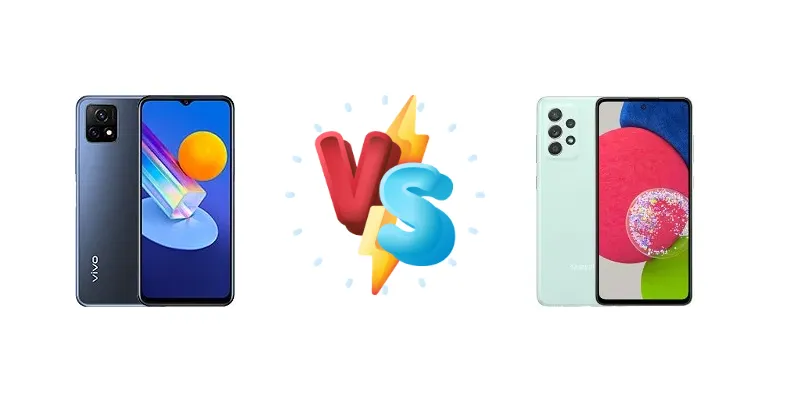
Both the vivo Y72 5G (India) and the Samsung Galaxy A52s 5G occupy the competitive mid-range 5G smartphone space, but cater to slightly different priorities. The Y72 5G aims for affordability, while the A52s 5G pushes for a more balanced experience with a stronger chipset. This comparison dissects their key differences to help you choose the right device.
🏆 Quick Verdict
For most users, the Samsung Galaxy A52s 5G is the superior choice. Its Snapdragon 778G chipset delivers significantly better performance, making it ideal for gaming and demanding applications. While the Y72 5G offers 5G connectivity at a lower price point, the A52s’ overall experience is more refined.
| Network |
|---|
| 2G bands | GSM 850 / 900 / 1800 / 1900 | GSM 850 / 900 / 1800 / 1900 |
| 3G bands | HSDPA 850 / 900 / 1700(AWS) / 2100 | HSDPA 850 / 900 / 1700(AWS) / 1900 / 2100 |
| 4G bands | 1, 3, 4, 5, 8, 38, 40, 41 | 1, 2, 3, 4, 5, 7, 8, 12, 17, 20, 26, 28, 32, 38, 40, 41, 66 |
| 5G bands | 78 SA/NSA | 1, 3, 5, 7, 8, 20, 28, 38, 40, 41, 66, 78 SA/NSA/Sub6 |
| Speed | HSPA, LTE, 5G | HSPA 42.2/5.76 Mbps, LTE Cat18 1200/150 Mbps, 5G |
| Technology | GSM / HSPA / LTE / 5G | GSM / HSPA / LTE / 5G |
| Launch |
|---|
| Announced | 2021, July 15 | 2021, August 17 |
| Status | Available. Released 2021, July 15 | Available. Released 2021, September 01 |
| Body |
|---|
| Build | - | Glass front (Gorilla Glass 5), plastic back |
| Dimensions | 164.2 x 75.4 x 8.4 mm (6.46 x 2.97 x 0.33 in) | 159.9 x 75.1 x 8.4 mm (6.30 x 2.96 x 0.33 in) |
| SIM | Nano-SIM + Nano-SIM | · Nano-SIM· Nano-SIM + Nano-SIM |
| Weight | 185.5 g (6.56 oz) | 189 g (6.67 oz) |
| | - | IP67 dust/water resistant (up to 1m for 30 min) |
| Display |
|---|
| Protection | - | Corning Gorilla Glass 5 |
| Resolution | 1080 x 2408 pixels, 20:9 ratio (~401 ppi density) | 1080 x 2400 pixels, 20:9 ratio (~405 ppi density) |
| Size | 6.58 inches, 104.3 cm2 (~84.2% screen-to-body ratio) | 6.5 inches, 102.0 cm2 (~84.9% screen-to-body ratio) |
| Type | IPS LCD, 90Hz, HDR10, 460 nits (typ) | Super AMOLED, 120Hz, 800 nits (HBM) |
| Platform |
|---|
| CPU | Octa-core (2x2.0 GHz Kryo 460 & 6x1.8 GHz Kryo 460) | Octa-core (1x2.4 GHz Cortex-A78 & 3x2.2 GHz Cortex-A78 & 4x1.9 GHz Cortex-A55) |
| Chipset | Qualcomm SM4350 Snapdragon 480 5G (8 nm) | Qualcomm SM7325 Snapdragon 778G 5G (6 nm) |
| GPU | Adreno 619 | Adreno 642L |
| OS | Android 11, Funtouch 11.1 | Android 11, upgradable to Android 14, One UI 6 |
| Memory |
|---|
| Card slot | No | microSDXC (uses shared SIM slot) |
| Internal | 128GB 8GB RAM | 128GB 4GB RAM, 128GB 6GB RAM, 128GB 8GB RAM, 256GB 6GB RAM, 256GB 8GB RAM |
| Main Camera |
|---|
| Dual | 48 MP, f/1.8, 25mm (wide), 1/2.0", 0.8µm, PDAF
Auxiliary lens | - |
| Features | LED flash, HDR, panorama | LED flash, panorama, HDR |
| Quad | - | 64 MP, f/1.8, 26mm (wide), 1/1.7", 0.8µm, PDAF, OIS
12 MP, f/2.2, 123˚ (ultrawide), 1.12µm
5 MP (macro)
Auxiliary lens |
| Single | 8 MP, f/1.8, (wide) | 32 MP, f/2.2, 26mm (wide), 1/2.8", 0.8µm |
| Video | 1080p@30fps | 4K@30fps, 1080p@30/60fps; gyro-EIS |
| Selfie camera |
|---|
| Features | HDR | HDR |
| Single | 8 MP, f/1.8, (wide) | 32 MP, f/2.2, 26mm (wide), 1/2.8", 0.8µm |
| Video | 1080p@30fps | 4K@30fps, 1080p@30/60fps |
| Sound |
|---|
| 3.5mm jack | Yes | Yes |
| 35mm jack | Yes | Yes |
| Loudspeaker | Yes | Yes, with stereo speakers |
| Comms |
|---|
| Bluetooth | 5.1, A2DP, LE, aptX HD | 5.0, A2DP, LE |
| NFC | No | Yes (market/region dependent) |
| Positioning | GPS, GLONASS, BDS, GALILEO | GPS, GLONASS, GALILEO, BDS, QZSS |
| Radio | No | No |
| USB | USB Type-C 2.0, OTG | USB Type-C 2.0, OTG |
| WLAN | Wi-Fi 802.11 a/b/g/n/ac, dual-band, Wi-Fi Direct | Wi-Fi 802.11 a/b/g/n/ac/6, dual-band, Wi-Fi Direct |
| Features |
|---|
| Sensors | Fingerprint (side-mounted), accelerometer, proximity, compass | Fingerprint (under display, optical), accelerometer, gyro, compass |
| | - | Virtual Proximity Sensing |
| Battery |
|---|
| Charging | 18W wired | 25W wired |
| Type | 5000 mAh | Li-Ion 4500 mAh |
| Misc |
|---|
| Colors | Prism Magic, Slate Grey | Awesome Black, Awesome White, Awesome Purple, Awesome Mint |
| Models | V2060 | SM-A528B, SM-A528B/DS, SM-A528N |
| Price | About 240 EUR | £ 112.98 / € 249.47 |
| SAR | 1.04 W/kg (head) | 0.72 W/kg (head) |
| SAR EU | - | 0.88 W/kg (head) 0.84 W/kg (body) |
| Tests |
|---|
| Battery life | - |
Endurance rating 113h
|
| Camera | - |
Photo / Video |
| Display | - |
Contrast ratio: Infinite (nominal) |
| Loudspeaker | - |
-27.5 LUFS (Good)
|
| Performance | - |
AnTuTu: 429675 (v8), 506432(v9)
GeekBench: 11060 (v4.4), 2801 (v5.1)
GFXBench: 28fps (ES 3.1 onscreen) |
vivo Y72 5G (India)
- More affordable price point
- 5G connectivity
- Potentially longer battery life (based on endurance rating)
- Significantly weaker processor
- Less detailed display specifications
- Slower charging speed
Samsung Galaxy A52s 5G
- Much faster Snapdragon 778G processor
- Brighter and more vibrant display
- Faster 25W charging
- Likely superior camera performance
- Higher price
- Similar battery life to the Y72 5G
Display Comparison
The Samsung Galaxy A52s 5G boasts a notably brighter display, reaching a measured peak brightness of 800 nits, compared to an unspecified brightness for the vivo Y72 5G. This difference translates to better visibility outdoors. While both displays have an 'infinite' contrast ratio (typical for AMOLED panels), the A52s’ higher brightness provides a more impactful viewing experience. The Y72 5G’s display specifications are less detailed, suggesting a potentially lower-quality panel overall.
Camera Comparison
Both devices offer photo and video capabilities, but detailed sensor information for the vivo Y72 5G is lacking. The Samsung Galaxy A52s 5G likely benefits from Samsung’s image processing expertise and potentially a larger main sensor (though specifics aren't provided). While both will likely perform adequately in good lighting, the A52s’ superior processing power will likely result in better low-light performance and more detailed images. The prevalence of 2MP macro sensors on both devices suggests limited utility for detailed close-up photography.
Performance
The performance gap is the most significant differentiator. The Samsung Galaxy A52s 5G is powered by the Qualcomm Snapdragon 778G 5G (6nm), featuring a 1x2.4 GHz Cortex-A78 prime core and 3x2.2 GHz Cortex-A78 performance cores, alongside 4x1.9 GHz Cortex-A55 efficiency cores. This contrasts sharply with the vivo Y72 5G’s Snapdragon 480 5G (8nm) with its 2x2.0 GHz Kryo 460 and 6x1.8 GHz Kryo 460 configuration. The 6nm process node of the 778G is more efficient, and the core architecture is significantly more powerful, resulting in faster app loading, smoother multitasking, and superior gaming performance. The A52s is the clear winner for users who demand responsiveness.
Battery Life
Both phones achieve an Endurance rating of 113 hours, indicating similar overall battery life despite the vivo Y72 5G’s unspecified battery capacity. However, the Samsung Galaxy A52s 5G supports 25W wired charging, significantly faster than the Y72 5G’s 18W charging. This means the A52s can replenish its battery much quicker, minimizing downtime. While battery life is comparable, the faster charging speed gives the A52s an edge in convenience.
Buying Guide
Buy the vivo Y72 5G (India) if your primary need is affordable 5G connectivity and basic smartphone functionality, and you prioritize cost savings over raw performance. Buy the Samsung Galaxy A52s 5G if you value a smoother user experience, better gaming capabilities, and a brighter, more vibrant display, and are willing to spend a bit more.
Frequently Asked Questions
❓ Is the Snapdragon 480 5G in the vivo Y72 5G sufficient for playing PUBG Mobile?
While the Snapdragon 480 5G can run PUBG Mobile, it will likely require lower graphics settings and may experience occasional frame drops, especially during intense firefights. The A52s 5G with its Snapdragon 778G will provide a much smoother and more consistent gaming experience.
❓ How much faster is the 25W charging on the Samsung Galaxy A52s 5G compared to the 18W charging on the vivo Y72 5G?
The 25W charging on the A52s 5G will significantly reduce charging times. Expect a full charge in approximately 60-75 minutes, while the Y72 5G’s 18W charging will likely take over 90 minutes, potentially closer to two hours.
❓ Does the Samsung Galaxy A52s 5G experience thermal throttling during prolonged gaming sessions?
The Snapdragon 778G is generally efficient, and the A52s 5G incorporates thermal management features. While some throttling may occur during extremely long gaming sessions, it's typically less pronounced than with less efficient chipsets. The 6nm process node helps mitigate heat buildup.