
vivo Y72 5G (India) vs Motorola Edge 20 Fusion: A Detailed Comparison
| Phones Images | |||||
|---|---|---|---|---|---|
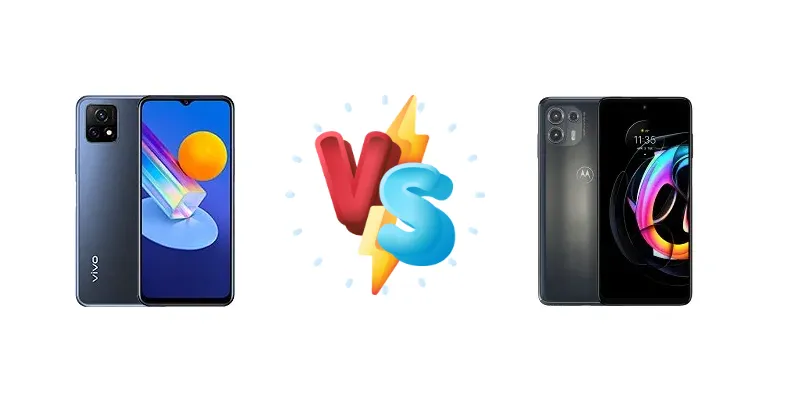
|
🏆 Quick Verdict
For most users, the Motorola Edge 20 Fusion emerges as the stronger choice. Its Mediatek Dimensity 800U chipset provides a noticeable performance advantage over the Snapdragon 480 in the vivo Y72 5G, translating to smoother multitasking and a better gaming experience. The faster 30W charging also significantly reduces downtime, making it the more practical option.
| PHONES | ||
|---|---|---|
| Phone Names | vivo Y72 5G (India) | Motorola Edge 20 Fusion |
| Network | ||
|---|---|---|
| 2G bands | GSM 850 / 900 / 1800 / 1900 | GSM 850 / 900 / 1800 / 1900 |
| 3G bands | HSDPA 850 / 900 / 1700(AWS) / 2100 | HSDPA 850 / 900 / 1700(AWS) / 1900 / 2100 |
| 4G bands | 1, 3, 4, 5, 8, 38, 40, 41 | 1, 2, 3, 4, 5, 7, 8, 12, 13, 17, 18, 19, 20, 26, 28, 32, 34, 38, 39, 40, 41, 42, 43, 66 |
| 5G bands | 78 SA/NSA | 1, 3, 5, 7, 8, 20, 28, 38, 40, 41, 77, 78, 66 SA/NSA/Sub6 |
| Speed | HSPA, LTE, 5G | HSPA 42.2/5.76 Mbps, LTE Cat18 1200/150 Mbps, 5G |
| Technology | GSM / HSPA / LTE / 5G | GSM / HSPA / LTE / 5G |
| Launch | ||
|---|---|---|
| Announced | 2021, July 15 | 2021, August 17 |
| Status | Available. Released 2021, July 15 | Available. Released 2021, August 27 |
| Body | ||
|---|---|---|
| Build | - | Glass front |
| Dimensions | 164.2 x 75.4 x 8.4 mm (6.46 x 2.97 x 0.33 in) | 166 x 76 x 8.3 mm (6.54 x 2.99 x 0.33 in) |
| SIM | Nano-SIM + Nano-SIM | Nano-SIM + Nano-SIM |
| Weight | 185.5 g (6.56 oz) | 185 g (6.53 oz) |
| - | Water-repellent design | |
| Display | ||
|---|---|---|
| Resolution | 1080 x 2408 pixels, 20:9 ratio (~401 ppi density) | 1080 x 2400 pixels, 20:9 ratio (~393 ppi density) |
| Size | 6.58 inches, 104.3 cm2 (~84.2% screen-to-body ratio) | 6.7 inches, 108.4 cm2 (~85.9% screen-to-body ratio) |
| Type | IPS LCD, 90Hz, HDR10, 460 nits (typ) | OLED, 1B colors, 90Hz, HDR10+ |
| Platform | ||
|---|---|---|
| CPU | Octa-core (2x2.0 GHz Kryo 460 & 6x1.8 GHz Kryo 460) | Octa-core (2x2.4 GHz Cortex-A76 & 6x2.0 GHz Cortex-A55) |
| Chipset | Qualcomm SM4350 Snapdragon 480 5G (8 nm) | Mediatek Dimensity 800U (7 nm) |
| GPU | Adreno 619 | Mali-G57 MC3 |
| OS | Android 11, Funtouch 11.1 | Android 11 |
| Memory | ||
|---|---|---|
| Card slot | No | microSDXC |
| Internal | 128GB 8GB RAM | 128GB 6GB RAM, 128GB 8GB RAM |
| Main Camera | ||
|---|---|---|
| Dual | 48 MP, f/1.8, 25mm (wide), 1/2.0", 0.8µm, PDAF Auxiliary lens | - |
| Features | LED flash, HDR, panorama | LED flash, HDR, panorama |
| Single | 8 MP, f/1.8, (wide) | - |
| Triple | - | 108 MP, f/1.9, (wide), 1/1.52", 0.7µm, PDAF 8 MP, f/2.2, 118˚ (ultrawide) Auxiliary lens |
| Video | 1080p@30fps | 4K@30fps, 1080p@30/60/120fps, gyro-EIS |
| Selfie camera | ||
|---|---|---|
| Features | HDR | HDR |
| Single | 8 MP, f/1.8, (wide) | 32 MP, f/2.3, (wide), 0.7µm |
| Video | 1080p@30fps | 1080p@30fps |
| Sound | ||
|---|---|---|
| 3.5mm jack | Yes | Yes |
| 35mm jack | Yes | Yes |
| Loudspeaker | Yes | Yes |
| Comms | ||
|---|---|---|
| Bluetooth | 5.1, A2DP, LE, aptX HD | 5.0, A2DP, LE |
| NFC | No | Yes |
| Positioning | GPS, GLONASS, BDS, GALILEO | GPS, GLONASS, GALILEO |
| Radio | No | FM radio |
| USB | USB Type-C 2.0, OTG | USB Type-C 2.0 |
| WLAN | Wi-Fi 802.11 a/b/g/n/ac, dual-band, Wi-Fi Direct | Wi-Fi 802.11 a/b/g/n/ac, dual-band, Wi-Fi Direct |
| Features | ||
|---|---|---|
| Sensors | Fingerprint (side-mounted), accelerometer, proximity, compass | Fingerprint (side-mounted), accelerometer, gyro, proximity, compass |
| Battery | ||
|---|---|---|
| Charging | 18W wired | 30W wired |
| Type | 5000 mAh | Li-Po 5000 mAh |
| Misc | ||
|---|---|---|
| Colors | Prism Magic, Slate Grey | Electric Graphite, Cyber Teal |
| Models | V2060 | - |
| Price | About 240 EUR | About 250 EUR |
| SAR | 1.04 W/kg (head) | - |
vivo Y72 5G (India)
- Potentially better battery life due to Snapdragon 480's efficiency.
- More affordable price point (likely).
- Clean and simple software experience (typical of vivo).
- Significantly slower charging speed (18W).
- Less powerful processor for gaming and demanding apps.
- Limited performance headroom for future software updates.
Motorola Edge 20 Fusion
- Faster and more powerful Dimensity 800U chipset.
- Significantly faster 30W charging.
- Better performance for gaming and multitasking.
- Potentially shorter battery life compared to the vivo.
- May be slightly more expensive.
- Motorola's software can include bloatware (though improving).
Display Comparison
Neither device boasts a standout display. While specific panel details (like peak brightness or color gamut coverage) are unavailable, the focus here is on the underlying performance. Both likely utilize LCD panels common in this price bracket. The real difference lies elsewhere, as display quality isn't a key differentiator.
Camera Comparison
Without detailed camera specs beyond the presence of a main sensor, a direct comparison is difficult. However, the Motorola Edge 20 Fusion likely benefits from a more sophisticated image signal processor (ISP) integrated within the Dimensity 800U. This ISP can deliver better dynamic range, noise reduction, and overall image quality. The vivo Y72 5G’s Snapdragon 480 ISP is adequate, but likely won’t match the Motorola’s processing capabilities. The prevalence of 2MP macro/depth sensors on both devices suggests these are largely marketing features and won't significantly impact image quality.
Performance
The core difference between these phones is their chipsets. The Motorola Edge 20 Fusion’s Mediatek Dimensity 800U, fabricated on a 7nm process, demonstrably outperforms the Qualcomm Snapdragon 480 (8nm) in the vivo Y72 5G. The Dimensity 800U’s Cortex-A76 cores, clocked at 2.4 GHz, offer a significant uplift in CPU performance compared to the Snapdragon 480’s Kryo 460 cores (2.0 GHz). This translates to faster app loading times, smoother multitasking, and a more responsive user interface. The GPU within the Dimensity 800U also provides a more capable gaming experience, handling demanding titles at higher settings. While the Snapdragon 480 is efficient, it’s geared towards basic tasks, and will show its limitations with graphically intensive applications.
Battery Life
The vivo Y72 5G’s 18W charging is a clear disadvantage compared to the Motorola Edge 20 Fusion’s 30W charging. While battery capacity isn’t specified, the faster charging of the Motorola will significantly reduce downtime. A full charge from 0-100% on the Motorola will likely take around an hour, while the vivo could easily exceed 1.5 hours. The Snapdragon 480’s efficiency *may* offset the slower charging for some users, providing slightly longer battery life between charges, but the convenience of faster charging is a significant benefit.
Buying Guide
Buy the vivo Y72 5G (India) if you prioritize long-term battery life and a consistently stable, if less powerful, experience for everyday tasks like browsing and social media. Buy the Motorola Edge 20 Fusion if you value performance for gaming, demanding apps, and appreciate the convenience of significantly faster charging speeds, even if it means slightly reduced battery longevity.