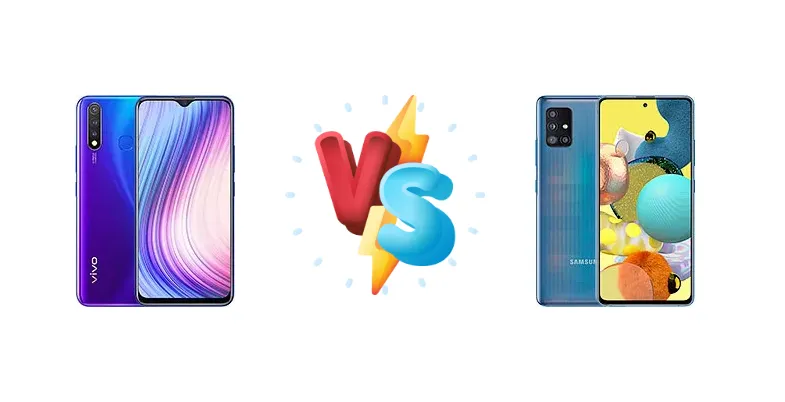
The vivo Y5s and Samsung Galaxy A51 5G UW represent different approaches to the affordable 5G smartphone market. The Y5s aims for value with a Mediatek Helio P65, while the A51 5G UW leverages Qualcomm's Snapdragon 765G for a more robust experience. This comparison dissects their key differences to determine which device delivers the best bang for your buck.
🏆 Quick Verdict
For the average user prioritizing performance and future-proofing, the Samsung Galaxy A51 5G UW is the clear winner. Its Snapdragon 765G chipset offers a substantial performance advantage over the vivo Y5s' Helio P65, making it better suited for demanding tasks and 5G connectivity. However, the Y5s remains a viable option for basic users on a tight budget.
| Network |
|---|
| 2G bands | GSM 850 / 900 / 1800 / 1900 | GSM 850 / 900 / 1800 / 1900 |
| 3G bands | HSDPA 850 / 900 / 2100 | HSDPA 850 / 900 / 1900 / 2100 |
| 4G bands | 1, 3, 5, 8, 28, 34, 38, 39, 40, 41 | 2, 4, 5, 13, 66 |
| 5G bands | - | 260, 261 mmWave |
| Speed | HSPA, LTE | HSPA, LTE, 5G |
| Technology | GSM / HSPA / LTE | GSM / HSPA / LTE / 5G |
| Launch |
|---|
| Announced | 2019, November. Released 2019, December | 2020, August 14 |
| Status | Discontinued | Available. Released 2020, August 14 |
| Body |
|---|
| Build | - | Glass front (Gorilla Glass 3), plastic back, aluminum frame |
| Dimensions | 162.2 x 76.5 x 8.9 mm (6.39 x 3.01 x 0.35 in) | 158.8 x 73.4 x 8.6 mm (6.25 x 2.89 x 0.34 in) |
| SIM | · Nano-SIM· Nano-SIM + Nano-SIM | Nano-SIM (pre-installed) |
| Weight | 193 g (6.81 oz) | 188.8 g (6.67 oz) |
| Display |
|---|
| Protection | - | Corning Gorilla Glass 3 |
| Resolution | 1080 x 2340 pixels, 19.5:9 ratio (~395 ppi density) | 1080 x 2400 pixels, 20:9 ratio (~405 ppi density) |
| Size | 6.53 inches, 104.7 cm2 (~84.4% screen-to-body ratio) | 6.5 inches, 102.0 cm2 (~87.5% screen-to-body ratio) |
| Type | IPS LCD | Super AMOLED |
| Platform |
|---|
| CPU | Octa-core (2x2.0 GHz Cortex-A75 & 6x1.7 GHz Cortex-A55) | Octa-core (1x2.4 GHz Kryo 475 Prime & 1x2.2 GHz Kryo 475 Gold & 6x1.8 GHz Kryo 475 Silver) |
| Chipset | Mediatek MT6768 Helio P65 (12 nm) | Qualcomm SM7250 Snapdragon 765G 5G (7 nm) |
| GPU | Mali-G52 MC2 | Adreno 620 |
| OS | Android 9.0 (Pie), Funtouch 9.2 | Android 10, One UI 2 |
| Memory |
|---|
| Card slot | microSDXC (dedicated slot) | microSDXC (uses shared SIM slot) |
| Internal | 128GB 6GB RAM | 128GB 6GB RAM |
| | eMMC 5.1 | UFS 2.1 |
| Main Camera |
|---|
| Features | LED flash, HDR, panorama | LED flash, panorama, HDR |
| Quad | - | 48 MP, f/2.0, 26mm (wide), 1/2.0", 0.8µm, PDAF
12 MP, f/2.2, 123˚ (ultrawide)
5 MP (macro)
Auxiliary lens |
| Single | - | 5 MP, AF |
| Triple | 16 MP, f/1.8, (wide), PDAF
8 MP, f/2.2, 13mm (ultrawide)
2 MP (macro) | - |
| Video | 1080p@30fps | 4K@30fps, 1080p@30/120fps; gyro-EIS |
| Selfie camera |
|---|
| Features | HDR | HDR |
| Single | 16 MP, f/2.0, 26mm (wide), 1/3.06", 1.0µm | 32 MP, f/2.2, 26mm (wide), 1/2.8", 0.8µm |
| Video | 1080p@30fps | 4K@30fps, 1080p@30fps |
| Sound |
|---|
| 3.5mm jack | Yes | Yes |
| 35mm jack | Yes | Yes |
| Loudspeaker | Yes | Yes |
| Comms |
|---|
| Bluetooth | 5.0, A2DP, LE | 5.0, A2DP, LE |
| NFC | No | Yes |
| Positioning | GPS, GLONASS, BDS | GPS, GLONASS, GALILEO, BDS |
| Radio | FM radio | FM radio, RDS, recording |
| USB | microUSB 2.0, OTG | USB Type-C 2.0, OTG |
| WLAN | Wi-Fi 802.11 a/b/g/n/ac, dual-band, Wi-Fi Direct | Wi-Fi 802.11 a/b/g/n/ac, dual-band, Wi-Fi Direct |
| Features |
|---|
| Sensors | Fingerprint (rear-mounted), accelerometer, proximity, compass | Fingerprint (under display, optical), accelerometer, gyro, proximity, compass |
| | - | ANT+ |
| Battery |
|---|
| Charging | 18W wired
5W reverse wired | 15W wired |
| Stand-by | - | Up to 672 h |
| Talk time | - | Up to 5 h |
| Type | 5000 mAh, non-removable | Li-Po 4500 mAh |
| Misc |
|---|
| Colors | Magnetic Black, Spring White, Blue | Prism Bricks Blue |
| Models | V1934A | SM-A516V |
| Price | About 190 EUR | About 470 EUR |
| SAR | - | 0.70 W/kg (head) 1.25 W/kg (body) |
| SAR EU | - | 0.59 W/kg (head) 1.32 W/kg (body) |
vivo Y5s
- Faster charging speed (18W vs 15W)
- Reverse wireless charging capability
- Potentially lower price point
- Significantly weaker processor (Helio P65)
- Less efficient chipset (12nm process)
- Likely inferior camera performance
Samsung Galaxy A51 5G UW
- More powerful processor (Snapdragon 765G)
- More efficient chipset (7nm process)
- Better 5G performance and future-proofing
- Superior image processing capabilities
- Slower charging speed (15W)
- Generally higher price point
- No reverse wireless charging
Display Comparison
Neither device boasts a particularly standout display. While specific display specs (resolution, panel type) are not provided for the Y5s, its market positioning suggests an LCD panel. The A51 5G UW also likely features an LCD. The key difference lies in processing power impacting UI smoothness. The Snapdragon 765G's superior GPU will contribute to a more fluid scrolling experience, even if both displays share similar characteristics. Bezels are expected to be comparable, typical of this price bracket.
Camera Comparison
Without detailed camera specs beyond the presence of sensors, a direct comparison is limited. However, the Snapdragon 765G’s image signal processor (ISP) is generally more advanced than the Helio P65’s, offering better image processing capabilities. This means the A51 5G UW is likely to produce more detailed and dynamic photos, especially in challenging lighting conditions. The A51 5G UW is more likely to have features like better HDR processing and noise reduction. The Y5s likely relies more heavily on software processing to compensate for its less powerful ISP.
Performance
The performance gap is the most significant differentiator. The Samsung Galaxy A51 5G UW’s Qualcomm Snapdragon 765G (7nm) is built on a smaller, more efficient process node than the vivo Y5s’ Mediatek Helio P65 (12nm). This translates to better power efficiency and sustained performance. The Snapdragon 765G’s Kryo CPU architecture (1x2.4 GHz Prime, 1x2.2 GHz Gold, 6x1.8 GHz Silver) is demonstrably more capable than the Helio P65’s (2x2.0 GHz Cortex-A75 & 6x1.7 GHz Cortex-A55). Gamers and multitasking users will see a substantial benefit from the A51 5G UW. The 7nm process also implies better thermal management, reducing the likelihood of throttling during extended use.
Battery Life
The vivo Y5s offers 18W wired charging, with 5W reverse wired charging, while the Samsung Galaxy A51 5G UW is limited to 15W wired charging. While the Y5s charges slightly faster, the Snapdragon 765G’s superior power efficiency means the A51 5G UW will likely offer comparable, if not better, real-world battery life despite potentially having a similar or slightly smaller battery capacity. The 5W reverse charging on the Y5s is a niche feature, useful for topping up accessories but not a major selling point.
Buying Guide
Buy the vivo Y5s if you need a very affordable smartphone for basic tasks like calling, texting, and light social media use, and aren't concerned with demanding gaming or heavy multitasking. Buy the Samsung Galaxy A51 5G UW if you prioritize smoother performance, 5G connectivity, and a more responsive user experience, even if it means spending a bit more. The A51 5G UW is the better choice for users who want a phone that will last longer and handle more complex applications.
Frequently Asked Questions
❓ Will the Snapdragon 765G in the A51 5G UW handle demanding games like PUBG or Call of Duty?
Yes, the Snapdragon 765G is capable of running PUBG and Call of Duty at medium to high settings with playable frame rates. While it's not a flagship-level gaming chip, it provides a significantly smoother gaming experience than the Helio P65 in the Y5s, which may struggle with consistent performance in these titles.
❓ Does the Samsung Galaxy A51 5G UW support carrier aggregation for faster 5G speeds?
Yes, the Snapdragon 765G supports carrier aggregation, allowing it to combine multiple 5G channels for faster download and upload speeds. This is a crucial feature for maximizing the benefits of 5G connectivity, and the Y5s' Helio P65 may have limited or no carrier aggregation support.
❓ Is the 5W reverse charging on the vivo Y5s actually useful?
The 5W reverse charging is a slow charging method, best suited for topping up small accessories like wireless earbuds or a smartwatch in an emergency. It won't significantly charge a phone, but it can be a convenient feature to have in a pinch.
❓ How will the 7nm process of the Snapdragon 765G affect long-term performance?
The 7nm process node is more power-efficient and generates less heat than the 12nm process used in the Helio P65. This means the A51 5G UW is less likely to experience performance throttling during extended use, maintaining smoother performance over time.