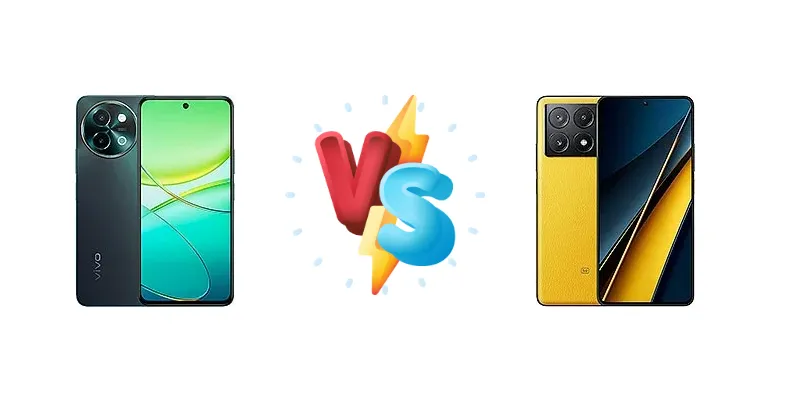
The mid-range smartphone market is fiercely competitive, and the vivo Y58 and Xiaomi Poco X6 Pro represent compelling options at different ends of the spectrum. The Y58 focuses on efficient performance and a streamlined experience, while the Poco X6 Pro aims for near-flagship power at a more accessible price point. This comparison dissects their key differences to help you choose the right device.
🏆 Quick Verdict
For the average user prioritizing raw performance and gaming capabilities, the Xiaomi Poco X6 Pro is the clear winner. Its Dimensity 8300 Ultra chipset significantly outperforms the Snapdragon 4 Gen 2 in the vivo Y58. However, the Y58 offers a more efficient processor and a potentially smoother everyday experience for basic tasks.
| Network |
|---|
| 2G bands | GSM 850 / 900 / 1800 / 1900 | GSM 850 / 900 / 1800 / 1900 |
| 3G bands | HSDPA 850 / 900 / 2100 | HSDPA 850 / 900 / 1700(AWS) / 1900 / 2100 |
| 4G bands | 1, 3, 5, 8, 28, 38, 40, 41 | 1, 2, 3, 4, 5, 7, 8, 18, 19, 20, 28, 38, 40, 41, 48, 66 |
| 5G bands | 1, 3, 5, 8, 28, 38, 40, 77, 78 SA/NSA | 1, 2, 3, 5, 7, 8, 20, 28, 38, 40, 41, 48, 77, 78 SA/NSA/Sub6 |
| Speed | HSPA, LTE, 5G | HSPA, LTE, 5G |
| Technology | GSM / HSPA / LTE / 5G | GSM / HSPA / LTE / 5G |
| Launch |
|---|
| Announced | 2024, June 20 | 2024, January 11 |
| Status | Available. Released 2024, June 20 | Available. Released 2024, January 12 |
| Body |
|---|
| Build | Glass front, plastic frame, plastic back | Glass front (Gorilla Glass 5), plastic frame, plastic back or silicone polymer back (eco leather) |
| Dimensions | 165.7 x 76 x 8 mm (6.52 x 2.99 x 0.31 in) | 160.5 x 74.3 x 8.3 mm (6.32 x 2.93 x 0.33 in) |
| SIM | Nano-SIM + Nano-SIM | Nano-SIM + Nano-SIM |
| Weight | 199 g (7.02 oz) | 186 g or 190 g (6.56 oz) |
| Display |
|---|
| Protection | - | Corning Gorilla Glass 5 |
| Resolution | 1080 x 2408 pixels, 20:9 ratio (~393 ppi density) | 1220 x 2712 pixels, 20:9 ratio (~446 ppi density) |
| Size | 6.72 inches, 108.8 cm2 (~86.4% screen-to-body ratio) | 6.67 inches, 107.4 cm2 (~90.1% screen-to-body ratio) |
| Type | IPS LCD, 120Hz, 1024 nits (HBM) | AMOLED, 68B colors, 120Hz, 1920Hz PWM, HDR10+, Dolby Vision, 500 nits (typ), 1200 nits (HBM), 1800 nits (peak) |
| Platform |
|---|
| CPU | Octa-core (2x2.2 GHz Cortex-A78 & 6x1.95 GHz Cortex-A55) | Octa-core (1x3.35 GHz Cortex-A715 & 3x3.20 GHz Cortex-A715 & 4x2.20 GHz Cortex-A510) |
| Chipset | Qualcomm SM4450 Snapdragon 4 Gen 2 (4 nm) | Mediatek Dimensity 8300 Ultra (4 nm) |
| GPU | Adreno 613 | Mali G615-MC6 |
| OS | Android 14, Funtouch 14 | Android 14, up to 3 major Android upgrades, HyperOS |
| Memory |
|---|
| Card slot | microSDXC (uses shared SIM slot) | No |
| Internal | 128GB 8GB RAM | 256GB 8GB RAM, 256GB 12GB RAM, 512GB 12GB RAM |
| Main Camera |
|---|
| Dual | 50 MP, f/1.8, (wide), PDAF
Auxiliary lens | - |
| Features | LED flash, HDR, panorama | LED flash, HDR, panorama |
| Triple | - | 64 MP, f/1.7, 25mm (wide), 1/2.0", 0.7µm, PDAF, OIS
8 MP, f/2.2, 120˚ (ultrawide), 1/4.0", 1.12µm
2 MP (macro) |
| Video | 1080p@30fps | 4K@24/30fps, 1080p@30/60fps, gyro-EIS |
| Selfie camera |
|---|
| Features | - | HDR, panorama |
| Single | 8 MP, f/2.1, (wide) | 16 MP, f/2.4, (wide), 1/3.06", 1.0µm |
| Video | 1080p@30fps | 1080p@30/60fps |
| Sound |
|---|
| 35mm jack | Yes | No |
| Loudspeaker | Yes, with stereo speakers | Yes, with dual speakers |
| Comms |
|---|
| Bluetooth | 5.1, A2DP, LE | 5.4, A2DP, LE, aptX HD |
| Infrared port | - | Yes |
| NFC | No | Yes (market/region dependent) |
| Positioning | GPS, GALILEO, GLONASS, BDS, QZSS | GPS, GALILEO, GLONASS, QZSS, BDS (B1I+B1c) |
| Radio | FM radio | No |
| USB | USB Type-C 2.0, OTG | USB Type-C 2.0, OTG |
| WLAN | Wi-Fi 802.11 a/b/g/n/ac, dual-band | Wi-Fi 802.11 a/b/g/n/ac/6, dual-band, Wi-Fi Direct |
| Features |
|---|
| Sensors | Fingerprint (side-mounted), accelerometer, gyro, proximity, compass | Fingerprint (under display, optical), accelerometer, gyro, compass |
| Battery |
|---|
| Charging | 44W wired | 67W wired, QC2.0, PD3.0, 100% in 45 min |
| Type | 6000 mAh | 5000 mAh |
| Misc |
|---|
| Colors | Himalayan Blue, Sundarbans Green | Black, Yellow, Gray |
| Models | V2355 | 2311DRK48G, 2311DRK48I |
| Price | About 220 EUR | € 195.30 / $ 209.79 / £ 274.99 / ₹ 21,999 |
| SAR EU | - | 0.99 W/kg (head) 1.00 W/kg (body) |
vivo Y58
- Efficient Snapdragon 4 Gen 2 processor
- Potentially longer battery life due to processor efficiency
- More affordable price point (likely)
- Significantly lower performance compared to the Poco X6 Pro
- Likely less capable camera system
- Slower charging speed
Xiaomi Poco X6 Pro
- Powerful Mediatek Dimensity 8300 Ultra chipset
- Faster 67W charging with QC2.0/PD3.0 support
- Brighter display for better outdoor visibility
- Potentially shorter battery life due to higher performance
- May experience more thermal throttling under heavy load
- Higher price point
Display Comparison
The Poco X6 Pro boasts a significantly brighter display, reaching a measured peak of 1148 nits. This translates to superior visibility outdoors under direct sunlight compared to the Y58, whose brightness is not specified but is likely lower given its market positioning. While both utilize 4nm chipsets, the display’s impact on overall power draw should be considered; a brighter screen consumes more energy. Details regarding panel technology (AMOLED vs. LCD) and refresh rates are missing for the Y58, but the X6 Pro’s brightness advantage is a clear win for outdoor usability.
Camera Comparison
The context data for both devices is limited regarding camera specifics. However, the Poco X6 Pro’s positioning suggests a more robust camera system, likely featuring a higher-resolution main sensor and more advanced image processing capabilities. The Y58 likely focuses on providing adequate image quality for casual use. Without detailed sensor size and aperture information, it’s difficult to make a definitive judgment, but the X6 Pro’s brand reputation and price point suggest a more capable camera experience, including better video recording features.
Performance
The performance gap between these devices is substantial. The Poco X6 Pro’s Mediatek Dimensity 8300 Ultra, with its octa-core configuration (1x3.35 GHz Cortex-A715 & 3x3.20 GHz Cortex-A715 & 4x2.20 GHz Cortex-A510), is in a different league than the vivo Y58’s Qualcomm SM4450 Snapdragon 4 Gen 2 (2x2.2 GHz Cortex-A78 & 6x1.95 GHz Cortex-A55). The Dimensity 8300 Ultra’s higher clock speeds and more advanced core architecture deliver significantly faster processing speeds and superior graphics performance. While both are built on a 4nm process, the Dimensity chip’s design prioritizes performance, potentially leading to more thermal throttling under sustained load, but offering a much higher ceiling. The Y58’s Snapdragon 4 Gen 2 is optimized for efficiency, making it suitable for everyday tasks.
Battery Life
The Poco X6 Pro demonstrates a strong battery performance with an active use score of 11:46h, indicating excellent endurance. The vivo Y58’s battery capacity is not specified, but its Snapdragon 4 Gen 2 chipset’s efficiency could potentially offset a smaller battery size. The X6 Pro’s 67W wired charging, supporting QC2.0 and PD3.0, and a full charge in 45 minutes, is significantly faster than the Y58’s 44W charging. This faster charging speed is a major convenience factor for users who need to quickly top up their battery.
Buying Guide
Buy the vivo Y58 if you need a reliable daily driver with good battery life and prioritize efficiency over peak performance. It’s ideal for users who primarily browse, use social media, and make calls. Buy the Xiaomi Poco X6 Pro if you prefer a phone capable of handling demanding games, multitasking, and content creation. It’s the better choice for power users and mobile gamers.
Frequently Asked Questions
❓ Will the Poco X6 Pro’s Dimensity 8300 Ultra overheat during prolonged gaming sessions?
While the Dimensity 8300 Ultra is a powerful chip, it can generate heat under sustained load. The Poco X6 Pro likely incorporates thermal management solutions to mitigate throttling, but some performance reduction is possible during extended gaming. The Snapdragon 4 Gen 2 in the Y58 will run cooler, but at the cost of significantly lower performance.
❓ Is the 44W charging on the vivo Y58 slow compared to the Poco X6 Pro’s 67W?
Yes, 44W is considerably slower than 67W. The Poco X6 Pro can fully charge in approximately 45 minutes, while the Y58 will take significantly longer. This difference is noticeable for users who frequently need to quickly replenish their battery.
❓ How does the Snapdragon 4 Gen 2 handle multitasking compared to the Dimensity 8300 Ultra?
The Dimensity 8300 Ultra excels at multitasking due to its more powerful CPU and larger cache. The Snapdragon 4 Gen 2 can handle basic multitasking, but will struggle with demanding applications or numerous apps running simultaneously. Expect slower app switching and potential lag on the Y58.