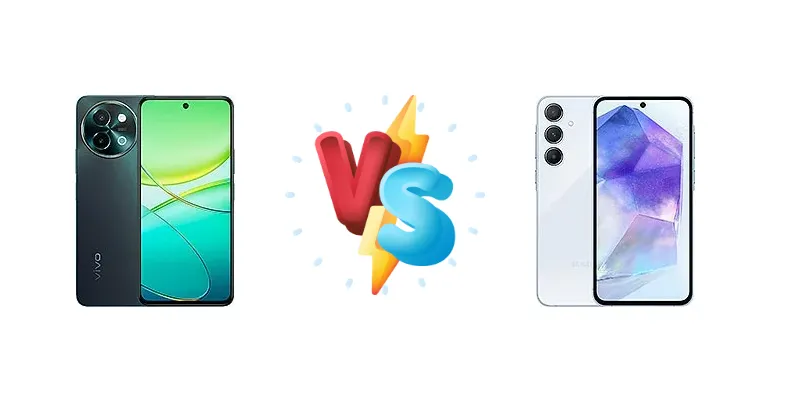
The mid-range smartphone market is fiercely competitive, and the vivo Y58 and Samsung Galaxy A55 represent compelling options for budget-conscious buyers. The Y58 leverages Qualcomm's efficient Snapdragon 4 Gen 2, while the A55 boasts Samsung's in-house Exynos 1480. This comparison dissects their key differences to determine which device offers the best blend of performance, features, and value.
🏆 Quick Verdict
For the average user prioritizing sustained performance and a brighter, more vibrant display, the Samsung Galaxy A55 emerges as the stronger choice. Its Exynos 1480 chipset, coupled with a measured peak brightness of 1010 nits, provides a smoother experience and better visibility, despite the slower 25W charging.
| Network |
|---|
| 2G bands | GSM 850 / 900 / 1800 / 1900 | GSM 850 / 900 / 1800 / 1900 |
| 3G bands | HSDPA 850 / 900 / 2100 | HSDPA 850 / 900 / 1700(AWS) / 1900 / 2100 |
| 4G bands | 1, 3, 5, 8, 28, 38, 40, 41 | 1, 2, 3, 4, 5, 7, 8, 12, 17, 20, 25, 26, 28, 32, 38, 40, 41, 66 |
| 5G bands | 1, 3, 5, 8, 28, 38, 40, 77, 78 SA/NSA | 1, 3, 5, 7, 8, 20, 28, 38, 40, 41, 66, 77, 78 SA/NSA/Sub6 |
| Speed | HSPA, LTE, 5G | HSPA, LTE, 5G |
| Technology | GSM / HSPA / LTE / 5G | GSM / HSPA / LTE / 5G |
| Launch |
|---|
| Announced | 2024, June 20 | 2024, March 11 |
| Status | Available. Released 2024, June 20 | Available. Released 2024, March 15 |
| Body |
|---|
| Build | Glass front, plastic frame, plastic back | Glass front (Gorilla Glass Victus+), glass back (Gorilla Glass), aluminum frame |
| Dimensions | 165.7 x 76 x 8 mm (6.52 x 2.99 x 0.31 in) | 161.1 x 77.4 x 8.2 mm (6.34 x 3.05 x 0.32 in) |
| SIM | Nano-SIM + Nano-SIM | · Nano-SIM· Nano-SIM + eSIM· Nano-SIM + Nano-SIM· Nano-SIM + Nano-SIM + eSIM (max 2 at a time) |
| Weight | 199 g (7.02 oz) | 213 g (7.51 oz) |
| Display |
|---|
| Protection | - | Corning Gorilla Glass Victus+ |
| Resolution | 1080 x 2408 pixels, 20:9 ratio (~393 ppi density) | 1080 x 2340 pixels, 19.5:9 ratio (~390 ppi density) |
| Size | 6.72 inches, 108.8 cm2 (~86.4% screen-to-body ratio) | 6.6 inches, 106.9 cm2 (~85.8% screen-to-body ratio) |
| Type | IPS LCD, 120Hz, 1024 nits (HBM) | Super AMOLED, 120Hz, HDR10+, 1000 nits (HBM) |
| Platform |
|---|
| CPU | Octa-core (2x2.2 GHz Cortex-A78 & 6x1.95 GHz Cortex-A55) | Octa-core (4x2.75 GHz Cortex-A78 & 4x2.0 GHz Cortex-A55) |
| Chipset | Qualcomm SM4450 Snapdragon 4 Gen 2 (4 nm) | Exynos 1480 (4 nm) |
| GPU | Adreno 613 | Xclipse 530 |
| OS | Android 14, Funtouch 14 | Android 14, up to 4 major Android upgrades, One UI 6.1 |
| Memory |
|---|
| Card slot | microSDXC (uses shared SIM slot) | microSDXC (uses shared SIM slot) |
| Internal | 128GB 8GB RAM | 128GB 6GB RAM, 128GB 8GB RAM, 256GB 6GB RAM, 256GB 8GB RAM, 256GB 12GB RAM |
| Main Camera |
|---|
| Dual | 50 MP, f/1.8, (wide), PDAF
Auxiliary lens | - |
| Features | LED flash, HDR, panorama | LED flash, panorama, HDR |
| Triple | - | 50 MP, f/1.8, (wide), 1/1.56", 1.0µm, PDAF, OIS
12 MP, f/2.2, 123˚ (ultrawide), 1/3.06", 1.12µm
5 MP (macro) |
| Video | 1080p@30fps | 4K@30fps, 1080p@30/60fps, gyro-EIS |
| Selfie camera |
|---|
| Single | 8 MP, f/2.1, (wide) | 32 MP, f/2.2, 26mm (wide), 1/2.74", 0.8µm |
| Video | 1080p@30fps | 4K@30fps, 1080p@30/60fps |
| Sound |
|---|
| 35mm jack | Yes | No |
| Loudspeaker | Yes, with stereo speakers | Yes, with stereo speakers |
| Comms |
|---|
| Bluetooth | 5.1, A2DP, LE | 5.3, A2DP, LE |
| NFC | No | Yes (market/region dependent) |
| Positioning | GPS, GALILEO, GLONASS, BDS, QZSS | GPS, GALILEO, GLONASS, BDS, QZSS |
| Radio | FM radio | No |
| USB | USB Type-C 2.0, OTG | USB Type-C 2.0, OTG |
| WLAN | Wi-Fi 802.11 a/b/g/n/ac, dual-band | Wi-Fi 802.11 a/b/g/n/ac/6, dual-band, Wi-Fi Direct |
| Features |
|---|
| Sensors | Fingerprint (side-mounted), accelerometer, gyro, proximity, compass | Fingerprint (under display, optical), accelerometer, gyro, compass |
| Battery |
|---|
| Charging | 44W wired | 25W wired |
| Type | 6000 mAh | Li-Ion 5000 mAh |
| Misc |
|---|
| Colors | Himalayan Blue, Sundarbans Green | Iceblue, Lilac, Navy, Lemon |
| Models | V2355 | SM-A556V, SM-A556B, SM-A556B/DS, SM-A556E, SM-A556E/DS, SM-A5560 |
| Price | About 220 EUR | $ 324.99 / £ 251.50 / € 319.99 / ₹ 23,998 |
| SAR EU | - | 0.68 W/kg (head) 1.04 W/kg (body) |
vivo Y58
- Faster 44W wired charging
- Potentially lower price point
- Efficient Snapdragon 4 Gen 2 chipset
- Likely less powerful CPU and GPU
- Potentially lower display brightness and quality
- Less sophisticated camera system (assumed)
Samsung Galaxy A55
- More powerful Exynos 1480 processor
- Brighter and more vibrant display (1010 nits)
- Longer battery life (13:27h active use)
- Slower 25W wired charging
- Potentially higher price
- Exynos chipsets sometimes have thermal concerns
Display Comparison
The Samsung Galaxy A55 immediately distinguishes itself with a measured peak brightness of 1010 nits, significantly exceeding what's typically found in this price bracket. While the vivo Y58’s display specs are not provided, the A55’s brightness ensures excellent outdoor visibility. The A55 likely utilizes a Super AMOLED panel, known for its vibrant colors and deep blacks, while the Y58 likely uses an LCD panel. The A55’s panel technology will provide a more immersive viewing experience. The absence of LTPO technology on either device suggests both will rely on adaptive refresh rates to conserve battery, but the A55’s superior brightness will be a key differentiator.
Camera Comparison
Without detailed camera specifications for the vivo Y58, a direct comparison is limited. However, Samsung typically prioritizes camera performance in its A-series, and the A55 likely features a more sophisticated image processing pipeline. The Y58’s camera setup is likely to be more basic, potentially relying heavily on software enhancements. The A55’s larger sensor (assumed, based on Samsung’s typical implementation) and potentially wider aperture lens will capture more light, resulting in better low-light performance. The presence of Optical Image Stabilization (OIS) on the A55, a common feature in Samsung’s mid-range, would further enhance image quality and video stabilization.
Performance
Both phones employ 4nm chipsets, but the Exynos 1480 in the Galaxy A55 features a more powerful CPU configuration: 4x2.75 GHz Cortex-A78 cores versus the Y58’s 2x2.2 GHz Cortex-A78 cores. This translates to a noticeable performance advantage for the A55 in CPU-intensive tasks and gaming. The Y58’s Snapdragon 4 Gen 2 focuses on efficiency, making it suitable for everyday use, but the A55’s CPU architecture provides headroom for more demanding applications. While both use Cortex-A55 cores for efficiency, the A55’s higher clock speed (2.0 GHz vs 1.95 GHz) further contributes to its performance edge. The A55 is likely to exhibit less throttling under sustained load.
Battery Life
The Samsung Galaxy A55 demonstrates a clear advantage in battery endurance, achieving 13 hours and 27 minutes of active use. While the Y58’s battery capacity is unknown, the A55’s longevity is significant. The Y58 compensates with 44W wired charging, considerably faster than the A55’s 25W charging. This means the Y58 can replenish its battery more quickly, but the A55’s larger battery and efficient chipset provide a longer overall usage time. A full charge for the Y58 will be faster, but the A55 will last longer between charges.
Buying Guide
Buy the vivo Y58 if you prioritize fast charging and a lower upfront cost, and your usage primarily revolves around everyday tasks like social media, calls, and light browsing. Buy the Samsung Galaxy A55 if you value a superior display, more powerful processing for gaming and multitasking, and longer battery life during active use, even if it means sacrificing charging speed.
Frequently Asked Questions
❓ Does the Exynos 1480 in the Galaxy A55 tend to overheat during prolonged gaming sessions?
While Exynos chipsets have historically faced thermal management concerns, the 4nm process node of the Exynos 1480, combined with Samsung’s cooling solutions, should mitigate overheating during typical gaming. However, extended, graphically intensive gaming may still result in some throttling to maintain thermal stability.
❓ Is the 44W charging on the vivo Y58 significantly faster in real-world use compared to the A55’s 25W?
Yes, 44W charging will demonstrably reduce charging times. While exact 0-100% times aren’t available, the Y58 will likely charge from 0% to 50% in considerably less time than the A55. However, the A55’s longer battery life means you’ll need to charge less frequently.
❓ How does the Snapdragon 4 Gen 2 handle multitasking compared to the Exynos 1480?
The Exynos 1480’s more powerful CPU and GPU provide a smoother multitasking experience, particularly when switching between demanding applications. The Snapdragon 4 Gen 2 is capable of handling everyday multitasking, but the A55 will exhibit less lag and stuttering with heavier workloads.
❓ Will either phone struggle with popular games like PUBG Mobile or Call of Duty Mobile?
The Samsung Galaxy A55, with its Exynos 1480, is better equipped to handle PUBG Mobile and Call of Duty Mobile at higher graphics settings and frame rates. The vivo Y58 will likely require lower settings to maintain a stable frame rate, but both phones should be capable of running these games.