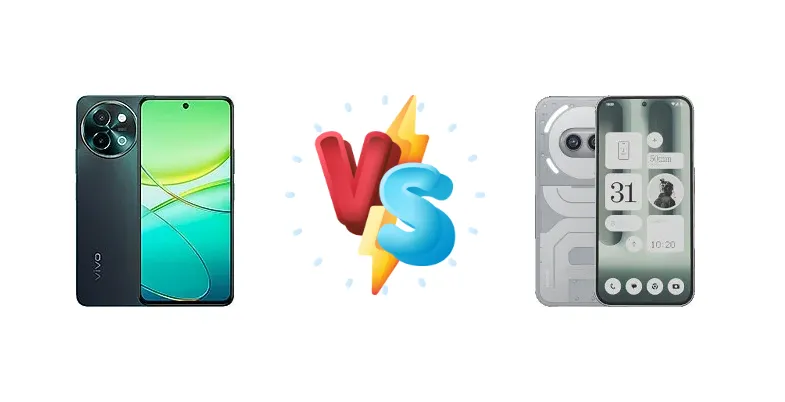
The mid-range smartphone market is fiercely competitive, and the vivo Y58 and Nothing Phone (2a) Plus represent compelling options for budget-conscious buyers. The Y58 focuses on affordability with a Snapdragon chipset, while the Nothing Phone (2a) Plus aims for a more premium experience with a Mediatek Dimensity processor and faster charging. This comparison dives deep into the specifics to determine which device delivers the best value.
🏆 Quick Verdict
For the average user prioritizing battery life and a brighter, more vibrant display, the Nothing Phone (2a) Plus is the clear winner. Its Dimensity 7350 Pro chipset and 50W charging offer a noticeable advantage over the vivo Y58’s Snapdragon 4 Gen 2 and 44W charging, despite the Y58’s lower price point.
| Network |
|---|
| 2G bands | GSM 850 / 900 / 1800 / 1900 | GSM 850 / 900 / 1800 / 1900 |
| 3G bands | HSDPA 850 / 900 / 2100 | HSDPA 800 / 850 / 900 / 1700(AWS) / 1900 / 2100 |
| 4G bands | 1, 3, 5, 8, 28, 38, 40, 41 | 1, 3, 4, 5, 7, 8, 18, 19, 20, 26, 28, 38, 39, 40, 41, 42, 66 |
| 5G bands | 1, 3, 5, 8, 28, 38, 40, 77, 78 SA/NSA | 1, 3, 5, 7, 8, 20, 28, 38, 40, 41, 66, 77, 78 SA/NSA |
| Speed | HSPA, LTE, 5G | HSPA, LTE, 5G |
| Technology | GSM / HSPA / LTE / 5G | GSM / HSPA / LTE / 5G |
| Launch |
|---|
| Announced | 2024, June 20 | 2024, July 31 |
| Status | Available. Released 2024, June 20 | Available. Released 2024, August 03 |
| Body |
|---|
| Build | Glass front, plastic frame, plastic back | Glass front (Gorilla Glass 5), plastic frame, plastic back |
| Dimensions | 165.7 x 76 x 8 mm (6.52 x 2.99 x 0.31 in) | 161.7 x 76.3 x 8.5 mm (6.37 x 3.00 x 0.33 in) |
| SIM | Nano-SIM + Nano-SIM | Nano-SIM + Nano-SIM |
| Weight | 199 g (7.02 oz) | 190 g (6.70 oz) |
| Display |
|---|
| Protection | - | Corning Gorilla Glass 5 |
| Resolution | 1080 x 2408 pixels, 20:9 ratio (~393 ppi density) | 1080 x 2412 pixels, 20:9 ratio (~395 ppi density) |
| Size | 6.72 inches, 108.8 cm2 (~86.4% screen-to-body ratio) | 6.7 inches, 107.5 cm2 (~87.1% screen-to-body ratio) |
| Type | IPS LCD, 120Hz, 1024 nits (HBM) | AMOLED, 1B colors, 120Hz, 2160Hz PWM, HDR10+, 700 nits (typ), 1100 nits (HBM), 1300 nits (peak) |
| Platform |
|---|
| CPU | Octa-core (2x2.2 GHz Cortex-A78 & 6x1.95 GHz Cortex-A55) | Octa-core (2x3.0 GHz Cortex-A715 & 6x 2.0 GHz Cortex-A510) |
| Chipset | Qualcomm SM4450 Snapdragon 4 Gen 2 (4 nm) | Mediatek Dimensity 7350 Pro (4 nm) |
| GPU | Adreno 613 | Mali-G610 MC4 |
| OS | Android 14, Funtouch 14 | Android 14, up to 3 major Android upgrades, Nothing OS 3.0 |
| Memory |
|---|
| Card slot | microSDXC (uses shared SIM slot) | No |
| Internal | 128GB 8GB RAM | 256GB 8GB RAM, 256GB 12GB RAM |
| Main Camera |
|---|
| Dual | 50 MP, f/1.8, (wide), PDAF
Auxiliary lens | 50 MP, f/1.9, 24mm (wide), 1/1.57", 1.0µm, PDAF, OIS
50 MP, f/2.2, 114˚ (ultrawide), 1/2.76", 0.64µm |
| Features | LED flash, HDR, panorama | LED flash, panorama, HDR |
| Video | 1080p@30fps | 4K@30fps, 1080p@60/120fps, gyro-EIS |
| Selfie camera |
|---|
| Features | - | HDR |
| Single | 8 MP, f/2.1, (wide) | 50 MP, f/2.2, (wide), 1/2.76" |
| Video | 1080p@30fps | 4K@30fps |
| Sound |
|---|
| 35mm jack | Yes | No |
| Loudspeaker | Yes, with stereo speakers | Yes, with stereo speakers |
| Comms |
|---|
| Bluetooth | 5.1, A2DP, LE | 5.3, A2DP, LE |
| NFC | No | Yes, 360˚ |
| Positioning | GPS, GALILEO, GLONASS, BDS, QZSS | GPS, GALILEO, GLONASS, BDS, QZSS |
| Radio | FM radio | No |
| USB | USB Type-C 2.0, OTG | USB Type-C 2.0, OTG |
| WLAN | Wi-Fi 802.11 a/b/g/n/ac, dual-band | Wi-Fi 802.11 a/b/g/n/ac/6, dual-band, Wi-Fi Direct |
| Features |
|---|
| Sensors | Fingerprint (side-mounted), accelerometer, gyro, proximity, compass | Fingerprint (under display, optical), accelerometer, gyro, proximity, compass |
| Battery |
|---|
| Charging | 44W wired | 50W wired, 50% in 21 min, 100% in 56 min |
| Type | 6000 mAh | 5000 mAh |
| Misc |
|---|
| Colors | Himalayan Blue, Sundarbans Green | Black, Grey |
| Models | V2355 | A142P |
| Price | About 220 EUR | € 269.90 / ₹ 22,599 |
vivo Y58
- More affordable price point
- Efficient Snapdragon 4 Gen 2 chipset
- Compact and lightweight design (likely)
- Lower peak display brightness
- Slower charging speeds
- Less powerful processor for demanding tasks
Nothing Phone (2a) Plus
- Superior battery life (16:34h active use)
- Faster 50W charging
- Brighter and more vibrant display (1097 nits)
- Higher price compared to the vivo Y58
- Larger size and weight (potentially)
- Nothing OS may not appeal to all users
Display Comparison
The Nothing Phone (2a) Plus boasts a significantly brighter display, reaching a measured peak of 1097 nits. This is a crucial advantage for outdoor use, where the vivo Y58’s likely lower peak brightness (spec not provided, but typical for the segment) would struggle. While both utilize LCD panels, the Nothing Phone (2a) Plus’s higher brightness translates to a more vivid and readable experience. The absence of LTPO technology on either device means refresh rates are likely fixed, impacting power consumption during dynamic content viewing.
Camera Comparison
Without detailed camera specifications for the vivo Y58, a direct comparison is challenging. However, the Nothing Phone (2a) Plus likely benefits from a more sophisticated image signal processor (ISP) integrated within the Dimensity 7350 Pro. While megapixel counts aren’t everything, a larger sensor size (not specified for either device) paired with a wider aperture generally results in better low-light performance. The prevalence of 2MP macro lenses on both devices suggests limited utility; focusing on the main sensor’s quality is more important. Image processing algorithms will also play a key role, and Nothing’s software approach is generally well-regarded.
Performance
The Mediatek Dimensity 7350 Pro in the Nothing Phone (2a) Plus represents a substantial performance leap over the Qualcomm Snapdragon 4 Gen 2 found in the vivo Y58. The Dimensity 7350 Pro’s Cortex-A715 cores, clocked at 3.0 GHz, offer significantly higher single-core performance than the Y58’s Cortex-A78 cores at 2.2 GHz. This translates to snappier app launches, smoother multitasking, and a more responsive overall user experience. Both chipsets are built on a 4nm process, offering good efficiency, but the Dimensity 7350 Pro’s superior architecture provides a clear edge. The Nothing Phone (2a) Plus is better suited for demanding applications and light gaming.
Battery Life
The Nothing Phone (2a) Plus demonstrates a clear advantage in battery performance, achieving an active use score of 16:34 hours. While the vivo Y58’s battery capacity is unknown, the Nothing Phone (2a) Plus’s combination of efficient chipset and optimized software delivers superior endurance. Furthermore, the 50W wired charging on the Nothing Phone (2a) Plus is significantly faster than the Y58’s 44W charging – reaching 50% in 21 minutes and 100% in 56 minutes. This faster charging minimizes downtime and provides greater convenience.
Buying Guide
Buy the vivo Y58 if you need a highly affordable smartphone for basic tasks like calling, texting, and light social media use, and are willing to compromise on performance and display quality. Buy the Nothing Phone (2a) Plus if you prioritize a smoother user experience, longer battery life, a brighter display for outdoor visibility, and faster charging speeds, even if it means spending a bit more.
Frequently Asked Questions
❓ Does the Dimensity 7350 Pro in the Nothing Phone (2a) Plus get hot during extended gaming sessions?
The Dimensity 7350 Pro is a relatively efficient chipset built on a 4nm process. While some heat generation is inevitable during prolonged gaming, the Nothing Phone (2a) Plus’s thermal management system is designed to prevent significant throttling. User reports suggest it maintains stable performance for extended periods, though sustained peak performance may see some minor temperature increases.
❓ Is the 44W charging on the vivo Y58 slow compared to the competition?
44W charging is becoming less common as faster charging technologies proliferate. Compared to the Nothing Phone (2a) Plus’s 50W charging, it is indeed slower. While 44W can still provide a reasonable charge time, it will take longer to reach 100% capacity, potentially requiring overnight charging for some users.
❓ How does Nothing OS compare to Funtouch OS on the vivo Y58 in terms of bloatware and user experience?
Nothing OS is known for its clean, near-stock Android experience with minimal bloatware. Funtouch OS, on the other hand, historically includes a significant amount of pre-installed apps and customizations. Nothing OS prioritizes simplicity and performance, while Funtouch OS offers more features but can feel cluttered to some users.