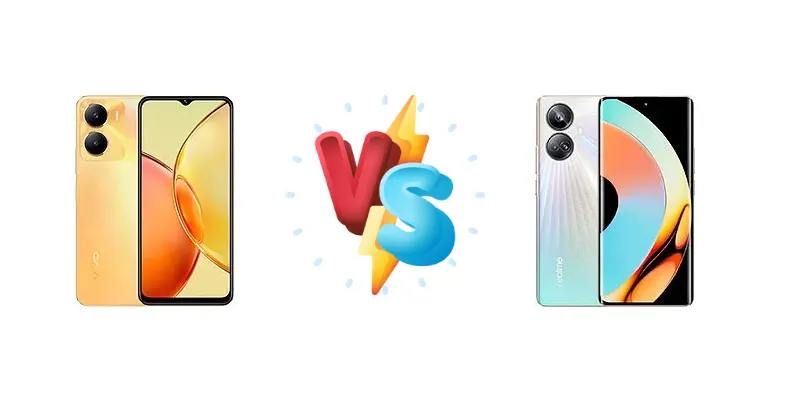
The mid-range smartphone market is fiercely competitive, and the Realme 10 Pro+ and vivo Y56 represent compelling options for budget-conscious buyers. While both leverage MediaTek Dimensity chipsets, they target slightly different priorities: the Realme 10 Pro+ emphasizes fast charging and performance, while the vivo Y56 focuses on providing a solid experience at an even more accessible price point. This comparison dissects their key differences to help you choose the right device.
🏆 Quick Verdict
For most users, the Realme 10 Pro+ is the superior choice. Its Dimensity 1080 chipset delivers significantly better performance than the Y56’s Dimensity 700, and the 67W charging is a game-changer. While the Y56 offers affordability, the Pro+ provides a more future-proof and enjoyable user experience.
| Network |
|---|
| 2G bands | GSM 850 / 900 / 1800 / 1900 | GSM 850 / 900 / 1800 / 1900 - SIM 1 & SIM 2 |
| 3G bands | HSDPA 850 / 900 / 2100 | HSDPA 850 / 900 / 1700(AWS) / 1900 / 2100 |
| 4G bands | 1, 3, 5, 8, 38, 40, 41 | 1, 3, 5, 7, 8, 19, 28, 34, 38, 39, 40, 41 |
| 5G bands | 1, 3, 8, 28, 77, 78 SA/NSA | 1, 3, 5, 8, 28, 40, 41, 77, 78 SA/NSA |
| Speed | HSPA, LTE, 5G | HSPA, LTE-A, 5G |
| Technology | GSM / HSPA / LTE / 5G | GSM / CDMA / HSPA / CDMA2000 / LTE / 5G |
| | - | CDMA2000 1x |
| Launch |
|---|
| Announced | 2023, February 17 | 2022, November 17 |
| Status | Available. Released 2023, February 17 | Available. Released 2022, November 24 |
| Body |
|---|
| Build | Glass front, plastic frame, plastic back | Glass front, plastic frame, plastic back |
| Dimensions | 164.1 x 75.6 x 8.2 mm (6.46 x 2.98 x 0.32 in) | 161.5 x 73.9 x 7.8 mm or 8 mm |
| SIM | Nano-SIM + Nano-SIM | Dual SIM (Nano-SIM, dual stand-by) |
| Weight | 184 g (6.49 oz) | 173 g / 175 g (6.10 oz) |
| | IPX4 water/ IP5X dust resistant | - |
| Display |
|---|
| Resolution | 1080 x 2408 pixels, 20:9 ratio (~401 ppi density) | 1080 x 2412 pixels, 20:9 ratio (~394 ppi density) |
| Size | 6.58 inches, 104.3 cm2 (~84.1% screen-to-body ratio) | 6.7 inches, 108.0 cm2 (~90.5% screen-to-body ratio) |
| Type | IPS LCD | AMOLED, 1B colors, HDR10+, 120Hz, 800 nits |
| Platform |
|---|
| CPU | Octa-core (2x2.2 GHz Cortex-A76 & 6x2.0 GHz Cortex-A55) | Octa-core (2x2.6 GHz Cortex-A78 & 6x2.0 GHz Cortex-A55) |
| Chipset | Mediatek Dimensity 700 (7 nm) | Mediatek MT6877V Dimensity 1080 (6 nm) |
| GPU | Mali-G57 MC2 | Mali-G68 MC4 |
| OS | Android 13, Funtouch 13 | Android 13, Realme UI 4.0 |
| Memory |
|---|
| Card slot | microSDXC (uses shared SIM slot) | No |
| Internal | 128GB 4GB RAM, 128GB 8GB RAM | 128GB 6GB RAM, 128GB 8GB RAM, 256GB 8GB RAM, 256GB 12GB RAM |
| Main Camera |
|---|
| Dual | 50 MP, f/1.8, (wide), 1/2.76", 0.64µm, PDAF
Auxiliary lens | - |
| Features | LED flash, HDR, panorama | LED flash, HDR, panorama |
| Single | 16 MP, f/2.0, (wide) | 16 MP, f/2.5, 25mm (wide) |
| Triple | - | 108 MP, f/1.8, 24mm (wide), 1/1.67", 0.64µm, PDAF
8 MP, f/2.2, 16mm, 112˚ (ultrawide)
2 MP, f/2.4, (macro) |
| Video | 1080p@30fps | 4K@30fps, 1080p@30/60/120/480fps, 720p@960fps, gyro-EIS |
| Selfie camera |
|---|
| Features | - | Panorama |
| Single | 16 MP, f/2.0, (wide) | 16 MP, f/2.5, 25mm (wide) |
| Video | 1080p@30fps | 1080p@30fps |
| Sound |
|---|
| 3.5mm jack | Yes | No |
| 35mm jack | Yes | - |
| Loudspeaker | Yes | Yes, with stereo speakers |
| | - | 24-bit/192kHz audio |
| Comms |
|---|
| Bluetooth | 5.1, A2DP, LE | 5.2, A2DP, LE, aptX HD |
| NFC | No | Yes (market/region dependent) |
| Positioning | GPS, GLONASS, GALILEO, BDS, QZSS | GPS (L1+L5), GALILEO, GLONASS, BDS, QZSS |
| Radio | FM radio | No |
| USB | USB Type-C, OTG | USB Type-C 2.0 |
| WLAN | Wi-Fi 802.11 a/b/g/n/ac, dual-band | Wi-Fi 802.11 a/b/g/n/ac/6, dual-band |
| Features |
|---|
| Sensors | Fingerprint (side-mounted), accelerometer, proximity, compass | Fingerprint (under display, optical), accelerometer, gyro, proximity, compass |
| Battery |
|---|
| Charging | 18W wired | 67W wired, PD3.0, 50% in 17 min (advertised) |
| Type | 5000 mAh | Li-Po 5000 mAh, non-removable |
| Misc |
|---|
| Colors | Orange Shimmer, Black Engine | Dark Matter Black, Nebula Blue, Hyperspace |
| Models | V2225 | RMX3687, RMX3686 |
| Price | About 220 EUR | $ 269.00 / ₹ 22,999 |
| Tests |
|---|
| Battery life | - |
Endurance rating 149h
|
| Camera | - |
Photo / Video |
| Display | - |
Contrast ratio: Infinite (nominal) |
| Loudspeaker | - |
-25.4 LUFS (Very good)
|
| Performance | - |
AnTuTu: 522376 (v9)
GeekBench: 2371 (v5.1)
GFXBench: 23fps (ES 3.1 onscreen) |
vivo Y56
- More powerful Dimensity 1080 chipset
- Significantly faster 67W charging
- Likely superior display quality (AMOLED)
- Potentially better camera performance
- Potentially higher price point
- May lack a microSD card slot (market dependent)
Realme 10 Pro+
- More affordable price
- Reliable MediaTek Dimensity 700 chipset for basic tasks
- Decent battery life for everyday use
- Potentially lighter and more compact
- Slower 18W charging
- Less powerful chipset for demanding tasks
- Likely lower display quality (LCD)
- Potentially limited camera capabilities
Display Comparison
The Realme 10 Pro+ boasts an unspecified display with an 'Infinite' contrast ratio, suggesting a strong AMOLED panel, common in this price bracket. While the Y56’s display specifications are absent, it’s likely an LCD panel. The Realme’s potential AMOLED technology will deliver richer colors and deeper blacks. The lack of detailed display specs for the Y56 suggests it’s a cost-saving measure, potentially impacting viewing experience. The Realme 10 Pro+’s display is likely to be more vibrant and visually appealing.
Camera Comparison
Detailed camera specifications are limited for both devices. However, the Realme 10 Pro+ is likely to feature a more advanced camera system, potentially with a larger sensor and more sophisticated image processing. The absence of specific details for the Y56 suggests a more basic camera setup. While megapixel counts aren’t everything, the Realme’s chipset provides more processing power for computational photography, potentially resulting in better image quality, especially in low-light conditions. The Realme 10 Pro+ is expected to deliver more versatile and higher-quality photos and videos.
Performance
The core difference lies in the chipsets. The Realme 10 Pro+ utilizes the MediaTek Dimensity 1080 (6nm), featuring a more powerful CPU configuration with 2x2.6 GHz Cortex-A78 cores compared to the vivo Y56’s Dimensity 700 (7nm) and its 2x2.2 GHz Cortex-A76 cores. The 6nm process node of the Dimensity 1080 is more efficient, translating to better performance per watt and potentially less thermal throttling during sustained workloads. This means the Realme 10 Pro+ will handle demanding games and applications with greater ease. While both use Cortex-A55 cores for efficiency, the A78 cores in the Realme offer a substantial performance uplift.
Battery Life
The Realme 10 Pro+ shines with its 67W wired charging, capable of reaching 50% charge in just 17 minutes (advertised). This is a massive advantage over the vivo Y56’s slower 18W charging. While the Y56’s battery capacity is unknown, the Realme’s faster charging significantly reduces downtime. The Realme 10 Pro+’s support for PD3.0 further enhances its charging versatility. The 149-hour endurance rating of the Realme 10 Pro+ suggests a well-optimized battery system, despite potentially having a similar capacity to the Y56.
Buying Guide
Buy the vivo Y56 if you prioritize absolute affordability and need a reliable daily driver for basic tasks like calling, texting, and light social media use. You’ll appreciate its lower price tag. Buy the Realme 10 Pro+ if you value faster performance for gaming and multitasking, demand significantly quicker charging speeds, and want a phone that feels more responsive and capable in the long run. The Pro+ is for users who want more from their smartphone without breaking the bank.
Frequently Asked Questions
❓ Does the Dimensity 1080 in the Realme 10 Pro+ get hot during prolonged gaming sessions?
The Dimensity 1080’s 6nm process node is designed for efficiency, and the Realme 10 Pro+ likely incorporates thermal management solutions to mitigate heat. While some warming is expected during intensive gaming, it shouldn’t result in significant throttling or discomfort, offering a more sustained gaming experience than the Dimensity 700 in the Y56.
❓ Is the 18W charging on the vivo Y56 slow compared to other phones in this price range?
Yes, 18W charging is relatively slow compared to the 33W or 67W charging found on many competing devices, including the Realme 10 Pro+. Expect a significantly longer charging time – potentially over 2 hours for a full charge – which may be inconvenient for users accustomed to faster charging speeds.
❓ Will the Realme 10 Pro+ handle graphically demanding games like Genshin Impact or Call of Duty Mobile?
The Dimensity 1080 is capable of running these games, but you’ll likely need to adjust graphics settings to medium or high for a smooth experience. The Y56’s Dimensity 700 will struggle with these titles at higher settings, requiring significant compromises in visual fidelity.
❓ Does the vivo Y56 support VoLTE and VoWiFi for improved call quality?
Support for VoLTE and VoWiFi varies by region and carrier. While the Y56 likely supports these features in many markets, it’s crucial to verify compatibility with your specific carrier before purchasing to ensure optimal call quality.