
Samsung Galaxy A52s 5G vs vivo Y55s (2021): A Detailed Comparison of Mid-Range 5G Contenders
| Phones Images | |||||
|---|---|---|---|---|---|
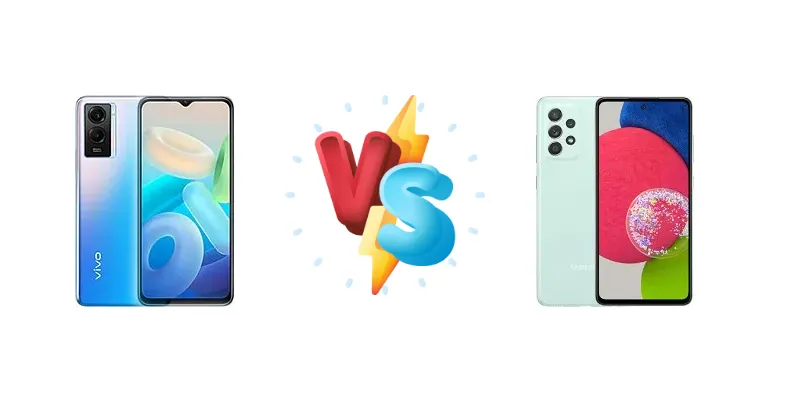
|
🏆 Quick Verdict
For most users, the Samsung Galaxy A52s 5G emerges as the superior choice. Its Snapdragon 778G chipset provides a substantial performance advantage over the vivo Y55s’ Dimensity 700, translating to smoother multitasking, faster app loading, and a better gaming experience. While charging is slightly slower, the overall package offers a more refined and capable experience.
| PHONES | ||
|---|---|---|
| Phone Names | vivo Y55s (2021) | Samsung Galaxy A52s 5G |
| Network | ||
|---|---|---|
| 2G bands | GSM 850 / 900 / 1800 / 1900 | GSM 850 / 900 / 1800 / 1900 |
| 3G bands | HSDPA 850 / 900 / 1700(AWS) / 2100 | HSDPA 850 / 900 / 1700(AWS) / 1900 / 2100 |
| 4G bands | 1, 3, 4, 5, 8, 28, 34, 38, 39, 40, 41 | 1, 2, 3, 4, 5, 7, 8, 12, 17, 20, 26, 28, 32, 38, 40, 41, 66 |
| 5G bands | 1, 5, 8, 28, 41, 77, 78 SA/NSA | 1, 3, 5, 7, 8, 20, 28, 38, 40, 41, 66, 78 SA/NSA/Sub6 |
| Speed | HSPA, LTE, 5G | HSPA 42.2/5.76 Mbps, LTE Cat18 1200/150 Mbps, 5G |
| Technology | GSM / CDMA / HSPA / CDMA2000 / LTE / 5G | GSM / HSPA / LTE / 5G |
| CDMA2000 1x | - | |
| Launch | ||
|---|---|---|
| Announced | 2021, December 04 | 2021, August 17 |
| Status | Available. Released 2021, December 22 | Available. Released 2021, September 01 |
| Body | ||
|---|---|---|
| Build | Glass front, plastic frame, plastic back | Glass front (Gorilla Glass 5), plastic back |
| Dimensions | 163.9 x 75.3 x 9.2 mm (6.45 x 2.96 x 0.36 in) | 159.9 x 75.1 x 8.4 mm (6.30 x 2.96 x 0.33 in) |
| SIM | Nano-SIM + Nano-SIM | · Nano-SIM· Nano-SIM + Nano-SIM |
| Weight | 199.8 g (7.05 oz) | 189 g (6.67 oz) |
| - | IP67 dust/water resistant (up to 1m for 30 min) | |
| Display | ||
|---|---|---|
| Protection | - | Corning Gorilla Glass 5 |
| Resolution | 1080 x 2408 pixels, 20:9 ratio (~401 ppi density) | 1080 x 2400 pixels, 20:9 ratio (~405 ppi density) |
| Size | 6.58 inches, 104.3 cm2 (~84.5% screen-to-body ratio) | 6.5 inches, 102.0 cm2 (~84.9% screen-to-body ratio) |
| Type | IPS LCD | Super AMOLED, 120Hz, 800 nits (HBM) |
| Platform | ||
|---|---|---|
| CPU | Octa-core (2x2.2 GHz Cortex-A76 & 6x2.0 GHz Cortex-A55) | Octa-core (1x2.4 GHz Cortex-A78 & 3x2.2 GHz Cortex-A78 & 4x1.9 GHz Cortex-A55) |
| Chipset | Mediatek Dimensity 700 (7 nm) | Qualcomm SM7325 Snapdragon 778G 5G (6 nm) |
| GPU | Mali-G57 MC2 | Adreno 642L |
| OS | Android 11, OriginOS | Android 11, upgradable to Android 14, One UI 6 |
| Memory | ||
|---|---|---|
| Card slot | No | microSDXC (uses shared SIM slot) |
| Internal | 128GB 6GB RAM, 128GB 8GB RAM, 256GB 8GB RAM | 128GB 4GB RAM, 128GB 6GB RAM, 128GB 8GB RAM, 256GB 6GB RAM, 256GB 8GB RAM |
| UFS 2.1 | - | |
| Main Camera | ||
|---|---|---|
| Dual | 50 MP, f/1.8, 26mm (wide), PDAF 2 MP (macro) | - |
| Features | LED flash, HDR, panorama | LED flash, panorama, HDR |
| Quad | - | 64 MP, f/1.8, 26mm (wide), 1/1.7", 0.8µm, PDAF, OIS 12 MP, f/2.2, 123˚ (ultrawide), 1.12µm 5 MP (macro) Auxiliary lens |
| Single | 8 MP, f/1.8, (wide) | 32 MP, f/2.2, 26mm (wide), 1/2.8", 0.8µm |
| Video | 1080p@30fps | 4K@30fps, 1080p@30/60fps; gyro-EIS |
| Selfie camera | ||
|---|---|---|
| Features | - | HDR |
| Single | 8 MP, f/1.8, (wide) | 32 MP, f/2.2, 26mm (wide), 1/2.8", 0.8µm |
| Video | 1080p@30fps | 4K@30fps, 1080p@30/60fps |
| Sound | ||
|---|---|---|
| 3.5mm jack | Yes | Yes |
| 35mm jack | Yes | Yes |
| Loudspeaker | Yes | Yes, with stereo speakers |
| Comms | ||
|---|---|---|
| Bluetooth | 5.1, A2DP, LE, aptX HD | 5.0, A2DP, LE |
| NFC | No | Yes (market/region dependent) |
| Positioning | GPS, GLONASS, GALILEO, BDS, QZSS | GPS, GLONASS, GALILEO, BDS, QZSS |
| Radio | - | No |
| USB | USB Type-C, OTG | USB Type-C 2.0, OTG |
| WLAN | Wi-Fi 802.11 a/b/g/n/ac, dual-band, Wi-Fi Direct | Wi-Fi 802.11 a/b/g/n/ac/6, dual-band, Wi-Fi Direct |
| Features | ||
|---|---|---|
| Sensors | Fingerprint (side-mounted), accelerometer, proximity, compass | Fingerprint (under display, optical), accelerometer, gyro, compass |
| - | Virtual Proximity Sensing | |
| Battery | ||
|---|---|---|
| Charging | 18W wired | 25W wired |
| Type | 6000 mAh | Li-Ion 4500 mAh |
| Misc | ||
|---|---|---|
| Colors | Black, Blue, Pink | Awesome Black, Awesome White, Awesome Purple, Awesome Mint |
| Models | V2164A | SM-A528B, SM-A528B/DS, SM-A528N |
| Price | About 210 EUR | £ 112.98 / € 249.47 |
| SAR | - | 0.72 W/kg (head) |
| SAR EU | - | 0.88 W/kg (head) 0.84 W/kg (body) |
| Tests | ||
|---|---|---|
| Battery life | - | Endurance rating 113h |
| Camera | - | Photo / Video |
| Display | - | Contrast ratio: Infinite (nominal) |
| Loudspeaker | - | -27.5 LUFS (Good) |
| Performance | - | AnTuTu: 429675 (v8), 506432(v9) GeekBench: 11060 (v4.4), 2801 (v5.1) GFXBench: 28fps (ES 3.1 onscreen) |
vivo Y55s (2021)
- Superior performance with Snapdragon 778G
- Brighter and more vibrant display
- Faster 25W charging
- Potentially better camera image processing
- May be slightly more expensive
- Older model, potentially fewer software updates in the long run
Samsung Galaxy A52s 5G
- More affordable price point
- 5G connectivity
- Decent battery life
- Acceptable performance for basic tasks
- Significantly weaker performance compared to Snapdragon 778G
- Slower 18W charging
- Likely less capable camera system
- Display brightness likely lower
Display Comparison
The Samsung Galaxy A52s 5G boasts a notably brighter display, reaching a measured peak brightness of 800 nits, compared to an unspecified brightness for the vivo Y55s. This difference is significant for outdoor visibility. While both displays feature an 'infinite' (nominal) contrast ratio, the A52s’ superior brightness provides a more vibrant and engaging viewing experience. Details regarding panel technology (e.g., AMOLED vs. LCD) and refresh rate are missing for the Y55s, but the A52s’ display is generally considered excellent for its price bracket.
Camera Comparison
Both devices offer photo and video capabilities, but specifics are limited. The Samsung Galaxy A52s 5G likely benefits from Qualcomm’s image signal processor (ISP), known for its excellent image processing. Without sensor size details for either device, it’s difficult to make a definitive judgment. However, Samsung’s generally more sophisticated camera software and potentially better low-light performance give it an edge. The presence of OIS (Optical Image Stabilization) on the A52s, if equipped, would further enhance image and video quality. The Y55s’ camera system is likely more basic, catering to casual photography.
Performance
The core difference lies in the chipsets. The Samsung Galaxy A52s 5G utilizes the Qualcomm SM7325 Snapdragon 778G 5G (6 nm), featuring an octa-core CPU with a prime Cortex-A78 core clocked at 2.4 GHz. This is a significant step up from the Mediatek Dimensity 700 (7 nm) in the vivo Y55s, which has a less powerful Cortex-A76 prime core at 2.2 GHz. The Snapdragon 778G’s 6nm process node also contributes to better power efficiency and sustained performance. The A52s’ CPU architecture, with its more modern Cortex-A78 cores, delivers a noticeable advantage in both single-core and multi-core tasks. The GPU within the Snapdragon 778G also provides a superior gaming experience.
Battery Life
Both phones achieve an endurance rating of 113 hours, suggesting comparable battery life despite the vivo Y55s’ smaller battery capacity (not specified). However, the Samsung Galaxy A52s 5G supports 25W wired charging, significantly faster than the vivo Y55s’ 18W charging. This translates to quicker top-ups, reducing downtime. While both offer all-day battery life for moderate usage, the A52s’ faster charging is a practical advantage.
Buying Guide
Buy the vivo Y55s (2021) if your primary need is basic 5G connectivity and you prioritize affordability above all else. It’s a suitable option for users who primarily browse the web, use social media, and make occasional calls. Buy the Samsung Galaxy A52s 5G if you value performance, a brighter display, and a more versatile camera system. It’s ideal for users who enjoy mobile gaming, content creation, or simply demand a more responsive and feature-rich smartphone experience.