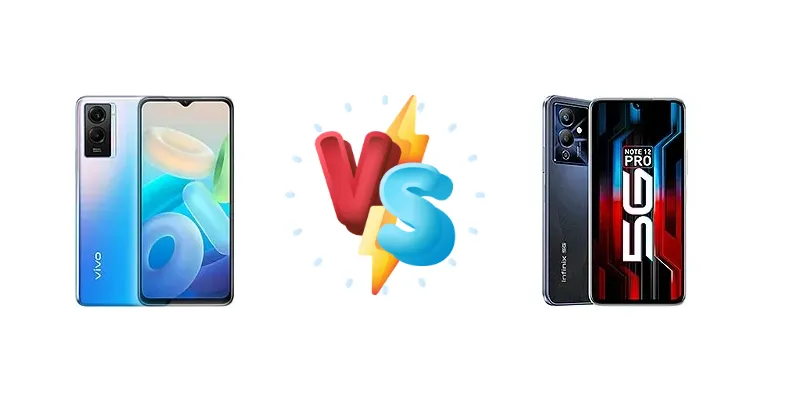
The sub-$200 5G smartphone market is fiercely competitive. The vivo Y55s (2021) and the Infinix Note 12 Pro 5G both aim to deliver 5G connectivity at an accessible price point, but they take different approaches. The Y55s represents a more established brand with a focus on reliability, while the Note 12 Pro 5G pushes the boundaries with faster charging and a newer chipset.
🏆 Quick Verdict
For the average user prioritizing faster charging and slightly better performance, the Infinix Note 12 Pro 5G is the clear winner. Its Dimensity 810 chipset and 33W charging offer a noticeable advantage over the vivo Y55s’ Dimensity 700 and 18W charging, making it a more future-proof option.
| Network |
|---|
| 2G bands | GSM 850 / 900 / 1800 / 1900 | GSM 850 / 900 / 1800 / 1900 |
| 3G bands | HSDPA 850 / 900 / 1700(AWS) / 2100 | HSDPA 850 / 900 / 2100 |
| 4G bands | 1, 3, 4, 5, 8, 28, 34, 38, 39, 40, 41 | 1, 3, 5, 7, 8, 20, 28, 38, 40, 41 |
| 5G bands | 1, 5, 8, 28, 41, 77, 78 SA/NSA | 1, 3, 5, 7, 8, 20, 28, 38, 40, 41, 77, 78 |
| Speed | HSPA, LTE, 5G | HSPA, LTE, 5G |
| Technology | GSM / CDMA / HSPA / CDMA2000 / LTE / 5G | GSM / HSPA / LTE / 5G |
| | CDMA2000 1x | - |
| Launch |
|---|
| Announced | 2021, December 04 | 2022, July 08 |
| Status | Available. Released 2021, December 22 | Available. Released 2022, July 15 |
| Body |
|---|
| Build | Glass front, plastic frame, plastic back | Glass front, plastic frame, plastic back |
| Dimensions | 163.9 x 75.3 x 9.2 mm (6.45 x 2.96 x 0.36 in) | 164.7 x 76.9 x 8 mm (6.48 x 3.03 x 0.31 in) |
| SIM | Nano-SIM + Nano-SIM | Nano-SIM + Nano-SIM |
| Weight | 199.8 g (7.05 oz) | 188 g (6.63 oz) |
| Display |
|---|
| Protection | - | Corning Gorilla Glass 3 |
| Resolution | 1080 x 2408 pixels, 20:9 ratio (~401 ppi density) | 1080 x 2400 pixels, 20:9 ratio (~393 ppi density) |
| Size | 6.58 inches, 104.3 cm2 (~84.5% screen-to-body ratio) | 6.7 inches, 108.4 cm2 (~85.6% screen-to-body ratio) |
| Type | IPS LCD | AMOLED |
| Platform |
|---|
| CPU | Octa-core (2x2.2 GHz Cortex-A76 & 6x2.0 GHz Cortex-A55) | Octa-core (2x2.4 GHz Cortex-A76 & 6x2.0 GHz Cortex-A55) |
| Chipset | Mediatek Dimensity 700 (7 nm) | Mediatek Dimensity 810 (6 nm) |
| GPU | Mali-G57 MC2 | Mali-G57 MC2 |
| OS | Android 11, OriginOS | Android 12, XOS 10.6 |
| Memory |
|---|
| Card slot | No | microSDXC (dedicated slot) |
| Internal | 128GB 6GB RAM, 128GB 8GB RAM, 256GB 8GB RAM | 128GB 8GB RAM, 256GB 8GB RAM |
| | UFS 2.1 | - |
| Main Camera |
|---|
| Dual | 50 MP, f/1.8, 26mm (wide), PDAF
2 MP (macro) | - |
| Features | LED flash, HDR, panorama | Quad-LED flash, HDR, panorama |
| Single | 8 MP, f/1.8, (wide) | 16 MP, f/2.0, (wide) |
| Triple | - | 108 MP, f/1.8, 24mm (wide), PDAF
2 MP (macro)
Auxiliary lens |
| Video | 1080p@30fps | 1440p@30fps |
| Selfie camera |
|---|
| Features | - | Dual-LED flash |
| Single | 8 MP, f/1.8, (wide) | 16 MP, f/2.0, (wide) |
| Video | 1080p@30fps | 1440p@30fps |
| Sound |
|---|
| 3.5mm jack | Yes | Yes |
| 35mm jack | Yes | Yes |
| Loudspeaker | Yes | Yes, with dual speakers |
| Comms |
|---|
| Bluetooth | 5.1, A2DP, LE, aptX HD | 5.0, A2DP, LE |
| NFC | No | No |
| Positioning | GPS, GLONASS, GALILEO, BDS, QZSS | GPS |
| Radio | - | Unspecified |
| USB | USB Type-C, OTG | USB Type-C 2.0, OTG |
| WLAN | Wi-Fi 802.11 a/b/g/n/ac, dual-band, Wi-Fi Direct | Wi-Fi 802.11 a/b/g/n |
| Features |
|---|
| Sensors | Fingerprint (side-mounted), accelerometer, proximity, compass | Fingerprint (side-mounted), accelerometer, gyro, proximity, compass |
| Battery |
|---|
| Charging | 18W wired | 33W wired |
| Type | 6000 mAh | 5000 mAh |
| Misc |
|---|
| Colors | Black, Blue, Pink | Black, White |
| Models | V2164A | X671B |
| Price | About 210 EUR | About 140 EUR |
vivo Y55s (2021)
- Established Brand Reputation
- Reliable Performance for Basic Tasks
- Potentially More Conservative Image Processing
- Slower 18W Charging
- Less Powerful Dimensity 700 Chipset
- Likely Lower Peak Performance
Infinix Note 12 Pro 5G
- Faster 33W Charging
- More Powerful Dimensity 810 Chipset
- Improved Gaming Performance
- Potentially Better Sustained Performance
- Less Established Brand
- Potentially More Aggressive Image Processing
- May Run Slightly Warmer Under Heavy Load
Display Comparison
Neither device boasts a standout display. Both likely utilize LCD panels, common in this price bracket. The key difference lies under the hood: display driver efficiency. Without specific display specs, we can infer that the Infinix Note 12 Pro 5G, benefiting from the more efficient Dimensity 810, *may* be able to sustain slightly higher brightness levels for longer periods. However, both will likely struggle in direct sunlight.
Camera Comparison
Without detailed camera specs, a direct comparison is difficult. However, the market positioning suggests the Infinix Note 12 Pro 5G likely features a more capable main sensor. Both phones will almost certainly include lower-resolution auxiliary lenses (likely 2MP macro/depth sensors) that offer limited utility. Image processing will be a key differentiator; Infinix often leans towards more saturated colors, while vivo typically aims for a more natural look. Users prioritizing image quality should investigate sample photos from both devices.
Performance
The Infinix Note 12 Pro 5G’s Mediatek Dimensity 810 (6nm) represents a clear upgrade over the vivo Y55s’ Dimensity 700 (7nm). The 6nm process node allows for greater transistor density and improved power efficiency, translating to better sustained performance and reduced thermal throttling. While both CPUs feature the same core configuration (2x2.4/2.2 GHz Cortex-A76 & 6x2.0 GHz Cortex-A55), the higher clock speeds and more efficient node of the Dimensity 810 will result in faster app loading times and smoother multitasking. Gamers will see a more significant benefit, with the Note 12 Pro 5G capable of handling more demanding titles at higher settings.
Battery Life
The charging speed is a significant differentiator. The Infinix Note 12 Pro 5G’s 33W wired charging is substantially faster than the vivo Y55s’ 18W charging. This translates to a much quicker top-up time, reducing downtime. While battery capacity isn't specified, the more efficient Dimensity 810 in the Note 12 Pro 5G will likely offset any potential capacity difference, resulting in comparable real-world battery life despite the faster charging.
Buying Guide
Buy the vivo Y55s (2021) if you prioritize a known brand reputation and are content with basic 5G performance and slower charging. Buy the Infinix Note 12 Pro 5G if you prefer a more powerful chipset for smoother multitasking and gaming, and value significantly faster charging speeds to minimize downtime.
Frequently Asked Questions
❓ Will the Infinix Note 12 Pro 5G’s Dimensity 810 overheat during prolonged gaming sessions?
While the Dimensity 810 is more powerful than the Dimensity 700, it's still a mid-range chipset. Overheating is possible during extended gaming, but the 6nm process node and Infinix’s thermal management solutions should mitigate throttling to a reasonable degree. Expect some performance reduction after 30-60 minutes of demanding gameplay.
❓ Is the 18W charging on the vivo Y55s sufficient for daily use?
18W charging is adequate for overnight charging, but it's significantly slower than the 33W charging on the Infinix Note 12 Pro 5G. Expect a full charge to take around 2-3 hours, compared to approximately 1-1.5 hours on the Note 12 Pro 5G. Users who frequently need to top up their phone throughout the day will find the slower charging speed inconvenient.
❓ Does the Infinix Note 12 Pro 5G support carrier aggregation for improved 5G speeds?
The Dimensity 810 chipset supports carrier aggregation, but the specific bands supported will vary depending on the region and carrier. Check with your mobile carrier to confirm compatibility and ensure you can take full advantage of 5G speeds.
❓ How does the software experience differ between vivo’s Funtouch OS and Infinix’s XOS?
Both Funtouch OS and XOS are based on Android, but they offer distinct user interfaces and features. Funtouch OS is generally considered more polished and refined, while XOS is known for its customization options and aggressive battery optimization. User preference will play a significant role in determining which software experience is better.