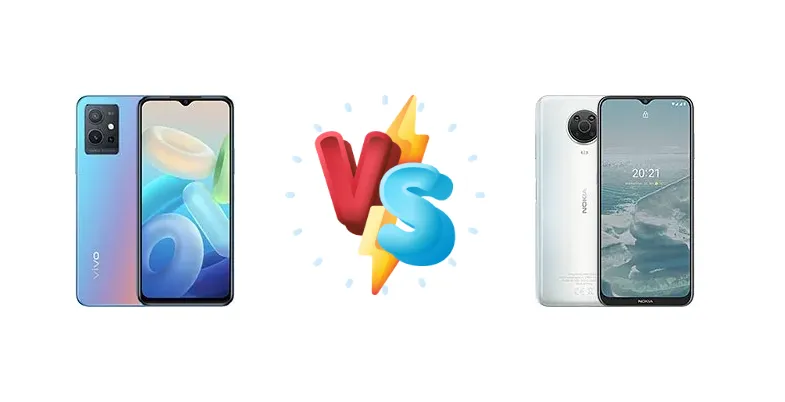
The budget smartphone market is fiercely competitive, offering incredible value for money. Today, we're pitting two contenders against each other: the vivo Y55 5G, boasting 5G connectivity, and the Nokia G20, known for its reliability and clean Android experience. Let's see which phone comes out on top.
🏆 Quick Verdict
The vivo Y55 5G is the clear winner thanks to its significantly faster Dimensity 700 chipset and 5G capabilities. While the Nokia G20 offers a dependable experience and longer software support, the Y55 5G's performance advantage makes it the better choice for most users.
| Network |
|---|
| 2G bands | GSM 850 / 900 / 1800 / 1900 | GSM 850 / 900 / 1800 / 1900 |
| 3G bands | HSDPA 850 / 900 / 1700(AWS) / 1900 / 2100 | HSDPA 850 / 900 / 1900 / 2100 - International |
| 4G bands | 1, 2, 3, 4, 5, 7, 8, 12, 17, 20, 28, 32, 38, 39, 40, 41 | 1, 3, 5, 7, 8, 20, 28, 38, 40, 41 - International |
| 5G bands | 1, 3, 5, 7, 8, 20, 28, 38, 40, 41, 78 SA/NSA | - |
| Speed | HSPA, LTE, 5G | HSPA 42.2/5.76 Mbps, LTE Cat4 150/50 Mbps |
| Technology | GSM / HSPA / LTE / 5G | GSM / HSPA / LTE |
| | - | 1, 2, 3, 4, 5, 7, 8, 12, 17, 28, 66 - LATAM |
| Launch |
|---|
| Announced | 2022, January 17 | 2021, April 08 |
| Status | Available. Released 2022, January 17 | Available. Released 2021, May 17 |
| Body |
|---|
| Build | Glass front, plastic frame, plastic back | - |
| Dimensions | 164 x 75.9 x 8.3 mm (6.46 x 2.99 x 0.33 in) | 164.9 x 76 x 9.2 mm (6.49 x 2.99 x 0.36 in) |
| SIM | Nano-SIM + Nano-SIM | · Nano-SIM· Nano-SIM + Nano-SIM |
| Weight | 187 g (6.60 oz) | 197 g (6.95 oz) |
| | - | Splash protection |
| Display |
|---|
| Resolution | 1080 x 2408 pixels, 20:9 ratio (~401 ppi density) | 720 x 1600 pixels, 20:9 ratio (~269 ppi density) |
| Size | 6.58 inches, 104.3 cm2 (~83.8% screen-to-body ratio) | 6.52 inches, 102.6 cm2 (~81.9% screen-to-body ratio) |
| Type | IPS LCD | IPS LCD |
| Platform |
|---|
| CPU | Octa-core (2x2.2 GHz Cortex-A76 & 6x2.0 GHz Cortex-A55) | Octa-core (4x2.3 GHz Cortex-A53 & 4x1.8 GHz Cortex-A53) |
| Chipset | Mediatek Dimensity 700 (7 nm) | Mediatek MT6765G Helio G35 (12 nm) |
| GPU | Mali-G57 MC2 | PowerVR GE8320 |
| OS | Android 11, Funtouch 12 | Android 11, upgradable to Android 13 |
| Memory |
|---|
| Card slot | microSDXC | microSDXC (dedicated slot) |
| Internal | 128GB 4GB RAM, 128GB 6GB RAM | 64GB 4GB RAM, 128GB 4GB RAM |
| Main Camera |
|---|
| Features | Dual-LED flash, HDR, panorama | LED flash, HDR, panorama |
| Quad | - | 48 MP, f/1.8, (wide), PDAF
5 MP, (ultrawide)
2 MP (macro)
Auxiliary lens |
| Single | 8 MP, f/1.8, (wide) | 8 MP, (wide) |
| Triple | 50 MP, f/1.8, 26mm (wide), PDAF
2 MP (macro)
Auxiliary lens | - |
| Video | 1080p@30fps, gyro-EIS | 1080p@30fps |
| Selfie camera |
|---|
| Single | 8 MP, f/1.8, (wide) | 8 MP, (wide) |
| Video | 1080p@30fps | 1080p@30fps |
| Sound |
|---|
| 3.5mm jack | Yes | Yes |
| 35mm jack | Yes | Yes |
| Loudspeaker | Yes | Yes |
| Comms |
|---|
| Bluetooth | 5.1, A2DP, LE | 5.0, A2DP, LE |
| NFC | Yes | Yes (market/region dependent) |
| Positioning | GPS, GLONASS, GALILEO, BDS, QZSS | GPS, GLONASS, BDS |
| Radio | FM radio | FM radio |
| USB | USB Type-C, OTG | USB Type-C 2.0, OTG |
| WLAN | Wi-Fi 802.11 a/b/g/n/ac, dual-band, Wi-Fi Direct | Wi-Fi 802.11 b/g/n |
| Features |
|---|
| Sensors | Fingerprint (side-mounted), accelerometer, gyro, proximity, compass | Fingerprint (side-mounted), accelerometer, gyro, proximity |
| Battery |
|---|
| Charging | 18W wired | 10W wired |
| Type | 5000 mAh | Li-Po 5050 mAh |
| Misc |
|---|
| Colors | Black, Blue | Glacier, Night |
| Models | V2127, V2154 | TA-1336, TA-1343, TA-1347, TA-1372, TA-1365 |
| Price | About 250 EUR | About 90 EUR |
| SAR | - | 1.01 W/kg (head) 1.02 W/kg (body) |
| SAR EU | - | 0.49 W/kg (head) 1.13 W/kg (body) |
vivo Y55 5G
- Faster Processor (Dimensity 700)
- 5G Connectivity
- Likely better camera quality
- Faster Charging (18W)
- Potentially less durable build
- Software updates may be less frequent than Nokia
Nokia G20
- Clean Android experience
- Longer software support (Guaranteed updates)
- Durable build quality
- Larger Battery Capacity
- Slower Processor (Helio G35)
- No 5G
- Slower Charging (10W)
- Lower performance
Display Comparison
Both phones feature HD+ displays, but the vivo Y55 5G likely has slightly better color accuracy and brightness due to more modern panel technology. The Nokia G20's display is functional but not exceptional. Expect similar viewing angles and resolution.
Camera Comparison
The vivo Y55 5G likely has a more versatile camera system, potentially with better low-light performance and image processing. The Nokia G20's camera is adequate for basic photography, but it lacks the advanced features and image quality of the Y55 5G. Expect the Y55 5G to have a higher resolution main sensor.
Performance
This is where the vivo Y55 5G truly shines. The Dimensity 700 chipset is a generation ahead of the Helio G35, offering significantly faster processing speeds and smoother multitasking. The Y55 5G handles apps and games with ease, while the G20 can feel sluggish at times.
Battery Life
The Nokia G20 has a larger battery capacity (5000mAh vs. 4860mAh in the Y55 5G), but the vivo Y55 5G's more efficient chipset may result in comparable battery life in real-world usage. Both phones should comfortably last a full day on a single charge.
Buying Guide
The vivo Y55 5G is ideal for users who want 5G connectivity and a smoother overall experience for everyday tasks and light gaming. The Nokia G20 is a good option for those prioritizing a clean Android experience, longer software updates, and a more durable build, even if it means sacrificing performance.
Frequently Asked Questions
❓ Which phone has better software support?
The Nokia G20 is known for its commitment to providing longer software updates and security patches, thanks to Nokia's partnership with Google.
❓ Is the vivo Y55 5G worth the extra cost for 5G?
If you live in an area with 5G coverage and want to future-proof your phone, the vivo Y55 5G is definitely worth the extra investment. The performance boost is also significant.