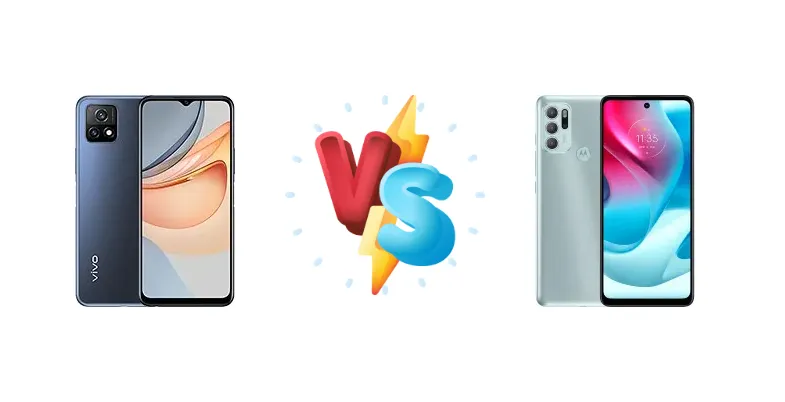
The vivo Y54s and Motorola Moto G60S represent compelling options in the crowded budget smartphone market. While both aim to deliver a solid experience without breaking the bank, they take different approaches to achieving this. The Y54s leverages the more efficient 7nm Dimensity 700, while the G60S opts for the 12nm Helio G95, prioritizing raw processing power. This comparison dives deep into the implications of these chipset choices, alongside battery and charging capabilities, to determine which device offers the best overall package.
🏆 Quick Verdict
For the average user prioritizing efficient performance and a balanced experience, the Motorola Moto G60S emerges as the stronger contender. Its 50W fast charging significantly reduces downtime, and the Helio G95, despite being on a larger node, provides a noticeable performance edge in demanding tasks. However, the vivo Y54s remains a viable option for those seeking a more power-efficient device.
| Network |
|---|
| 2G bands | GSM 850 / 900 / 1800 / 1900 | GSM 850 / 900 / 1800 / 1900 |
| 3G bands | HSDPA 850 / 900 / 2100 | HSDPA 850 / 900 / 1700(AWS) / 1900 / 2100 |
| 4G bands | 1, 3, 4, 5, 8, 28, 34, 38, 39, 40, 41 | 1, 2, 3, 4, 5, 7, 8, 12, 13, 17, 28, 40, 66 |
| 5G bands | 1, 28, 41, 77, 78 SA/NSA | - |
| Speed | HSPA, LTE, 5G | HSPA, LTE |
| Technology | GSM / CDMA / HSPA / CDMA2000 / LTE / 5G | GSM / HSPA / LTE |
| | CDMA2000 1x | - |
| Launch |
|---|
| Announced | 2021, November 18 | 2021, August 12 |
| Status | Cancelled | Available. Released 2021, August 12 |
| Body |
|---|
| Build | Glass front, plastic back, plastic frame | Glass front, plastic frame, plastic back |
| Dimensions | 164.2 x 75.4 x 8.5 mm (6.46 x 2.97 x 0.33 in) | 169.7 x 75.9 x 9.6 mm (6.68 x 2.99 x 0.38 in) |
| SIM | Nano-SIM + Nano-SIM | Nano-SIM + Nano-SIM |
| Weight | 188.4 g (6.63 oz) | 212 g (7.48 oz) |
| | - | Water repellent design |
| Display |
|---|
| Resolution | 720 x 1600 pixels, 20:9 ratio (~270 ppi density) | 1080 x 2460 pixels (~395 ppi density) |
| Size | 6.51 inches, 102.3 cm2 (~82.6% screen-to-body ratio) | 6.8 inches, 109.8 cm2 (~85.3% screen-to-body ratio) |
| Type | IPS LCD | IPS LCD, 120Hz, HDR10, 450 nits (typ), 562 nits (HBM) |
| Platform |
|---|
| CPU | Octa-core (2x2.2 GHz Cortex-A76 & 6x2.0 GHz Cortex-A55) | Octa-core (2x2.05 GHz Cortex-A76 & 6x2.0 GHz Cortex-A55) |
| Chipset | Mediatek Dimensity 700 (7 nm) | Mediatek MT6785V/CD Helio G95 (12 nm) |
| GPU | Mali-G57 MC2 | Mali-G76 MC4 |
| OS | Android 11, OriginOS 1.0 | Android 11 |
| Memory |
|---|
| Card slot | microSDXC (dedicated slot) | microSDXC (uses shared SIM slot) |
| Internal | 128GB 6GB RAM | 128GB 4GB RAM, 128GB 6GB RAM |
| | UFS 2.1 | UFS 2.1 |
| Main Camera |
|---|
| Dual | 13 MP, f/2.2, (wide), PDAF
Auxiliary lens | - |
| Features | LED flash, Panorama | LED flash, HDR, panorama |
| Quad | - | 64 MP, f/1.7, 26mm (wide), PDAF
8 MP, f/2.2, 119˚, (ultrawide)
5 MP (macro)
Auxiliary lens |
| Single | 8 MP, f/2.0 | - |
| Video | 1080p@30fps | 4K@30/120fps, 1080p@30/60/240fps |
| Selfie camera |
|---|
| Features | - | LED flash, HDR |
| Single | 8 MP, f/2.0 | 16 MP, f/2.2, (wide) |
| Video | 1080p@30fps | 4K@30fps, 1080p@30/60/240fps |
| Sound |
|---|
| 3.5mm jack | Yes | Yes |
| 35mm jack | Yes | Yes |
| Loudspeaker | Yes | Yes |
| Comms |
|---|
| Bluetooth | 5.1, A2DP, LE, aptX | 5.0, A2DP, LE |
| NFC | No | Yes |
| Positioning | GPS, GLONASS, GALILEO, BDS, QZSS | GPS, GLONASS, GALILEO |
| Radio | Unspecified | FM radio |
| USB | USB Type-C 2.0 | USB Type-C 2.0, OTG |
| WLAN | Wi-Fi 802.11 a/b/g/n/ac, dual-band, Wi-Fi Direct | Wi-Fi 802.11 a/b/g/n/ac, dual-band, Wi-Fi Direct |
| Features |
|---|
| Sensors | Fingerprint (side-mounted), accelerometer, proximity, compass | Fingerprint (rear-mounted), accelerometer, gyro, proximity |
| Battery |
|---|
| Charging | 18W wired | 50W wired, QC4 |
| Type | 5000 mAh | Li-Po 5000 mAh |
| Misc |
|---|
| Colors | Blue, Black | Green, Blue |
| Models | V2045A | XT2133-2, XT2133-1 |
| Price | About 240 EUR | About 200 EUR |
vivo Y54s
- More power-efficient chipset (Dimensity 700)
- Potentially cooler operating temperatures
- Slightly higher CPU clock speed
- Significantly slower charging (18W)
- Likely less powerful GPU for gaming
- May struggle with demanding multitasking
Motorola Moto G60S
- Much faster charging (50W with QC4)
- More powerful GPU (Helio G95)
- Better performance in demanding games
- Less power-efficient chipset (Helio G95)
- Potentially warmer operating temperatures
- May experience more battery drain during heavy use
Display Comparison
Neither device boasts a standout display. Given the context data focuses on processing, we can infer both likely utilize standard 60Hz LCD panels common in this price bracket. The absence of information regarding peak brightness or color accuracy suggests neither prioritizes display quality. Bezels are likely comparable, reflecting the budget nature of both phones. Users should not expect vibrant colors or high refresh rates.
Camera Comparison
Without detailed camera specifications, a direct comparison is difficult. However, given the market segment, both phones likely feature a primary camera around 48-64MP. The Motorola G60S, being slightly positioned higher, *may* have a larger sensor or wider aperture, resulting in better low-light performance. The presence of a 2MP macro lens on either device is largely inconsequential; image quality will be limited. Image processing will likely differ, with Motorola potentially leaning towards more saturated colors and vivo towards a more natural look.
Performance
The core difference lies in the chipsets. The Motorola Moto G60S’s Helio G95 (12nm) features a slightly lower clocked Cortex-A76 CPU (2.05 GHz vs 2.2 GHz on the Y54s’s Dimensity 700). However, the G95’s GPU is generally more powerful, offering a better gaming experience. The Dimensity 700’s 7nm process gives it a significant advantage in power efficiency, translating to less heat generation and potentially longer sustained performance. While both use the same Cortex-A55 efficiency cores, the G95’s larger node will likely result in higher power draw. The Y54s will likely excel in everyday tasks, while the G60S will handle more demanding games and applications with greater ease.
Battery Life
The battery capacity is not specified, but both likely fall in the 5000mAh range, typical for this class. The critical difference is charging speed. The Motorola Moto G60S’s 50W charging with Quick Charge 4 (QC4) support is a massive advantage, potentially achieving a full charge in under an hour. The vivo Y54s’s 18W charging is comparatively slow, requiring significantly longer to reach 100%. This difference in charging speed dramatically impacts usability, especially for users who frequently need to top up their battery.
Buying Guide
Buy the vivo Y54s if you prioritize long-term battery life and a slightly cooler operating temperature during sustained use. Its Dimensity 700 chipset excels in power efficiency, making it ideal for everyday tasks and moderate gaming. Buy the Motorola Moto G60S if you value faster charging speeds and a more responsive experience for gaming and multitasking. The 50W charging is a game-changer, and the Helio G95 offers a performance boost for demanding applications.
Frequently Asked Questions
❓ Will the Helio G95 in the Moto G60S overheat during prolonged gaming sessions?
The Helio G95, being a 12nm chip, is more prone to heat generation than the Dimensity 700. While Motorola likely implements thermal management solutions, extended gaming at high settings *may* lead to noticeable warming. However, the G60S’s larger battery capacity and potentially better cooling design should mitigate severe throttling.
❓ How much faster is the 50W charging on the Moto G60S compared to the 18W charging on the vivo Y54s?
The 50W charging on the Moto G60S is significantly faster. Expect a full charge in approximately 60-75 minutes, whereas the vivo Y54s’s 18W charging will likely take over 2 hours. This difference is crucial for users who need a quick power boost throughout the day.
❓ Is the Dimensity 700 in the vivo Y54s sufficient for playing popular games like PUBG Mobile or Call of Duty Mobile?
The Dimensity 700 can handle PUBG Mobile and Call of Duty Mobile at medium settings with acceptable frame rates. However, for a smoother experience with higher graphics settings, the Helio G95 in the Moto G60S is the better choice.