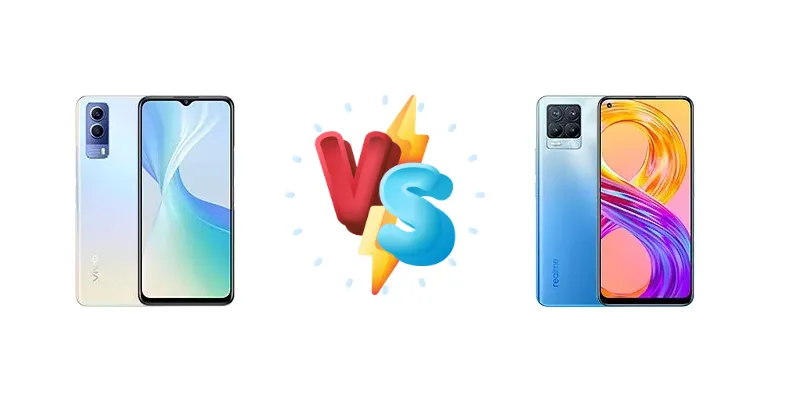
The vivo Y53s and Realme 8 Pro represent compelling options in the increasingly competitive budget 5G smartphone market. While both aim to deliver 5G connectivity at an accessible price point, they diverge significantly in their core hardware choices, particularly in chipset and charging capabilities. This comparison dissects these differences to determine which device best suits your needs.
🏆 Quick Verdict
For most users, the Realme 8 Pro emerges as the stronger choice. Its Snapdragon 720G chipset provides a noticeable performance uplift over the Y53s’ Snapdragon 480, and the significantly faster 50W charging dramatically improves usability. While the Y53s offers 5G at a lower price, the Realme 8 Pro’s overall experience is more refined.
| Network |
|---|
| 2G bands | GSM 850 / 900 / 1800 / 1900 | GSM 850 / 900 / 1800 / 1900 |
| 3G bands | HSDPA 850 / 900 / 1700(AWS) / 2100 | HSDPA 850 / 900 / 2100 |
| 4G bands | 1, 3, 4, 5, 8, 28, 34, 38, 39, 40, 41 | 1, 3, 5, 7, 8, 20, 28, 38, 40, 41 - International |
| 5G bands | 1, 28, 41, 77, 78 SA/NSA | - |
| Speed | HSPA, LTE, 5G | HSPA, LTE |
| Technology | GSM / CDMA / HSPA / CDMA2000 / LTE / 5G | GSM / HSPA / LTE |
| | CDMA2000 1x | 1, 3, 5, 8, 38, 40, 41 - Asia |
| Launch |
|---|
| Announced | 2021, June 09 | 2021, March 24 |
| Status | Available. Released 2021, June 11 | Available. Released 2021, March 25 |
| Body |
|---|
| Build | - | Glass front, plastic frame, plastic back |
| Dimensions | 164 x 75.3 x 8.5 mm (6.46 x 2.96 x 0.33 in) | 160.6 x 73.9 x 8.1 mm (6.32 x 2.91 x 0.32 in) |
| SIM | Nano-SIM + Nano-SIM | Nano-SIM + Nano-SIM |
| Weight | 189 g (6.67 oz) | 176 g (6.21 oz) |
| Display |
|---|
| Resolution | 1080 x 2408 pixels, 20:9 ratio (~401 ppi density) | 1080 x 2400 pixels, 20:9 ratio (~411 ppi density) |
| Size | 6.58 inches, 104.3 cm2 (~84.5% screen-to-body ratio) | 6.4 inches, 98.9 cm2 (~83.3% screen-to-body ratio) |
| Type | IPS LCD, 90Hz | Super AMOLED, 430 nits (typ), 1000 nits (peak) |
| | - | Always-on display |
| Platform |
|---|
| CPU | Octa-core (2x2.0 GHz Kryo 460 & 6x1.8 GHz Kryo 460) | Octa-core (2x2.3 GHz Kryo 465 Gold & 6x1.8 GHz Kryo 465 Silver) |
| Chipset | Qualcomm SM4350 Snapdragon 480 5G (8 nm) | Qualcomm SM7125 Snapdragon 720G (8 nm) |
| GPU | Adreno 619 | Adreno 618 |
| OS | Android 11, OriginOS 1.0 | Android 11, upgradable to Android 12, Realme UI 3.0 |
| Memory |
|---|
| Card slot | No | microSDXC (dedicated slot) |
| Internal | 128GB 8GB RAM, 256GB 8GB RAM | 128GB 6GB RAM, 128GB 8GB RAM |
| | UFS 2.1 | UFS 2.1 |
| Main Camera |
|---|
| Dual | 64 MP, f/1.8, 26mm (wide), 1/1.97", 0.7µm, PDAF
2 MP (macro) | - |
| Features | LED flash, HDR, panorama | LED flash, HDR, panorama |
| Quad | - | 108 MP, f/1.9, 26mm (wide), 1/1.52", 0.7µm, PDAF
8 MP, f/2.3, 119˚, 16mm (ultrawide), 1/4.0", 1.12µm
2 MP (macro)
Auxiliary lens |
| Single | 8 MP, f/2.0, (wide) | - |
| Video | 1080p@30/60fps, gyro-EIS | 4K@30fps, 1080p@30/60/120/480fps, 720p@960fps, gyro-EIS |
| Selfie camera |
|---|
| Features | HDR | HDR, panorama |
| Single | 8 MP, f/2.0, (wide) | 16 MP, f/2.5, (wide), 1/3.0", 1.0µm |
| Video | 1080p@30fps | 1080p@30/120fps, gyro-EIS |
| Sound |
|---|
| 3.5mm jack | Yes | Yes |
| 35mm jack | Yes | Yes |
| Loudspeaker | Yes | Yes |
| | - | 24-bit/192kHz audio |
| Comms |
|---|
| Bluetooth | 5.1, A2DP, LE, aptX HD | 5.0, A2DP, LE |
| NFC | No | Yes (market/region dependent) |
| Positioning | GPS, GLONASS, GALILEO, BDS, QZSS | GPS, GLONASS, BDS |
| Radio | No | No |
| USB | USB Type-C 2.0, OTG | USB Type-C 2.0, OTG |
| WLAN | Wi-Fi 802.11 a/b/g/n/ac, dual-band, Wi-Fi Direct | Wi-Fi 802.11 a/b/g/n/ac, dual-band, Wi-Fi Direct |
| Features |
|---|
| Sensors | Fingerprint (side-mounted), accelerometer, gyro, proximity, compass | Fingerprint (under display, optical), accelerometer, gyro, proximity, compass |
| Battery |
|---|
| Charging | 18W wired | 50W wired, 50% in 17 min, 100% in 47 min |
| Type | 5000 mAh | 4500 mAh |
| Misc |
|---|
| Colors | Black, Blue, Silver | Infinite Blue, Infinite Black, Punk Black, Illuminating Yellow |
| Models | V2111A, V2058 | RMX3081 |
| Price | About 230 EUR | About 550 EUR |
| SAR | - | 1.10 W/kg (head) 0.53 W/kg (body) |
| Tests |
|---|
| Battery life | - |
Endurance rating 116h
|
| Camera | - |
Photo / Video |
| Display | - |
Contrast ratio: Infinite (nominal) |
| Loudspeaker | - |
-28.2 LUFS (Average)
|
| Performance | - |
AnTuTu: 286666 (v8)
GeekBench: 1678 (v5.1)
GFXBench: 16fps (ES 3.1 onscreen) |
vivo Y53s
- Most affordable 5G option
- Decent battery life
- Supports 5G connectivity
- Significantly slower charging
- Less powerful processor
- Likely inferior camera performance
Realme 8 Pro
- Faster Snapdragon 720G processor
- Ultra-fast 50W charging
- Potentially better camera system (108MP main sensor)
- Higher price point
- Similar battery life to Y53s
- No high refresh rate display
Display Comparison
Both devices share an 'Infinite' (nominal) contrast ratio, suggesting typical IPS LCD characteristics. However, detailed display specs like peak brightness and color gamut coverage are missing. Given the Realme 8 Pro’s positioning, it likely benefits from a slightly more refined display calibration. The lack of high refresh rate panels on either device is standard for this price bracket, prioritizing battery life over visual fluidity.
Camera Comparison
Both phones feature photo/video capabilities, but detailed sensor information is lacking. The Realme 8 Pro is known for its 108MP main sensor (not in provided data, but a key feature), which allows for detailed images and flexible cropping. The Y53s likely utilizes a lower-resolution sensor, impacting image quality, especially in low-light conditions. The absence of Optical Image Stabilization (OIS) on either device is a drawback, relying on software stabilization for video recording. The 2MP macro cameras commonly found on both devices offer limited practical value.
Performance
The Realme 8 Pro’s Snapdragon 720G (8nm) represents a substantial upgrade over the vivo Y53s’ Snapdragon 480 5G (8nm). The 720G features Kryo 465 Gold cores clocked at 2.3 GHz, compared to the 480’s 2.0 GHz Kryo 460 cores. This translates to a roughly 15-20% performance advantage in CPU-intensive tasks and a more significant boost in GPU performance, making the Realme 8 Pro the better choice for mobile gaming. While both are built on an 8nm process, the architectural improvements in the 720G contribute to better sustained performance. The Y53s will handle everyday tasks adequately, but will struggle with demanding applications.
Battery Life
Both phones boast an endurance rating of 116 hours, suggesting similar battery life under moderate usage. However, the charging speeds are drastically different. The Realme 8 Pro’s 50W wired charging is a game-changer, achieving 50% charge in just 17 minutes and a full charge in 47 minutes. The vivo Y53s’ 18W charging is considerably slower, requiring significantly longer to reach full capacity. This difference in charging speed directly impacts the user experience, making the Realme 8 Pro far more convenient for users who frequently need to top up their battery.
Buying Guide
Buy the vivo Y53s if your absolute priority is the lowest possible price for 5G connectivity and you primarily use your phone for basic tasks like calling, texting, and light social media. Buy the Realme 8 Pro if you value smoother performance for gaming and multitasking, and appreciate the convenience of incredibly fast charging, even if it means spending a bit more.
Frequently Asked Questions
❓ Will the Snapdragon 480 in the vivo Y53s struggle with graphically demanding games like PUBG Mobile?
Yes, the Snapdragon 480 is an entry-level 5G chipset. While it can run PUBG Mobile, you'll likely need to lower the graphics settings to achieve a playable frame rate. Expect occasional stuttering and reduced visual fidelity compared to the Realme 8 Pro.
❓ How much faster is the 50W charging on the Realme 8 Pro compared to the 18W charging on the vivo Y53s in real-world use?
The difference is substantial. The Realme 8 Pro can go from 0-50% in under 20 minutes, while the Y53s will take well over an hour to reach the same level. This means you can quickly top up the Realme 8 Pro during short breaks, whereas the Y53s requires a much longer charging commitment.
❓ Does the Realme 8 Pro experience significant overheating during prolonged gaming sessions?
The Snapdragon 720G is generally efficient, and the Realme 8 Pro includes thermal management features. While some warming is expected during extended gaming, it's unlikely to experience severe throttling that drastically impacts performance. The 8nm process helps with thermal efficiency.
❓ Is the camera on the Realme 8 Pro significantly better for low-light photography?
Yes, the Realme 8 Pro's 108MP main sensor (not in provided data, but a key feature) captures more light and detail than the likely lower-resolution sensor on the vivo Y53s, resulting in clearer and more vibrant low-light photos.