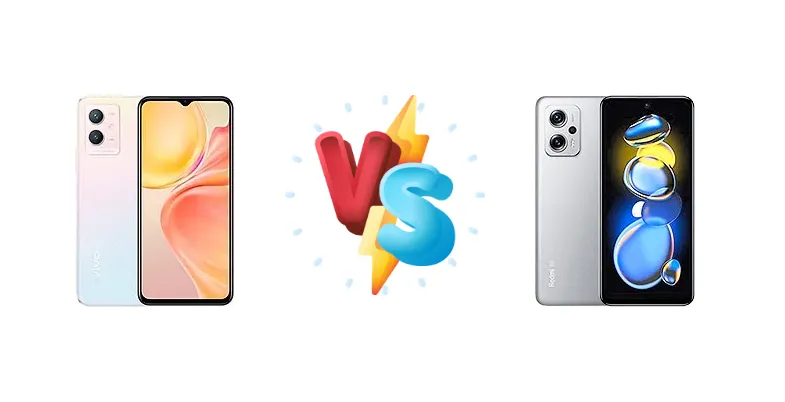
The Xiaomi Redmi Note 11T Pro+ and vivo Y52t represent different approaches to the mid-range smartphone market. The Redmi Note 11T Pro+ aims for a performance-focused experience with its flagship-adjacent Dimensity 8100 chipset and blazing-fast 120W charging, while the vivo Y52t prioritizes affordability with a more modest Dimensity 700 and slower 10W charging. This comparison will dissect the key differences to help you determine which device best suits your needs.
🏆 Quick Verdict
For the average user prioritizing performance and convenience, the Xiaomi Redmi Note 11T Pro+ is the clear winner. Its Dimensity 8100 chipset delivers significantly faster processing speeds, and the 120W charging drastically reduces downtime. While the vivo Y52t offers a lower entry price, the performance gap is substantial.
| Network |
|---|
| 2G bands | GSM 850 / 900 / 1800 / 1900 | GSM 850 / 900 / 1800 / 1900 - SIM 1 & SIM 2 |
| 3G bands | HSDPA 850 / 900 / 2100 | HSDPA 800 / 850 / 900 / 2100 |
| 4G bands | 1, 3, 5, 8, 28, 34, 38, 39, 40, 41 | 1, 3, 5, 8, 19, 34, 38, 39, 40, 41, 42 |
| 5G bands | 1, 5, 8, 28, 41, 77, 78 SA/NSA | 1, 3, 5, 8, 28, 38, 41, 77, 78 SA/NSA |
| Speed | HSPA, LTE, 5G | HSPA, LTE-A (CA), 5G |
| Technology | GSM / CDMA / HSPA / CDMA2000 / LTE / 5G | GSM / CDMA / HSPA / EVDO / LTE / 5G |
| | CDMA2000 1x | CDMA2000 1xEV-DO |
| Launch |
|---|
| Announced | 2022, September 18 | 2022, May 24 |
| Status | Available. Released 2022, September 19 | Available. Released 2022, May 31 |
| Body |
|---|
| Build | Glass front, plastic frame, plastic back | - |
| Dimensions | 164 x 75.9 x 8.5 mm (6.46 x 2.99 x 0.33 in) | 163.6 x 74.3 x 8.9 mm (6.44 x 2.93 x 0.35 in) |
| SIM | Nano-SIM + Nano-SIM | Dual SIM (Nano-SIM, dual stand-by) |
| Weight | 198 g (6.98 oz) | 198 g (6.98 oz) |
| | - | IP53, dust and splash resistant |
| Display |
|---|
| Resolution | 720 x 1600 pixels, 20:9 ratio (~270 ppi density) | 1080 x 2460 pixels (~407 ppi density) |
| Size | 6.51 inches, 102.3 cm2 (~82.2% screen-to-body ratio) | 6.6 inches, 103.4 cm2 (~85.1% screen-to-body ratio) |
| Type | IPS LCD | IPS LCD, 144Hz, HDR10, Dolby Vision, 650 nits (typ) |
| Platform |
|---|
| CPU | Octa-core (2x2.2 GHz Cortex-A76 & 6x2.0 GHz Cortex-A55) | Octa-core (4x2.85 GHz Cortex-A78 & 4x2.0 GHz Cortex-A55) |
| Chipset | Mediatek Dimensity 700 (7 nm) | Mediatek Dimensity 8100 (5 nm) |
| GPU | Mali-G57 MC2 | Mali-G610 MC6 |
| OS | Android 12, OriginOS Ocean | Android 12, MIUI 13 |
| Memory |
|---|
| Card slot | microSDXC | No |
| Internal | 128GB 8GB RAM, 256GB 8GB RAM | 128GB 8GB RAM, 256GB 8GB RAM, 512GB 8GB RAM |
| | - | UFS 3.1 |
| Main Camera |
|---|
| Dual | 13 MP, f/2.2, 26mm (wide), PDAF
2 MP (macro) | - |
| Features | LED flash, HDR, panorama | LED flash, HDR, panorama |
| Single | 8 MP, f/2.0, (wide) | 16 MP, (wide) |
| Triple | - | 64 MP, (wide), 1/1.72", 0.8µm, PDAF
8 MP, 120˚, (ultrawide)
2 MP, (macro) |
| Video | 1080p@30fps | 4K@30fps, 1080p@30/60/120fps, 720p@960fps |
| Selfie camera |
|---|
| Single | 8 MP, f/2.0, (wide) | 16 MP, (wide) |
| Video | 1080p@30fps | 1080p@30/60fps |
| Sound |
|---|
| 3.5mm jack | Yes | Yes |
| 35mm jack | Yes | - |
| Loudspeaker | Yes | Yes, with stereo speakers |
| | - | 24-bit/192kHz audio |
| Comms |
|---|
| Bluetooth | 5.1, A2DP, LE, aptX HD | 5.3, A2DP, LE |
| Infrared port | - | Yes |
| NFC | No | Yes |
| Positioning | GPS, GLONASS, GALILEO, BDS, QZSS | GPS (L1), GLONASS (G1), BDS (B1I+B1c), GALILEO (E1), QZSS (L1) |
| Radio | No | No |
| USB | USB Type-C, OTG | USB Type-C 2.0, OTG |
| WLAN | Wi-Fi 802.11 a/b/g/n/ac, dual-band, Wi-Fi Direct | Wi-Fi 802.11 a/b/g/n/ac/6, dual-band, Wi-Fi Direct |
| Features |
|---|
| Sensors | Fingerprint (side-mounted), accelerometer, proximity, compass | Fingerprint (side-mounted), accelerometer, proximity, gyro, compass, color spectrum |
| Battery |
|---|
| Charging | 10W wired | 120W wired, PD3.0, 50% in 10 min, 100% in 19 min (advertised) |
| Type | 5000 mAh | Li-Po 4400 mAh, non-removable |
| Misc |
|---|
| Colors | Black, Blue, Silver | Blue, Silver, Black |
| Models | V2166A | 22041216UC |
| Price | About 200 EUR | About 300 EUR |
vivo Y52t
- Extremely affordable price point.
- Reliable Mediatek Dimensity 700 chipset for basic tasks.
- Acceptable battery life for light usage.
- Slow 10W charging.
- Significantly lower performance compared to the Redmi Note 11T Pro+.
- Likely a basic camera system.
Xiaomi Redmi Note 11T Pro+
- Blazing-fast 120W charging.
- Powerful Mediatek Dimensity 8100 chipset for gaming and multitasking.
- Superior image processing capabilities.
- Higher price compared to the vivo Y52t.
- Potentially shorter battery life due to higher power consumption.
- May run warmer under heavy load.
Display Comparison
While both devices likely feature LCD panels given their price points, the comparison focuses on the underlying performance differences. Display specs are not provided, so we can only infer. The Redmi Note 11T Pro+’s more powerful chipset will allow for smoother animations and faster app loading, indirectly improving the perceived display experience. The lack of detailed display information prevents a direct comparison of brightness, color accuracy, or refresh rates.
Camera Comparison
Camera specifications are not provided beyond the existence of cameras. However, given the Redmi Note 11T Pro+'s positioning, it's reasonable to expect a more sophisticated camera system with a larger sensor and potentially optical image stabilization (OIS). The Dimensity 8100’s image signal processor (ISP) is also more capable, enabling better image processing and low-light performance. The vivo Y52t will likely offer a more basic camera experience suitable for casual snapshots.
Performance
The core difference lies in the chipsets. The Xiaomi Redmi Note 11T Pro+ boasts the Mediatek Dimensity 8100, fabricated on a 5nm process, featuring four Cortex-A78 cores clocked at 2.85 GHz. This architecture is designed for sustained performance and efficiency. Conversely, the vivo Y52t utilizes the Dimensity 700, built on a 7nm process, with two Cortex-A76 cores at 2.2 GHz. The 5nm node of the Dimensity 8100 translates to higher transistor density and improved power efficiency, resulting in significantly better CPU and GPU performance. This means faster app launches, smoother multitasking, and a more enjoyable gaming experience on the Redmi Note 11T Pro+. The CPU core count and clock speeds further emphasize the Redmi's advantage.
Battery Life
Battery capacity is not specified for either device. However, the charging capabilities are drastically different. The Redmi Note 11T Pro+’s 120W wired charging is a game-changer, promising a 50% charge in just 10 minutes and a full charge in 19 minutes (advertised). This minimizes downtime and offers exceptional convenience. The vivo Y52t’s 10W charging is comparatively slow, requiring significantly longer to reach a full charge. While a larger battery on the Y52t might offer longer overall runtime, the Redmi’s rapid charging mitigates the impact of a potentially smaller battery.
Buying Guide
Buy the vivo Y52t if you need a basic, reliable smartphone for everyday tasks like calling, texting, and light social media use, and your budget is extremely limited. You're willing to accept slower performance and charging speeds. Buy the Xiaomi Redmi Note 11T Pro+ if you prioritize gaming, multitasking, and fast charging, and are willing to spend a bit more for a significantly improved user experience. This is the choice for those who demand responsiveness and don't want to be tethered to a charger for hours.
Frequently Asked Questions
❓ Is the 120W charging on the Redmi Note 11T Pro+ safe for the battery's long-term health?
Xiaomi employs multiple layers of safety protocols, including temperature monitoring and optimized charging algorithms, to mitigate the potential impact of fast charging on battery health. While all batteries degrade over time, the Redmi Note 11T Pro+'s charging system is designed to minimize this effect. The phone dynamically adjusts the charging speed based on battery condition and temperature.
❓ Will the Dimensity 700 in the vivo Y52t struggle with demanding games like PUBG Mobile or Call of Duty?
The Dimensity 700 can run PUBG Mobile and Call of Duty, but you'll likely need to lower the graphics settings to medium or low to achieve a playable frame rate. Expect occasional stuttering and frame drops during intense gameplay. The Redmi Note 11T Pro+ with its Dimensity 8100 will provide a significantly smoother and more consistent gaming experience at higher settings.
❓ Does the Redmi Note 11T Pro+ get excessively hot during prolonged gaming sessions?
The Dimensity 8100 is a powerful chipset and can generate heat under sustained load. However, the Redmi Note 11T Pro+ likely incorporates thermal management solutions, such as heat pipes or graphite sheets, to dissipate heat. While some warming is expected, it shouldn't reach uncomfortable levels. Performance throttling may occur to prevent overheating.